
YouTube's AI Chat Feature Is Now on Your TV — And It's Changing How We Watch :
The battle for AI-powered smart TV experiences just got a major new player — and it's living right inside your YouTube app.
If you've ever paused a cooking video to Google an ingredient, or scrambled to look up a song mid-music video, YouTube's latest AI update is about to make your life significantly easier. The platform's conversational AI assistant — previously only available on mobile and desktop — has officially expanded to smart TVs, gaming consoles, and streaming devices. That means the biggest screen in your home is now smarter than ever.
What Is YouTube's Conversational AI Feature?
YouTube's conversational AI tool is an interactive, in-app assistant that lets viewers ask questions about a video while it's playing — no pausing, no tab-switching, no interrupting the experience. Think of it as having a knowledgeable friend sitting next to you on the couch, ready to answer any question the moment it pops into your head.
Launched initially in 2024 for mobile and web users, this YouTube AI assistant gained quiet traction among early adopters who loved the ability to deep-dive into content without leaving the app. Now, with its expansion to the living room, YouTube is making a bold statement: the future of TV is conversation.
How Does the YouTube AI Assistant Work on TV?
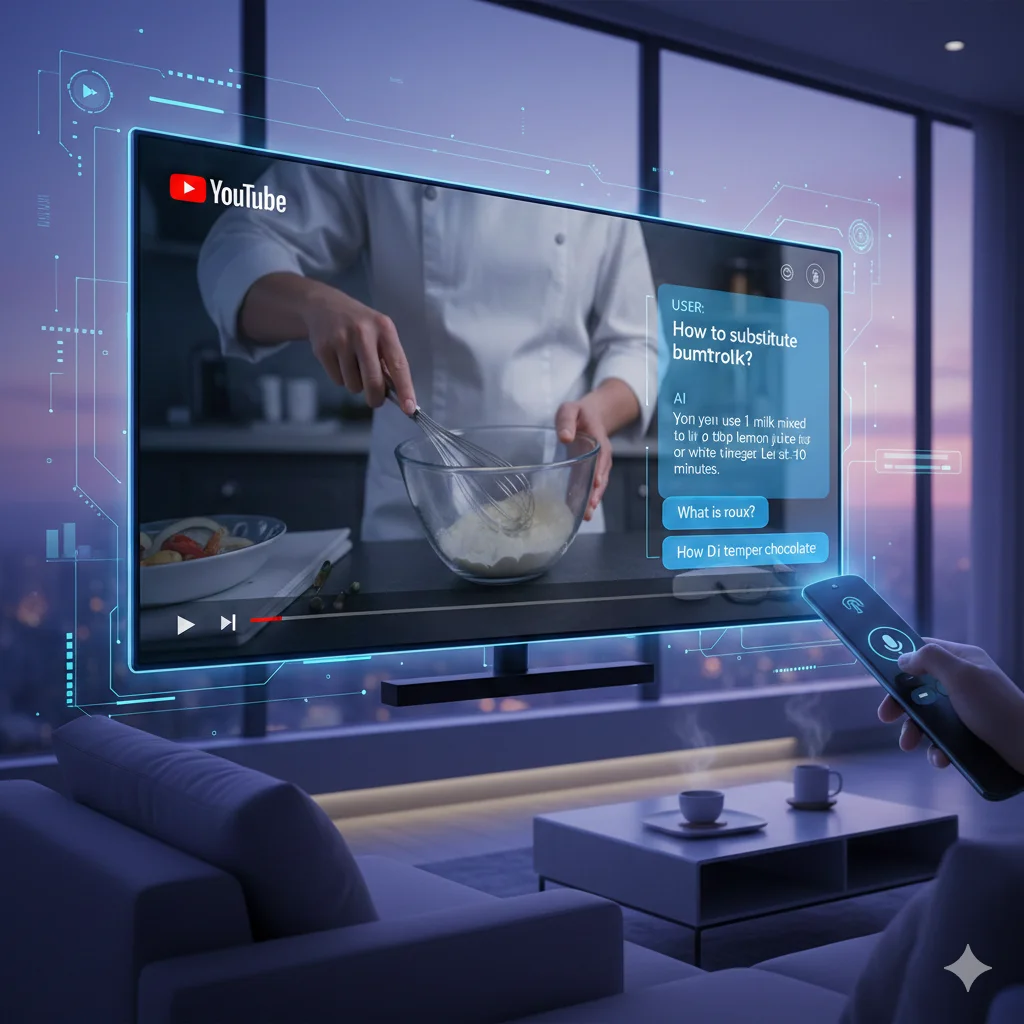
Using the feature on your TV is remarkably simple. Eligible users will see an "Ask" button appear on their screen while watching a video. Click it, and a conversational panel opens up — no separate device needed, no app-switching required.
YouTube even surfaces suggested questions based on what you're watching, so you don't need to know exactly what to ask. Or, if your remote has a microphone button, you can speak your question out loud and get an instant, context-aware answer.
Some real-world use cases that make this feature shine:
- Watching a baking tutorial and wondering how to substitute buttermilk? Just ask.
- Curious about the historical context behind a documentary's subject? Ask away.
- Trying to identify the sample used in a hip-hop track? The AI has you covered.
The feature currently supports English, Hindi, Spanish, Portuguese, and Korean, and is available to select users over the age of 18.
Why This Matters: YouTube Is Dominating the Living Room:
This expansion isn't happening in a vacuum. YouTube's push into the TV AI space is driven by a massive shift in how Americans consume content. According to a Nielsen report from April 2025, YouTube commanded 12.4% of total television audience time — surpassing streaming giants like Netflix and Disney. That's not a footnote; that's a seismic shift in the media landscape.
As more viewers treat YouTube as their primary TV platform, the pressure to deliver a premium, feature-rich experience on the big screen is enormous. The conversational AI tool is YouTube's answer to that pressure — a way to make passive viewing active and interactive, without disrupting the flow of the experience.
The Bigger Picture: AI Is Transforming the Smart TV Experience:
YouTube isn't alone in this race. The conversational AI for smart TVs** space is rapidly becoming one of the most competitive arenas in tech.
Amazon has rolled out Alexa+ on Fire TV, enabling users to have natural back-and-forth conversations about content, hunt for specific scenes, or ask questions about actors and filming locations — all using voice commands.
Roku has upgraded its AI voice assistant to handle open-ended, nuanced questions like "How scary is this movie?" or "What's the vibe of this show?" — going far beyond simple keyword searches.
Netflix is also quietly testing its own AI-powered search experience, signaling that the era of static, keyword-based content discovery is coming to an end across the board.
The trend is clear: AI-driven TV interaction is no longer a gimmick. It's becoming a baseline expectation.

Meta's Next Big Bet: This New App Lets You Build Games Simply by Typing a Prompt
YouTube's Broader AI Strategy: More Than Just a Chat Feature:
The conversational TV assistant is just one piece of YouTube's aggressive AI roadmap. The platform has been layering AI features across its entire ecosystem at a rapid pace:
Support our research
Independent analysis fueled by you.
AI-powered video upscaling automatically enhances lower-resolution uploads to full HD, improving the viewing experience without any effort from creators or viewers.
Comments summarization uses AI to distill thousands of viewer comments into digestible takeaways, so you can instantly gauge community sentiment without scrolling endlessly.
AI search carousels are making content discovery smarter and more personalized, surfacing relevant videos based on intent rather than just keywords.
AI-generated Shorts are on the horizon — YouTube has announced that creators will soon be able to generate Shorts using AI versions of their own likeness, opening up entirely new creative possibilities.
And for the most cutting-edge viewers, YouTube recently launched a dedicated Apple Vision Pro app, bringing an immersive, theater-scale watching experience to Apple's spatial computing headset.
What This Means for Viewers and Creators:
For everyday viewers, YouTube's AI expansion represents a meaningful quality-of-life improvement. The ability to get instant, relevant answers without leaving a video removes one of the biggest friction points in the modern content consumption experience.
For creators, it signals an important evolution in how content will be consumed. Videos that are information-rich — tutorials, explainers, documentaries, educational content — stand to benefit enormously from an AI layer that helps viewers extract maximum value. This could translate into longer watch times, stronger engagement, and new opportunities for content that genuinely informs.
Final Thoughts: Is This the Future of TV?
The integration of conversational AI into the television experience marks a genuine turning point. We're moving from a world where the TV is a passive output device to one where it's an interactive, intelligent companion. YouTube's expansion of its AI assistant to smart TVs is a significant step in that direction — and given the platform's dominance of television viewing time, it's a step that will resonate widely.
Whether you're a casual viewer, a devoted creator, or someone who simply wants a smarter way to engage with the content you love, YouTube's AI-powered TV experience is worth paying attention to. The living room just got a whole lot smarter.