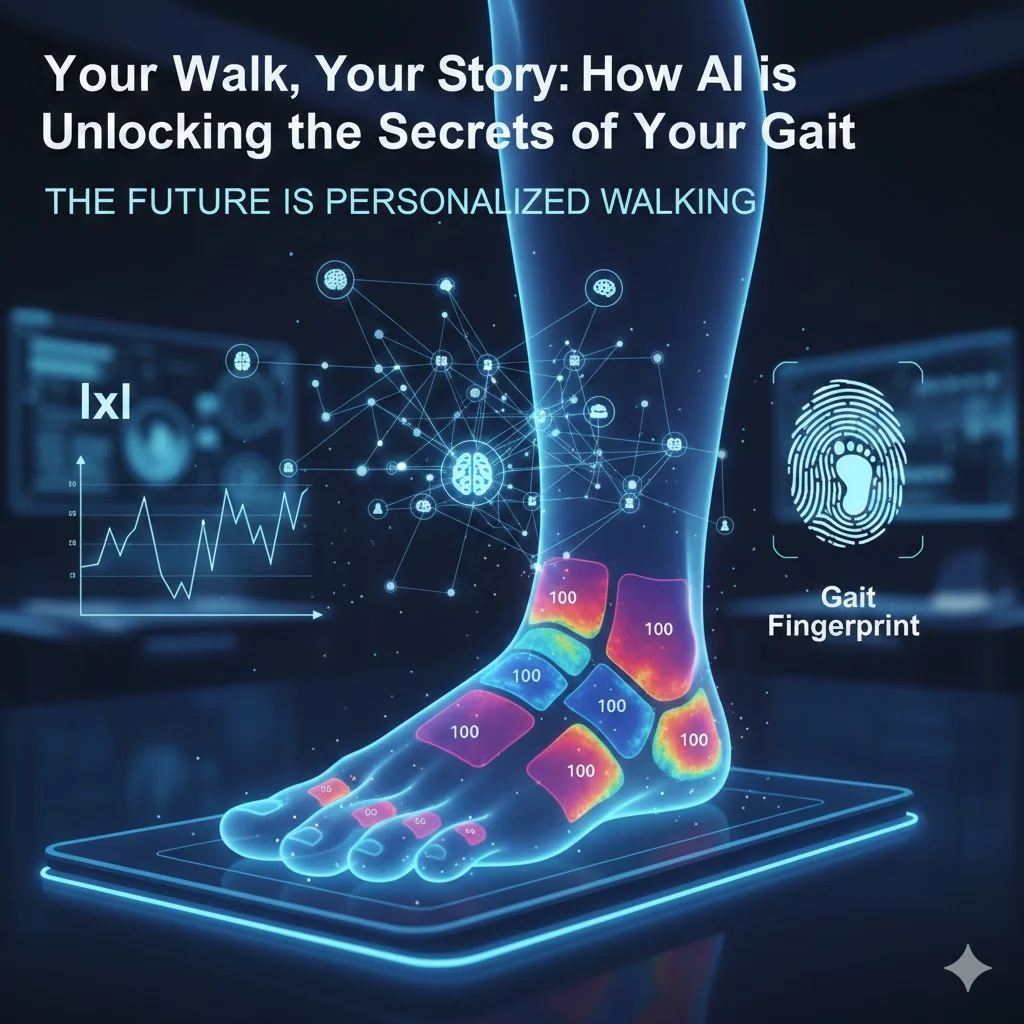

Ever thought about how you walk? Probably not much, unless you’ve stubbed a toe,
had a foot ache, or are training for a marathon. But what if the subtle dance of pressure beneath your feet—the minute variations in how each part of your foot interacts with the ground—held a unique story about your health, your balance, and even early signs of underlying medical conditions?
A fascinating new scientific study is showing us that the "wobbles" and variations in how our feet hit the ground aren't just random noise—they're a crucial, information-rich part of our individual "gait fingerprint." And guess what? Artificial Intelligence (AI) is rapidly becoming an indispensable tool for unraveling these hidden, personalized patterns.
Beyond the Average: Your Foot's Unique Language:
For decades, doctors and biomechanists have analyzed how we walk by comparing a patient's gait to an "average" person or a population norm. While useful, this approach has limitations. It's like trying to understand the nuances of a person's unique handwriting by only looking at the average way people form the letter 'A.' The richness, the individuality, and the subtle deviations that truly matter can be overlooked.
This new research, highlighted in our recent summary, challenges this traditional view. It suggests that each part of our foot, from the powerful big toe to the stable midfoot, has its own distinctive pressure signature and, crucially, its own pattern of variability. This variability isn't an error; it's a reflection of our nervous system's sophisticated motor control and our body's amazing adaptability.
The study made particularly intriguing findings regarding two specific foot regions:
-
The Big Toe's Partner (1st Metatarsal Head - 1MTH): This area, located beneath the ball of the foot near the big toe, is a major player in the "push-off" phase of walking. It’s responsible for generating much of the propulsion needed to move forward. The study found that this region showed low individuality in its pressure variability. This makes sense: to efficiently propel ourselves forward, most people utilize this area in a biomechanically similar, efficient manner. It’s like a universal "power button" that needs to function predictably.
-
The Midfoot's Keystone (2nd Metatarsal Head - 2MTH): In stark contrast, the area beneath the second toe showed high individuality in its pressure variability. This region is often considered a stable "keystone" in the foot's arch structure, acting as a pivot point. The unique ways individuals distribute pressure here likely reflect subtle differences in their bone structure, foot mechanics, overall posture, and how their motor control system finely tunes stability. It’s a highly personalized aspect of how we maintain balance and fine-tune our interaction with the ground.
Where AI Steps In: Transforming Raw Data into Personalized Insights:
Making sense of this intricate dance of pressure, variability, and individuality for hundreds of steps across ten different foot regions is a monumental task—far too complex and time-consuming for human analysis alone. This is precisely where Artificial Intelligence becomes not just helpful, but absolutely indispensable.
-
Precision Segmentation and Data Processing: Imagine trying to manually mark out 10 tiny, distinct zones on a dynamic pressure map for every single footfall over 200 steps. It would be an arduous and error-prone process. The study utilized advanced AI-based software to precisely and consistently segment the foot into these 10 distinct regions. This allows researchers, and soon clinicians, to gather and analyze colossal amounts of raw pressure data with unparalleled accuracy and efficiency, step after step. AI handles the grunt work, freeing up human experts for interpretation.
-
Sophisticated Pattern Recognition and Metrics: AI algorithms are exceptionally adept at identifying subtle, complex patterns and correlations that are often invisible to the human eye. They can crunch through vast datasets to not only quantify the raw pressure but, more importantly, calculate critical metrics like the "index of individuality" (IxI) for each foot region. This quantitative measure helps us understand: Is this pressure pattern common across all people, or is it unique to this individual? AI’s ability to process and interpret these nuanced metrics is what transforms raw data into meaningful clinical insights.
-
Establishing Personalized Baselines: Instead of a restrictive one-size-fits-all comparison, AI can help build and maintain a dynamic, personal baseline for each individual. As a patient walks on a pedobarometric platform (a special pressure-sensing mat) over time, the AI learns their unique gait fingerprint—how their pressure patterns normally vary and how much individuality each foot zone exhibits for them.
-
Early Detection and Predictive Analytics: This personalized, AI-powered analysis is a game-changer for diagnostics. When an individual's gait fingerprint changes—even subtly, in ways that might still fall within a "population average" but deviate from their own norm—the AI can flag it.
This could signal the earliest stages of a neurological condition (like Parkinson's or stroke recovery), musculoskeletal problems (such as impending osteoarthritis or a stress fracture), or even an increased risk of falls in the elderly. Imagine catching a subtle shift in the variability of the 2nd Metatarsal that indicates early-stage neuropathy in a diabetic patient, allowing for proactive intervention before a serious foot ulcer develops.
The Future is Personalized Walking:
This groundbreaking research, powered by AI, doesn't just refine our understanding of human locomotion; it fundamentally shifts the paradigm of diagnostic gait analysis. By moving beyond simple population averages and embracing the beautiful, information-rich variability of individual human movement, we’re stepping into an era of truly personalized medicine.
Your walk isn't just about getting from A to B anymore; it's a constant, silent conversation with your body, revealing its health status and adaptive capabilities. Thanks to AI, we’re finally learning to listen better, transforming every unique step into a vital part of your personal health story.
What do you think about the idea of your gait being a "fingerprint" for your health? How do you envision AI changing the way we monitor our well-being? Share your thoughts in the comments below!
Support our research
Independent analysis fueled by you.