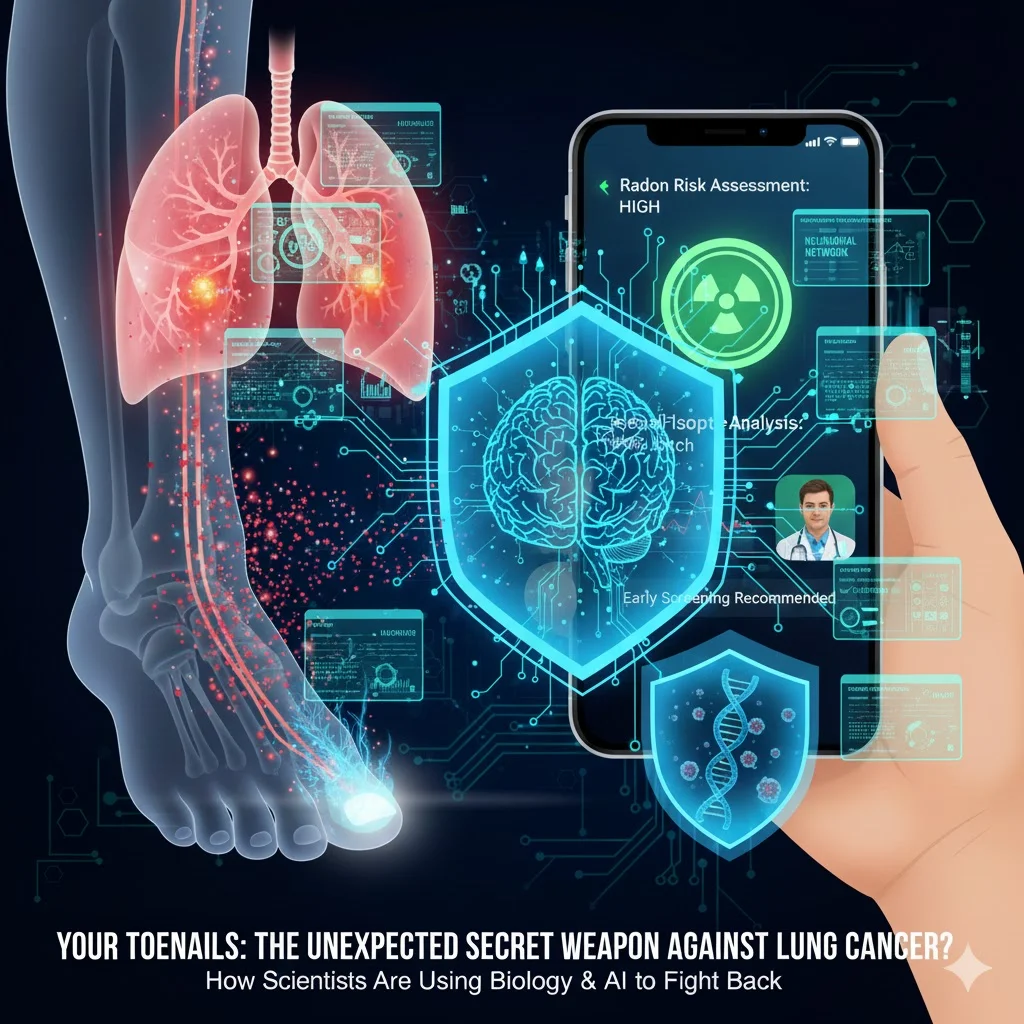

When we think of life-saving medical breakthroughs,
we often imagine high-tech labs, complex genetic sequencing, or perhaps groundbreaking pharmaceutical trials. We rarely think of our bathroom floor after a pedicure. Yet, a revolutionary study from the University of Calgary suggests that your discarded toenail clippings, analyzed with the power of Artificial Intelligence, could be the secret weapon we need to defeat lung cancer.
This isn't just about a surprising biological clue; it's about how cutting-edge technology is transforming seemingly mundane biological samples into powerful diagnostic tools.
The Hidden Threat: Radon, the Invisible Killer:
Most people associate lung cancer with smoking, and for good reason. However, there's another insidious culprit that's far less understood by the public: radon gas. This odorless, colorless, and radioactive gas naturally seeps from the ground, accumulating in homes and workplaces. After tobacco smoke, radon is the second leading cause of lung cancer worldwide.
The challenge? Measuring long-term radon exposure is incredibly difficult. Most people have no idea how much they've been breathing in over decades. This is where your toenails, and the analytical might of AI, step into the spotlight.
Our Toenails: A Biological Archive, Unlocked by AI:
Dr. Aaron Goodarzi, a biochemist at the University of Calgary, leads an interdisciplinary team that's uncovered a surprising truth. Their new pilot study, published in Environment International, reveals that radioactive lead isotopes found in toenails can act as a historical record of an individual's radon exposure.
"Our toenails hold long-term information about our exposure to radioactive toxicants in our environment such as radon gas. They are one of our body’s archives of past exposure," explains Dr. Goodarzi.
Here's how it works: When you inhale radon, it quickly decays into a form of radioactive lead. Your body, treating this lead like any other heavy metal, stores it in slow-shedding tissues like hair, skin, and nails. Because toenails grow slowly and consistently, they provide a unique, chronological record of what your body has been exposed to over months and even years.
But translating thousands, or even millions, of these "biological archives" into actionable health insights requires more than just lab equipment. This is where Artificial Intelligence becomes indispensable.
From Clippings to Critical Data: The AI Advantage
In collaboration with physicist Dr. Michael Wieser, the team uses highly sensitive isotope dilution mass spectrometry to measure these lead isotopes. This process generates vast amounts of complex data for each tiny clipping. To make this method practical and impactful on a national scale, AI is crucial:
- Mass Data Processing & Pattern Recognition: Imagine analyzing toenail samples from 10,000 Canadians, each providing a unique isotopic "fingerprint" of exposure. AI algorithms can rapidly process this immense volume of data, identifying subtle patterns and correlations between lead isotopes in nails and actual home radon levels far more efficiently than human analysis ever could.
-
Predictive Risk Modeling: By feeding AI this validated isotopic data alongside demographic and health information, scientists can train machine learning models to predict an individual's long-term radon exposure risk and, crucially, their potential for developing radon-induced lung cancer. This moves us towards personalized risk assessment.
-
Redefining Screening Criteria with AI: Currently, many lung cancer patients (like Emi Bossio, a non-smoker) don't meet traditional screening criteria, leading to late diagnoses. AI can help develop dynamic "Risk Scores" by integrating toenail data with other factors. This could enable doctors to recommend early screening for a broader, yet precisely identified, group of at-risk individuals who might otherwise be overlooked.
-
Optimizing Public Health Interventions: AI can analyze nationwide toenail data to create sophisticated "radon hot spot" maps, pinpointing geographical areas with high environmental risk. This allows public health initiatives to deploy resources more effectively for radon testing and mitigation efforts, preventing future exposures.
Real Lives, Real Impact, AI-Accelerated Hope:
For people like Emi Bossio, a 47-year-old lawyer and non-smoker who was shocked by a lung cancer diagnosis, this research, supercharged by AI, offers immense hope.

Meta's Next Big Bet: This New App Lets You Build Games Simply by Typing a Prompt
"I never smoked, never. I ate nutritiously and stayed fit," she said. "I thought to myself, I can’t have lung cancer. It was super shocking — a cataclysmic moment."
Bossio's story is tragically common: two in five Canadians with lung cancer don't meet current screening criteria, many having never smoked. Dr. Goodarzi's team believes toenail testing, validated and deployed with AI, could change this. By providing a powerful new screening tool to identify at-risk individuals earlier, it could lead to faster diagnoses and potentially life-saving treatments.
The Future of Cancer Prevention is in Your Toes and on Our Screens:
If this large-scale validation trial is successful, it could truly transform cancer prevention. By offering a precise, individual-level measurement of radon exposure, backed by the analytical power of AI, scientists can finally bridge the gap between environmental risk factors and personal health outcomes with unprecedented precision.
As Dr. Goodarzi states, "If this validation trial works, it could transform the future landscape of cancer prevention in Canada." And as Emi Bossio powerfully reminds us, "anyone with lungs can get lung cancer."
So, the next time you reach for your nail clippers, remember: those tiny clippings, combined with the intelligence of AI, might just hold the key to unlocking a healthier future for us all. Consider becoming a part of this incredible journey – your toenails could truly make a difference.
Support our research
Independent analysis fueled by you.