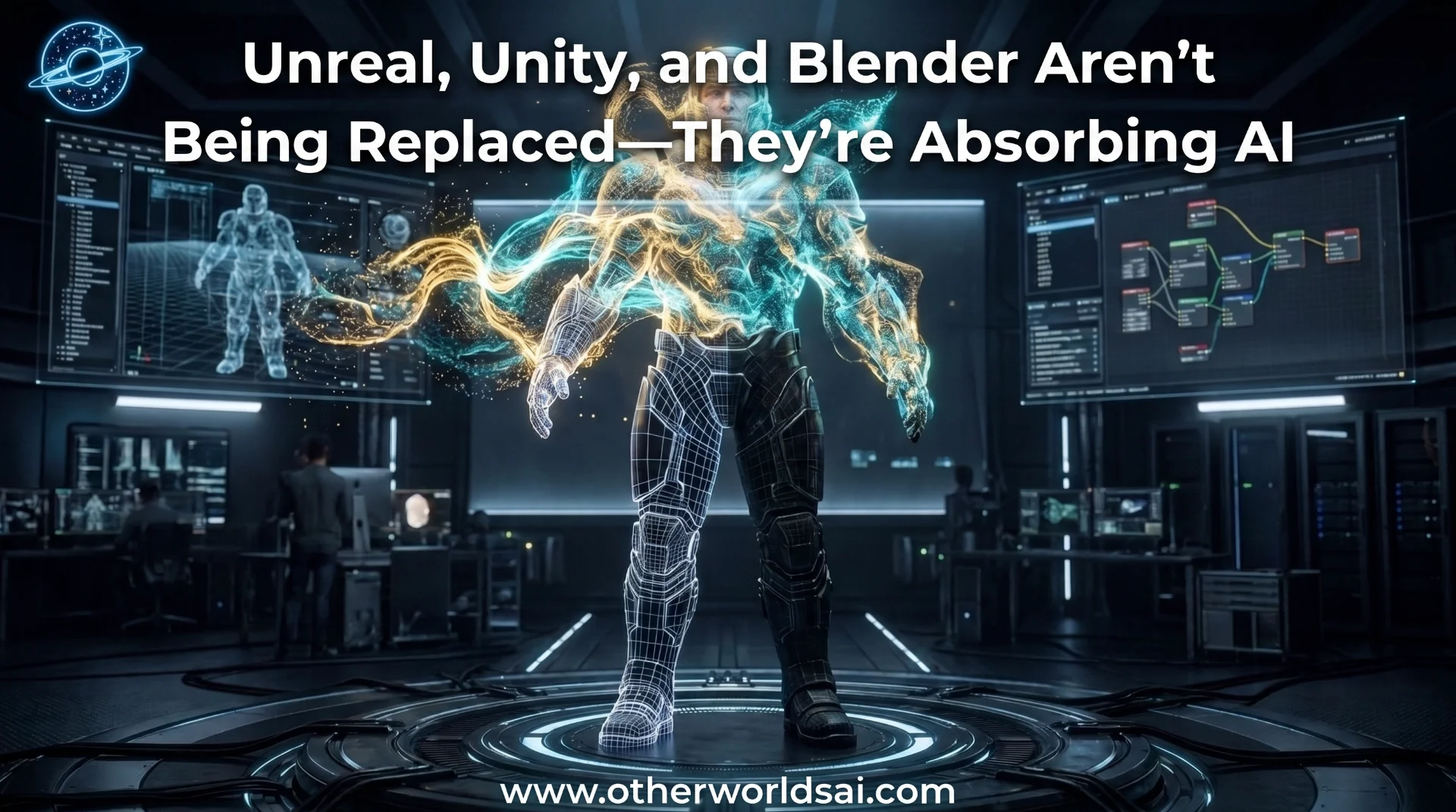

Unreal, Unity, and Blender Aren't Being Replaced—They're Absorbing AI.
Unity, Unreal Engine, and Blender vs. the New Wave of AI 3D Tools: Is AI Actually Replacing Game Engines?
AI can now generate a 3D character in under a minute. So why are Unity and Unreal Engine still running the show? A clear-eyed look at where AI genuinely speeds up 3D production — and where it still can't do the job alone.
~1 min: For AI to generate a background prop vs. 4-8 hours by hand
2: Major engines (Unity, Unreal) still anchoring most production pipelines
10+: AI tools now plugged directly into 3D and game-dev workflows
Type a sentence, get a 3D character in under a minute. It's no wonder people keep asking whether AI is about to make Unity, Unreal Engine, and traditional 3D pipelines obsolete.
The honest answer, based on how studios are actually building things in 2026, is more interesting than a simple yes or no. AI has become a genuinely powerful layer inside the 3D and animation pipeline — but it's landing on top of Unity and Unreal Engine, not underneath them. Here's what's actually changed, what hasn't, and what it means for anyone deciding how to build their next project.
1: The Old Guard Isn't Going Anywhere — It's Absorbing AI:
Unity and Unreal Engine remain the backbone of professional game and interactive 3D development, and both have spent the last year building AI directly into their editors rather than treating it as a bolt-on.
● Unity now ships AI assistance through Unity Muse and its in-editor Assistant and Generators, which can automate repetitive scene updates, generate placeholder assets from text prompts, and suggest code changes based on project context. Its ML-Agents toolkit also lets developers train NPC behavior with reinforcement learning, and Sentis runs neural networks directly on-device.
● Unreal Engine 5.6 has pushed toward being a full production environment in itself — asset creation, level design, animation, and cinematic tools all living in one place — alongside AI assistants for Blueprint and C++ help and AI-assisted material workflows.
● Blender, Maya, and 3ds Max remain the standard for hand-crafted modeling, rigging, and animation work where artists need full manual control, and they're increasingly used alongside AI generation tools rather than being replaced by them.
In other words, the industry's response to AI hasn't been to abandon these platforms — it's been to make them AI-native from the inside out.
2: The New Wave: What AI 3D Tools Are Actually Good At:
Outside the engines themselves, a genuinely new category of tools has matured fast: AI-powered 3D generation platforms that turn a text prompt or a reference image into a usable model in minutes. Tools like 3D AI Studio, Meshy, and Tripo generate models, clean up topology, and apply textures, then export directly to FBX or GLB formats that drop straight into Unity or Unreal Engine.
Animation has its own fast-moving AI toolkit. Mixamo remains the go-to for free auto-rigging and motion libraries, while tools like Cascadeur, DeepMotion, and Krikey AI use video-based motion capture or physics-assisted animation to generate character movement without a traditional mocap studio. On the character and NPC side, Inworld AI is turning game characters into conversational agents that can hold natural dialogue and remember context, and MetaHuman remains the standard for photorealistic human characters inside Unreal.
For 2D and concept work feeding into 3D pipelines, image generators like Scenario and Leonardo.ai are increasingly used to rapidly explore art direction and style before anything gets built in 3D at all. AI can now generate a meaningful share of a game's raw material — art assets, NPC dialogue, first-pass animation. What it still can't do on its own is game design, programming, and the creative direction that turns those pieces into something people actually want to play.
3: Where AI Wins Outright: Speed and Volume:
The clearest, least debatable win for AI is speed on repetitive or high-volume work. Background props, environment clutter, texture variations, and rapid prototypes are the areas where AI generation is simply faster than manual production by orders of magnitude — turning hours of modeling and texturing work into a task measured in minutes. For early prototyping, style exploration, and filling out a game world with secondary assets, AI tools have become a default part of many studios' workflow rather than a novelty.
4: Where Engines and Human Craft Still Win:
The gap shows up as soon as the work gets specific. Hero characters and anything central to a project's identity still benefit from manual modeling and animation, where artists have precise control over silhouette, proportion, and performance in a way current AI generation doesn't reliably match.
Full gameplay systems, engine-level performance optimization, platform deployment, and the overall creative direction of a project remain squarely in the domain of experienced developers and engines built for exactly that job.
AI tools also still depend on the engines to do anything with their output — every AI-generated model still needs to be rigged, imported, lit, and integrated inside Unity or Unreal Engine to actually become part of a playable experience.
5: So, Is AI Replacing Unity and Unreal Engine? The Verdict:
No — but it is changing what a lean team can accomplish without one. The realistic picture in 2026 is a hybrid pipeline: AI generation and animation tools handle volume and speed, while Unity, Unreal Engine, Blender, and the artists who know them handle control, polish, and everything that makes a project feel intentional rather than generated.
Studios that treat AI as a replacement for engine expertise tend to hit a ceiling fast. Studios that treat it as an accelerant inside a strong pipeline are shipping more, faster, without giving up quality where it matters most.
Where Otherworlds Studios Fits In:
The studios winning right now aren't choosing between traditional engines and AI tools — they're combining them. AI handles the volume work: background props, texture variations, first-pass rigging, rapid prototypes. Human artists and engineers handle the craft work: hero characters, gameplay systems, performance optimization, and the creative direction that makes a project actually feel like something.
Otherworlds Studios builds inside that hybrid pipeline every day — pairing deep Unity and Unreal Engine production experience with the fastest AI-assisted asset and animation workflows available, so projects move at AI speed without losing hand-crafted polish where it counts.
Have a project that needs both speed and craft? Let's talk about how a hybrid AI + engine pipeline could work for you.