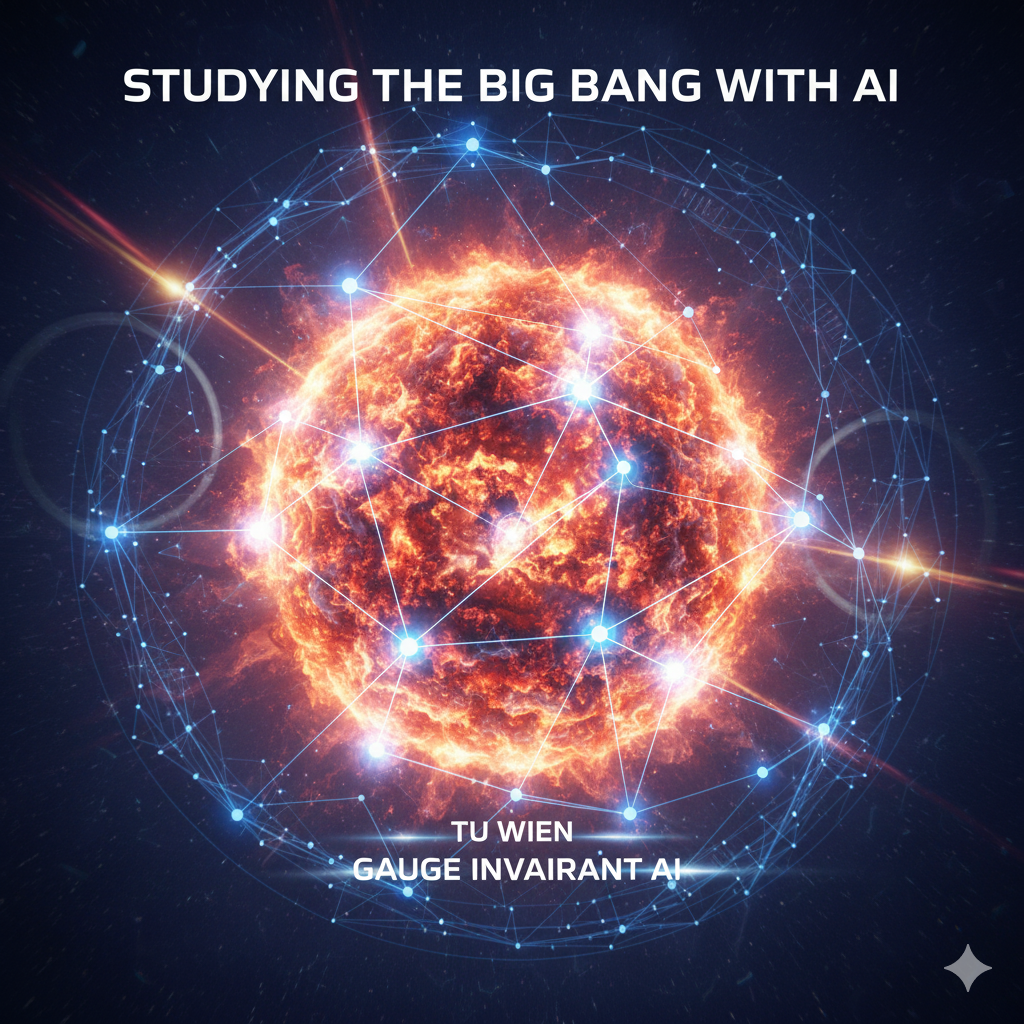

The earliest moments of our universe were filled with an exotic, fiery state of matter called quark-gluon plasma. Immediately after the Big Bang, everything existed in this form — a chaotic soup of quarks and gluons interacting at unimaginable energies. Today, scientists can briefly recreate this plasma by colliding atomic nuclei at particle accelerators such as CERN. But there’s a problem: simulating this extreme state of matter is so complex that even the world’s fastest supercomputers struggle. The plasma’s quantum interactions create data that’s difficult to calculate, let alone interpret. This is where artificial intelligence comes in.
Why Traditional AI Isn’t Enough:
AI already excels at tasks like image recognition, but using it to understand quantum matter is far more challenging. The mathematics of particle physics has a unique feature called gauge symmetry. In simple terms, the same physical state can be described in many different mathematical ways — like measuring temperature in Celsius or Kelvin. If an AI doesn’t respect these symmetries, it may produce results that look correct but are actually meaningless. Training a normal neural network to learn these rules on its own would be nearly impossible.
A New Kind of Neural Network:
Researchers at the Vienna University of Technology (TU Wien), led by Dr. Andreas Ipp and Dr. David Müller, developed a breakthrough: special neural network layers designed to automatically handle gauge invariance. These networks don’t just process raw simulation data — they inherently understand the symmetries of quantum fields. In tests, they performed much better than standard methods, learning how to interpret quark-gluon plasma data in a physically consistent way.
What This Means for Physics:
With these AI-driven tools, scientists can:
- Predict plasma behavior at later times without calculating every step in between.
- Speed up simulations, saving immense computing power.
- Ensure physical validity, since results always obey gauge symmetries. While it may take years before full-scale nuclear collisions at CERN can be simulated this way, the new approach represents a promising leap forward. It offers a powerful tool for studying physical phenomena so complex that traditional computation may never fully capture them.
Why It Matters:
By merging neural networks with the mathematical foundations of quantum physics, researchers have taken a major step toward simulating the universe’s first moments. This could deepen our understanding not only of the Big Bang, but also of how matter itself behaves under extreme conditions — a question at the heart of both cosmology and particle physics.
Support our research
Independent analysis fueled by you.