
In a major move to modernize the way federal agencies procure and deploy artificial intelligence (AI),
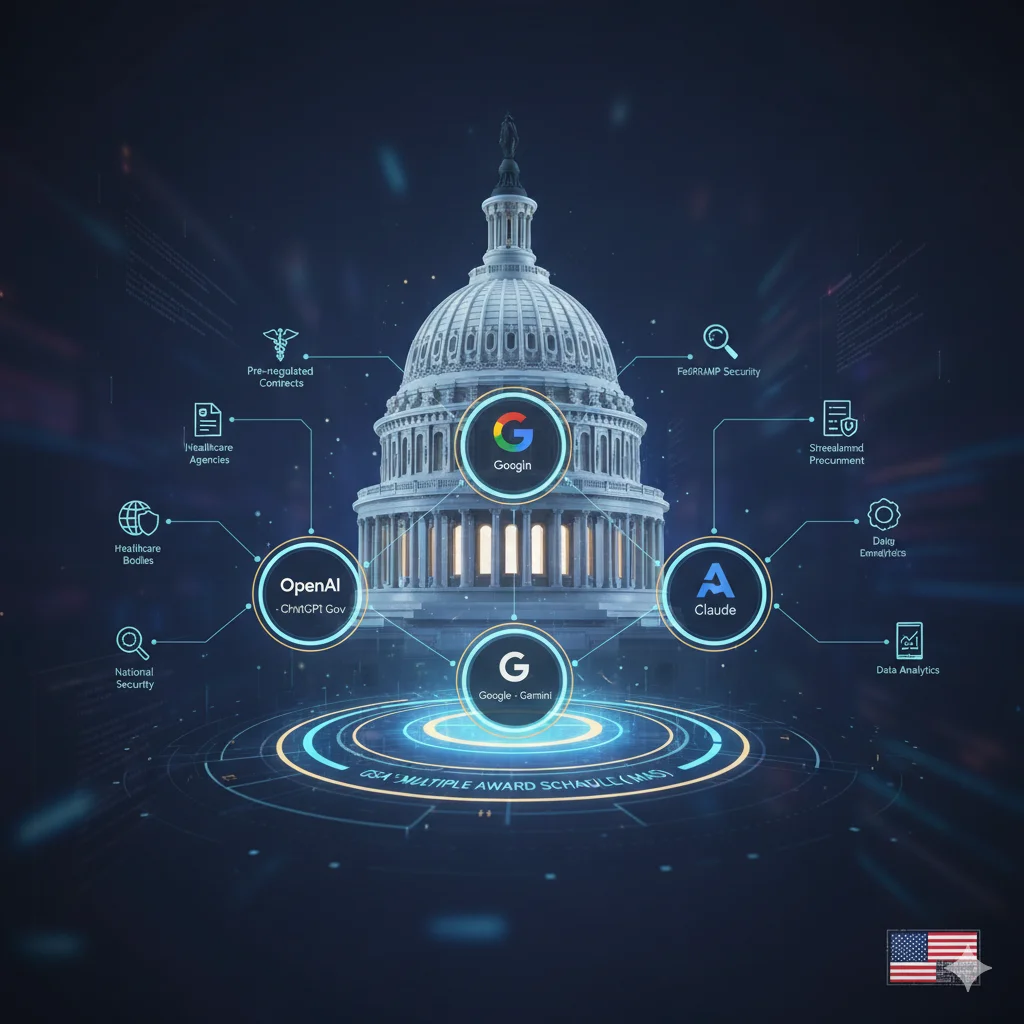
the U.S. General Services Administration (GSA) has added OpenAI, Google, and Anthropic to the Multiple Award Schedule (MAS) — a centralized federal contracting platform. This strategic approval enables civilian federal agencies to access advanced AI tools, including OpenAI’s ChatGPT, Google’s Gemini, and Anthropic’s Claude, under pre-negotiated contract terms and security standards.
This decision reflects a broader shift in federal technology policy and aligns closely with the Trump administration’s AI strategy that emphasizes rapid adoption, national competitiveness, and the use of AI systems “free from ideological bias.”
Why This Matters: Streamlining Federal AI Procurement:
Traditionally, federal agencies would negotiate individual contracts with technology vendors — a process that can take months or longer. By adding major AI providers to the MAS, GSA simplifies acquisition, reduces administrative overhead, and ensures agencies can implement AI with greater speed and consistency.
This reform is particularly significant for departments that rely on data analytics, natural language processing, and automation to improve service delivery.
Under the MAS program, agencies can purchase commercial AI software and services at pre-arranged pricing and terms. GSA consolidated these offerings after evaluating vendors on security, performance, and compliance — criteria that are central to federal technology adoption processes.
Key AI Tools Now Available to Federal Agencies:
The three companies expanded the MAS roster with their flagship AI platforms:
- OpenAI — ChatGPT: The federally approved version of ChatGPT (including ChatGPT Enterprise and ChatGPT Gov) offers advanced generative AI features, secure deployment environments, and customized support for government use cases.
OpenAI has also partnered with GSA to provide access “for a nominal cost,” effectively allowing federal agencies to leverage cutting-edge models for administrative, data analysis, and research tasks.
- Google — Gemini: Google’s Gemini AI system is included in the MAS with compliance considerations aimed at meeting government security standards. This expands federal access to multimodal AI — capable of understanding and generating text, images, and structured data — for applications in analytics and workflow optimization.
- Anthropic — Claude: Claude, Anthropic’s generative AI, has been added with pre-negotiated contract terms. In select cases, the company has offered Claude products to federal agencies for nominal fees as part of broader efforts to secure public sector adoption.
Context: New Federal AI Policy and Strategic Priorities:
The MAS update is part of a broader federal policy initiative aimed at accelerating AI integration into government operations. In July 2025, the administration issued a set of executive orders focused on expanding AI research, loosening environmental restrictions to support data center growth, and mandating that AI tools used by federal agencies be “free from ideological bias.”
Critics have characterized these directives as targeting “woke AI” while proponents argue they eliminate barriers to innovation.

Anthropic’s Surprise Double Launch Directly Targets OpenAI and Google’s AI Dominance
This policy environment underscores the government’s commitment to leveraging AI across the civilian federal landscape, from administrative processes to public services, in a way that balances efficiency, security, and political neutrality.
Broader Government AI Adoption and Ecosystem Expansion:
The inclusion of OpenAI, Google, and Anthropic in the MAS is not an isolated development.
GSA is exploring broader AI modernization initiatives:
- Perplexity AI Direct MAS Access: GSA has signed a OneGov agreement with Perplexity, making its enterprise AI platform available at deeply discounted rates designed to accelerate agency adoption.
- Meta’s Llama and Other Models: Other AI platforms, including Meta’s Llama, are being evaluated or approved for government use under GSA’s security and compliance criteria, signaling a growing diversity of approved AI solutions.
- OneGov Strategy: The GSA’s “OneGov” strategy aims to further reduce friction in government technology procurement by centralizing contracts, standardizing pricing, and expanding the range of approved solutions.
Potential Impacts on Government Agency Operations:
- Increased Efficiency: Federal agencies — from healthcare to regulatory bodies — stand to benefit from faster data processing, automated reporting, and AI-enhanced customer service. These efficiencies can translate into quicker turnaround on tasks like contract review, grant processing, fraud detection, and public communications.
- Enhanced Innovation: Access to generative AI can support innovation across federal missions. For example, AI can assist in natural language analysis for policy development, data science for public health research, and predictive analytics for infrastructure planning.
- Security and Compliance Considerations: All approved AI vendors must adhere to strict security guidelines, including FedRAMP compliance, which ensures cloud-based systems meet federal risk and data protection standards. Continued oversight will be key as adoption scales across agencies.
Conclusion:
The U.S. government’s approval of OpenAI, Google, and Anthropic for the Multiple Award Schedule marks a significant milestone in federal AI adoption. By streamlining access to powerful AI tools under secure, pre-negotiated contracts, agencies can more rapidly harness generative AI to improve efficiency and public service delivery.
As AI policy continues to evolve, future developments— including broader vendor participation and expanded AI use cases across civilian agencies —
are likely to shape the federal government’s trajectory toward comprehensive AI integration.
Support our research
Independent analysis fueled by you.