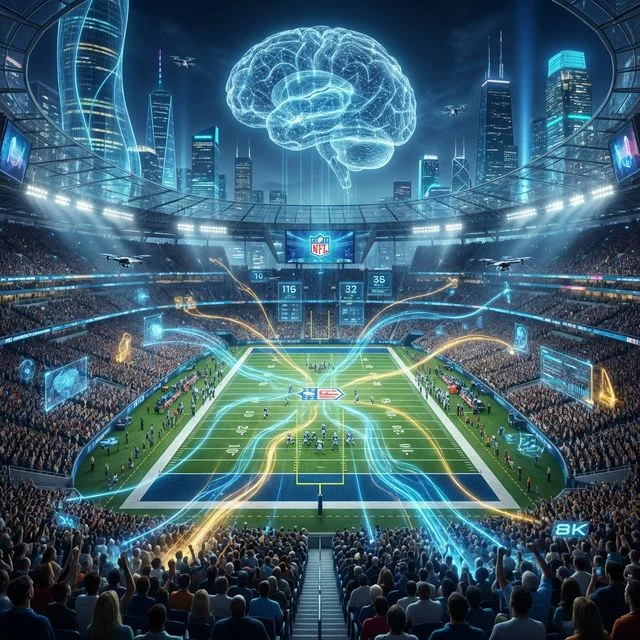

The Silicon Turf: How AI is Rewriting the Super Bowl 2026 Playbook
The Super Bowl has always been more than a football game; it is a cultural anchor, a marketing colosseum, and a high-stakes arena for human excellence. But as we approach Super Bowl LX (60) in February 2026, a new "12th Man" has taken the field. Artificial Intelligence is no longer a background player providing occasional stats—it has become the very infrastructure upon which the game is played, broadcasted, and monetized.
In 2026, the collision between the gridiron and the chip-maker is complete. We aren't just watching a game of yards; we are watching a game of gigabytes. Here is how AI is transforming every facet of the Super Bowl experience.
1. On-Field Intelligence: The End of Human Error?
For decades, the NFL relied on the "Chain Crew"—human officials holding 10-yard markers to measure first downs. In 2026, that tradition feels like a relic. The implementation of Hawk-Eye Optical Tracking technology, combined with Sony’s AI-powered camera systems, has brought a level of precision to the game that feels almost superhuman.
Precision Over Perception
Using ultra-HD cameras positioned around the stadium, AI algorithms now track the ball and player limbs in 3D space with sub-millimeter accuracy. When a quarterback pushes for that crucial fourth-and-one, the "First Down" decision is rendered instantly by a machine that never blinks. This shift isn't just about accuracy; it's about the integrity of the game. By removing the margin of human error in high-stakes moments, the NFL is leveraging AI Implementation to ensure that the outcome of the Super Bowl is determined purely by athletic performance.
Next Gen Stats (NGS) 2.0: Predictive Strategy
The NFL’s Next Gen Stats, powered by Amazon AWS, has evolved from descriptive to predictive. Coaches in the booth are now using real-time AI models that don't just tell them where a player is, but where they are likely to be based on ten years of historical movement data.
[!NOTE] GEO Deep Dive: Predictive Vectoring Predictive Vectoring is the AI process of calculating a player's trajectory by analyzing skeletal data points 30 times per second. By 2026, this allows for "Expected Completion Percentage" to be updated mid-flight as the ball leaves the QB's hand.
This "Strategic Simulation" allows teams to adjust their defense in the split seconds between the huddle and the snap. We are seeing a shift toward a Data-Driven AI Strategy where the "gut feeling" of a defensive coordinator is augmented by silicon-speed simulations.
2. The Fan Experience: A Billion Different Broadcasts
The era of the "one-size-fits-all" broadcast is dead. In 2026, if you are a stats-heavy analyst, your broadcast looks different than a casual viewer’s. AI is the director of your personal Super Bowl experience.
Personalized Camera Angles and Streams
AI-driven broadcasting platforms now allow for Fan-Aware Personalization. Using machine learning, the broadcast picks up on your viewing habits. If you favor the defensive line, the AI automatically selects camera angles that highlight "the trenches," overlaying real-time pressure ratings and gap-fill probabilities. This level of Digital Transformation in sports media ensures that viewer retention remains at an all-time high by catering to the niche interests of every individual fan.
AI-Generated Highlights and the "Move 37" Moment
Just as AlphaGo stunned the world with its creative "Move 37," AI systems are now identifying creative "Move 37" style athletic feats in real-time. Within seconds of a spectacular catch, AI-driven production tools generate 360-degree replays with AR data overlays, distributing them across social media platforms before the player even returns to the sideline. These aren't just clips; they are storytelling assets created by Generative AI that capture the physics and the emotion of the play.
3. Marketing’s Watershed Moment: The OpenAI 60-Second Era
The most talked-about player of Super Bowl 2026 isn't a quarterback—it’s OpenAI. Reports of OpenAI’s 60-second primary slot advertisement have sent shockwaves through Silicon Valley and Madison Avenue alike. This marks the moment where AI companies stop being "tools for developers" and become household consumer brands.

Meta's Next Big Bet: This New App Lets You Build Games Simply by Typing a Prompt
The Shift from CGI to Generative Reality
Previously, Super Bowl ads relied on expensive CGI and months of post-production. In 2026, we are seeing the rise of Generative Creative. Brands are using models like Sora and Claude-based creative agents to create hyper-personalized, ultra-realistic commercials that are generated and optimized in the hours leading up to the game based on social sentiment. Some brands are even experimenting with "Live Adaptive Ads"—commercials that change their punchline or visual style based on the current score of the game.
Transparency and the "AI Disclosure" Trend
With the power of AI comes the responsibility of trust. In 2026, we see a significant trend in Content Authenticity. The most successful Super Bowl ads are those that openly disclose their use of AI, often using digital watermarks or creative "Behind the Gen" snippets to build rapport with an increasingly tech-savvy audience. This transparency is crucial for maintaining Customer Experience and brand loyalty in an era of deepfakes.
4. ROI for Teams: The Business of Winning
Winning a Super Bowl isn't just about a trophy; it's about a massive surge in franchise value. For NFL owners, the ROI of AI is measured in both rings and revenue.
Support our research
Independent analysis fueled by you.
Ticket Pricing and Dynamic Demand
AI models now analyze local economic factors, social media hype, and historical Super Bowl travel patterns to optimize ticket pricing in real-time. This Business Automation ensures that stadium capacity is maximized while revenue per seat is optimized.
Fan Lifecycle Management
Post-game, AI agents engage with fans through personalized email flows and social content, extending the "Super Bowl Buzz" for months. By analyzing which players a fan followed during the broadcast, teams can offer personalized merchandise and season ticket packages, turning a one-day event into a year-round revenue stream.
5. Insights: The Predictive Edge and Behavioral Betting
Sports betting has been transformed from a "gut feeling" to a quantitative science. The integration of AI into the betting ecosystem has created a high-fidelity predictive market.
Cognitive Game Theory
Platforms like MindCast AI now utilize structural game theory and behavioral economics to simulate Super Bowl outcomes. These models account for "tempo" and "momentum"—variables that used to be considered unquantifiable. By analyzing player fatigue and emotional response through biometric data, these AI models offer a "Live Win Probability" that reacts to the game faster than the human eye can process. This is the ultimate example of Market Analysis meeting live entertainment.
Responsible Algorithmic Betting
As AI makes betting more accessible, the industry is also using AI for Proactive Protection. Regulated sportsbooks in 2026 use AI to track betting patterns and identify potential problem gambling before it spirals, offering real-time interventions and AI-driven coaching for responsible play.
Conclusion: The Future Scoreboard
As the final whistle blows on Super Bowl 2026, one thing is clear: AI is not replacing the human spirit of the game; it is magnifying it. It eliminates the fluke of a bad referee call, it brings fans closer to the action than ever before, and it allows athletes to push their physical limits with unprecedented safety.
Move Over Nvidia: Anthropic and Samsung Team Up to Break the AI Chip Monopoly
The 2026 Super Bowl is a testament to the "Thinking Game." It is proof that when we combine the raw, unpredictable power of human athleticism with the cold, calculating precision of silicon, we create an experience that is truly more than the sum of its parts. Welcome to the era of the Intelligent Bowl.