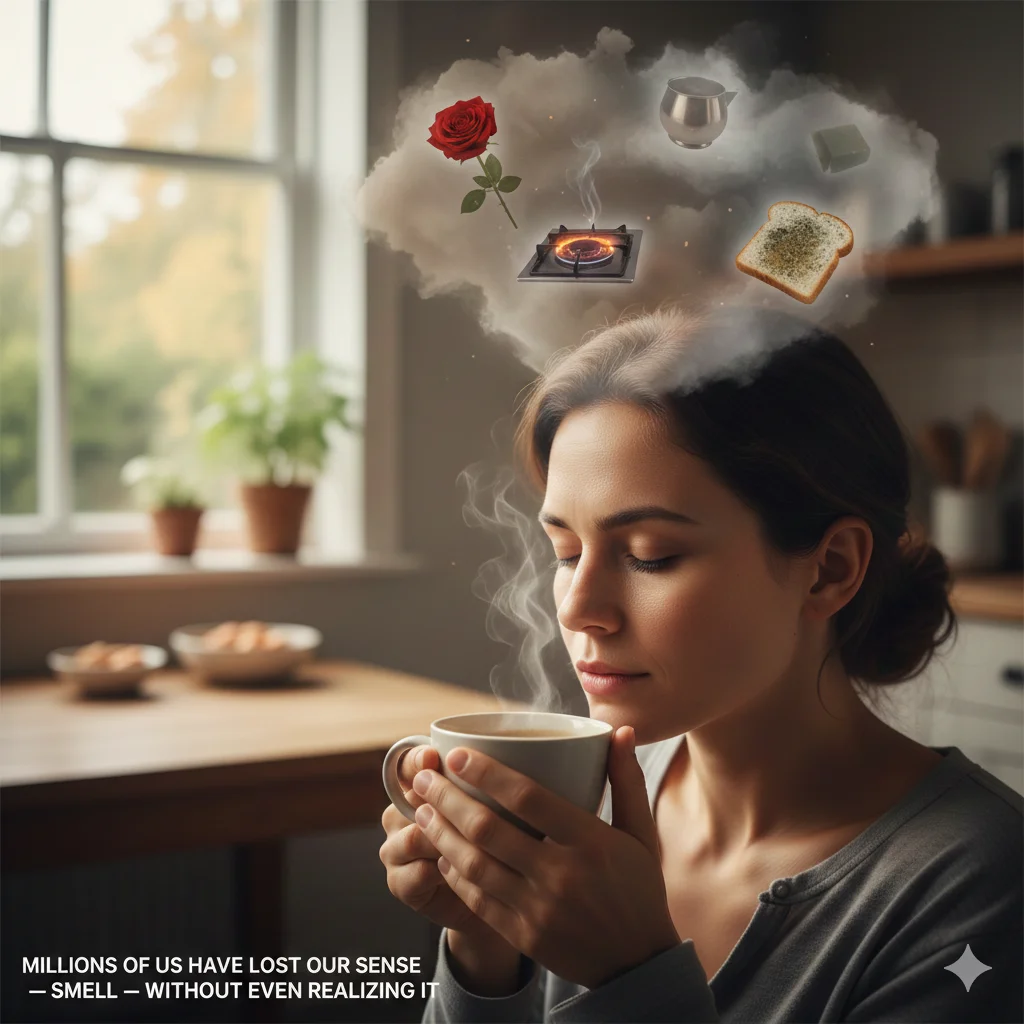

Have you ever taken a deep breath of your morning coffee and thought,
"This just doesn't smell as rich as it used to?" Or perhaps your favorite perfume, once so vivid, now seems strangely muted? If so, you're not alone, and you're not imagining things. A groundbreaking study reveals a hidden aftermath of the COVID-19 pandemic: millions of people worldwide may have lost some or all of their sense of smell, and the most astonishing part? Most of them haven't even realized it.
It's widely known that COVID-19 can lead to anosmia (complete smell loss) or hyposmia (a diminished sense of smell). This isn't unique to COVID-19; other viral infections have been observed to cause similar damage to the delicate cells and receptors in our noses responsible for detecting scents. For many, this sensory loss is temporary, a fleeting disruption that eventually resolves. But for a significant number, the change is permanent, and crucially, often so subtle that it goes completely unnoticed.
A Hidden Aftereffect Uncovered:
Researchers in the US embarked on a mission to quantify this "hidden" smell loss, analyzing the olfactory abilities of nearly 3,000 individuals who had contracted COVID-19, alongside a control group of almost 600 who hadn't. The smell tests were administered, on average, almost two years after the participants' initial positive COVID-19 test, providing a long-term perspective on the virus's impact.
The findings were nothing short of startling:
-
Among those who believed they had smell problems, a remarkable 80% were correct. Their self-awareness aligned with objective testing.
-
However, among those who didn't think anything was wrong, a staggering two-thirds actually exhibited a weakened sense of smell. This is the crux of the silent epidemic – the vast majority of people experiencing smell loss were entirely unaware of it.
"Our findings confirm that those with a history of COVID-19 may be especially at risk for a weakened sense of smell, an issue that is already underrecognized among the general population," explains Dr. Leora Horwitz from New York University’s Grossman School of Medicine. This research underscores a critical public health blind spot, revealing a widespread sensory impairment that has largely flown under the radar.
More Widespread Than We Thought:
The study's revelations didn't stop there. Even among participants who reported no confirmed COVID-19 infection, an unexpectedly high 60% showed signs of smell deficiency. Researchers speculate that many of these individuals might have experienced asymptomatic or undiagnosed COVID-19 infections, unknowingly contributing to the broader pool of those affected.
If these patterns are reflective of the global population, we could be looking at hundreds of millions of people living with reduced smell sensitivity, completely oblivious to how much their sensory world has diminished. The implications are profound, suggesting a fundamental shift in how a significant portion of humanity experiences one of our most primal senses.
Adding another layer of complexity, the research team posits that in some cases, COVID-19 might subtly affect brain regions responsible for self-awareness. This could further explain why individuals are failing to recognize their own sensory loss, creating a vicious cycle where the impairment itself hinders its detection.
Why Your Sense of Smell Matters More Than You Think:
Losing your sense of smell isn't just an inconvenience; it can have serious consequences for both your physical safety and your overall well-being. Our olfactory system acts as an early warning system, alerting us to dangers like gas leaks, spoiled food, or the insidious scent of smoke from a fire. Without this crucial sense, these everyday threats become significantly more perilous.
Beyond safety, smell is intricately linked to our memories, emotions, and even plays a vital role in our mental health. The scent of freshly baked cookies can transport us back to childhood, and the aroma of a loved one's perfume can evoke profound feelings. When these connections are severed or dulled, it can lead to a diminished quality of life, impacting our enjoyment of food, social interactions, and our ability to fully engage with the world around us.
Furthermore, a reduced sense of smell has been increasingly linked to serious health conditions such as Alzheimer's disease and broader cognitive decline. Given COVID-19's known impact on the brain, scientists are now intensely focused on understanding the complex interplay between our olfactory system and cognitive function. This connection raises urgent questions about the long-term neurological implications of the pandemic.
What Happens Next: The Call for Awareness:
The researchers advocate for a proactive approach, suggesting that routine smell testing should become an integral part of post-COVID care. If so many people are unknowingly living with compromised olfactory abilities, the very first step toward addressing this silent epidemic is awareness.
As Dr. Horwitz aptly states, "While patients may not notice right away, a dulled nose can have a profound impact on their mental and physical well-being." The cumulative effect of these subtle changes can chip away at our daily experiences, leading to a poorer quality of life without us ever pinpointing the cause
So, what can you do right now? The advice is refreshingly simple: pay attention to your nose. Take a moment to truly savor the scents around you. Does your morning coffee smell as robust as it used to? Is that freshly cut grass as vibrant? If things seem a little dull, or if you've had COVID-19, considering a medical smell test might reveal more than you expect.
This silent epidemic demands our attention, for the sake of our safety, our memories, and our overall well-being.