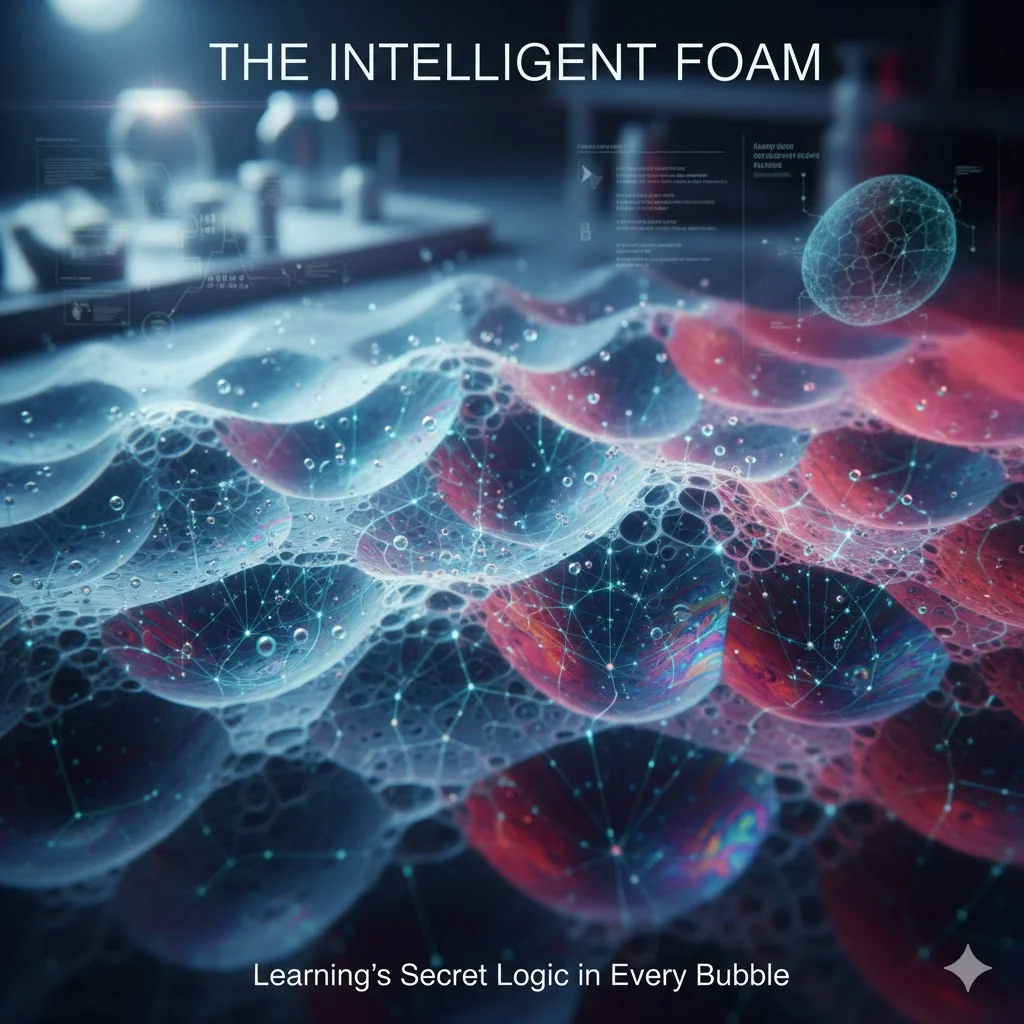

We interact with foam every single day—shaving cream,
the froth on a latte, or the bubbles in the kitchen sink. To the naked eye, these materials seem simple, stationary, and maybe a little boring once they settle.
But according to groundbreaking new research from the University of Pennsylvania, your morning cappuccino might be hiding the secret logic of the world’s most advanced Artificial Intelligence. This isn't just a playful analogy; it's a profound mathematical congruence that suggests "learning" isn't exclusive to brains or machines, but rather an emergent property shared by diverse physical and biological systems.
The "Frozen" Myth: A Paradigm Shift in Material Science:
scientists operated under a specific assumption that profoundly shaped our understanding of materials like foam. This was the "glass analogy," where foam bubbles, once settled into a shape, were thought to become "frozen" in place at a microscopic level. Imagine a chaotic collection of marbles in a box –
once they find their spots, they don't move unless the box is shaken. This view was compelling because it seemed to explain why foam holds its shape so robustly, acting like a soft solid despite its liquid-gas composition. It provided a tidy framework for understanding its mechanical stability.
However, using advanced computer simulations of unparalleled precision, Penn engineers at the School of Engineering and Applied Science discovered something startling and fundamentally different. Foam is never actually at rest, even when it appears perfectly still.
These simulations allowed researchers to track individual bubbles within a foam structure with incredible detail. What they observed defied the long-standing glass analogy. Instead of settling into fixed, static positions, the bubbles were in a constant state of flux, wandering, shifting, and subtly reorganizing themselves indefinitely.
The foam's overall macroscopic shape remained intact, providing the illusion of stability, but internally, it was a hive of incessant, microscopic motion. This discovery forces a complete re-evaluation of how we perceive the "stability" of many complex, disordered materials.
Why Foam is Like Deep Learning: An Uncanny Mathematical Parallel:
The most shocking and scientifically profound part of the study, published in Proceedings of the National Academy of Sciences (PNAS), isn't just that bubbles move—it's how they move. The intricate mathematical equations describing this restless, internal bubbling are nearly identical to the very same equations used to train today’s most powerful and sophisticated Deep Learning models.
This isn't a mere coincidence or a loose comparison; it's a deep structural similarity in their underlying dynamics. To grasp this, let's look at two critical aspects of modern AI training:
-
- The Death of the "Perfect" Solution: Embracing Flatness:
In the early, more naive days of Artificial Intelligence and machine learning, engineers tried to force AI models to find the "perfect" answer—the single, deepest "valley" in a complex, abstract mathematical landscape that represented all possible solutions.
The idea was to optimize the model to fit the training data with absolute precision. However, this approach often backfired spectacularly. Models optimized to such an extreme became brittle and fragile, performing poorly when exposed to new, unseen data. This phenomenon is known as "overfitting."
Modern Deep Learning, a cornerstone of today's AI, operates differently. It has learned to favor and seek out "flat" regions within this solution landscape. These are areas where many slightly different configurations or parameter settings yield equally good, or nearly equally good, performance.
The key insight here is that you don't need the absolute "best" single solution; rather, you need a robust solution that is stable across a range of minor perturbations. This flexibility is precisely what allows AI to generalize effectively and remain robust when confronted with real-world variability.
-
- Constant Reorganization: Foam's Adaptive Dance:
Intriguingly, foam exhibits this exact same behavior. Foam bubbles do not settle into single, deep energy minima (the "deepest valleys" of the old theory). Instead, they continuously explore broad, flat regions of equally stable configurations. The system finds a state of equilibrium, but within that equilibrium, there is a constant, subtle dance of reorganization.
"Foams constantly reorganize themselves. It’s striking that foams and modern AI systems appear to follow the same mathematical principles," explains Professor John C. Crocker, co-senior author of the study and Professor of Chemical and Biomolecular Engineering (CBE) at Penn. "Understanding why that happens is still an open question, but it could reshape how we think about adaptive materials and even living systems."
This continuous exploration, this subtle self-adjustment, is the very essence of what allows both foam and AI to maintain stability while adapting to internal stresses or minor external changes.
The "Landscape" of Learning: A Visual Analogy:
To intuitively understand this profound connection, let's refine the analogy of a boulder rolling down a mountain:
-
Old Theory (The "Frozen" Foam): Imagine each bubble as a perfectly spherical boulder that rolls into the deepest possible hole (a single, low-energy position) and becomes permanently stuck there. Once it's in, it doesn't move again unless a massive external force dislodges it. This accounted for apparent stability but failed to match empirical observations.
-
New Reality (The "Learning" Foam): Now, envision the bubble not as a boulder seeking the deepest hole, but as a curious hiker exploring a vast, high, flat plateau. There isn't a single "lowest" point to get stuck in. Instead, the hiker (the bubble) continuously wanders across this broad, equally stable terrain.
It doesn't need to find the absolute lowest point to be "stable"; it just needs to stay on the path, constantly adjusting its position within the plateau's boundaries. This continuous, low-energy movement within a stable, broad region is the hallmark of both foam and robust AI.
This fundamental shift in perspective explains why traditional foam models, which treated bubbles as static entities once settled, consistently fell short when compared to actual experimental data.
The missing piece was this dynamic, "learning-like" behavior, which modern AI research had already uncovered.