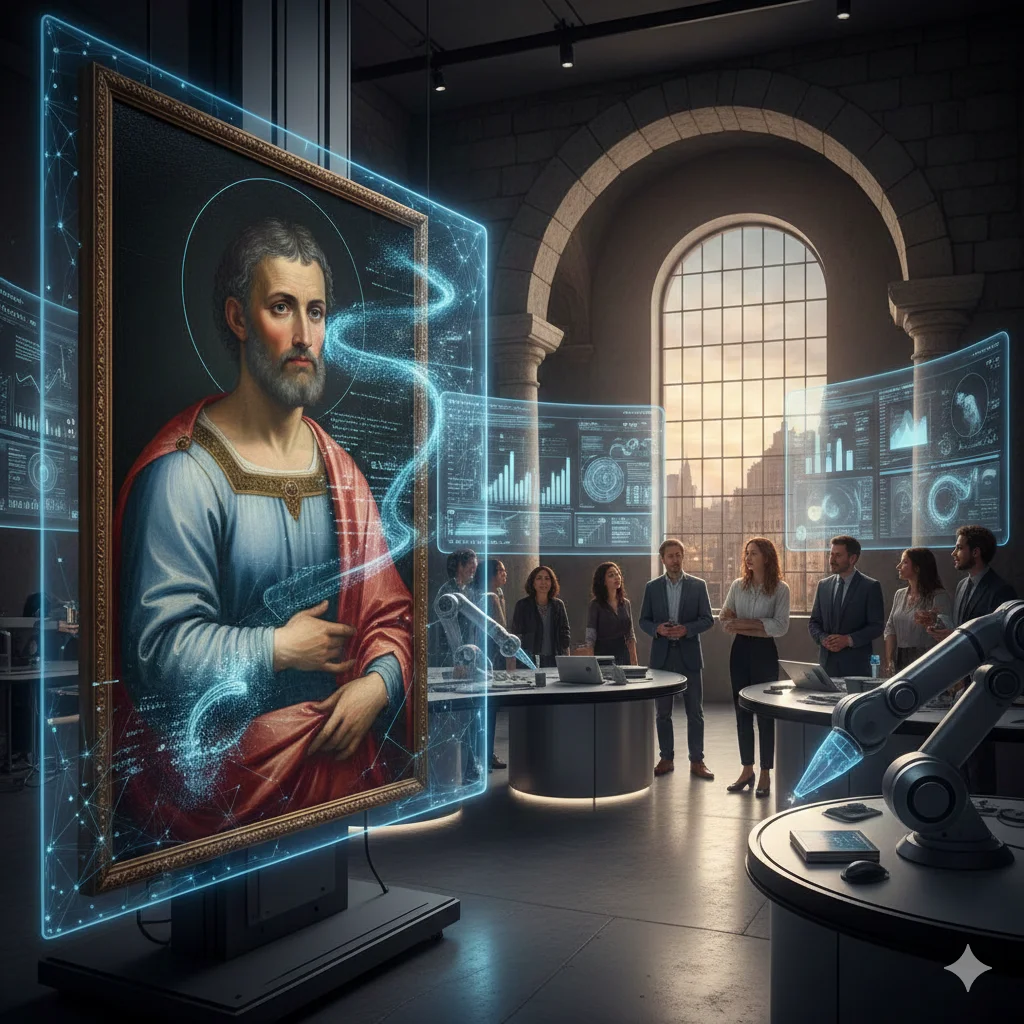

Unbelievable! 🤯 AI just uncovered a hidden secret in Raphael's Madonna della Rosa that art historians have debated for centuries!
For centuries, Raphael’s Madonna della Rosa has hung in prestigious galleries,
captivating viewers with its serene beauty and masterful composition. It stands as a testament to the genius of the High Renaissance. Yet, for nearly 200 years, a persistent whisper has circulated among art historians, a question that has quietly gnawed at the painting's unquestioned authenticity: Did Raphael truly paint every brushstroke of this iconic work?
While the trained human eye can admire the soft, almost ethereal glow of the Virgin Mary, the tender innocence of the Christ child, and the intricate folds of the drapery, it took an entirely different kind of perception – a "digital eye" – to finally pinpoint a subtle discrepancy, an unexpected detail that even the most seasoned experts had long debated.
A Neural Network with an Uncanny Eye for Detail:
The groundbreaking revelation emerged from the University of Bradford, where researchers embarked on an ambitious project to put this revered masterpiece under the microscopic scrutiny of artificial intelligence. Their tool was a custom-built AI model, meticulously trained on an exclusive diet of verified Raphael paintings.
This wasn't just any AI; it was an expert system designed to absorb and recognize the nuanced "DNA" of Raphael's artistry – his distinct brushstrokes, his signature color blending, his unique approach to shading, and even the microscopic rhythms of his hand.
To achieve this unprecedented level of accuracy, the team ingeniously modified Microsoft’s ResNet50 deep learning architecture, pairing it with a Support Vector Machine (SVM), a classical machine learning technique. This sophisticated, hybrid approach had previously demonstrated an astonishing 98% accuracy in identifying authentic Raphael paintings. However, instead of analyzing entire canvases, the researchers refined their methodology, instructing the AI to zoom in on individual faces within the Madonna della Rosa, searching for consistency and deviation.
The Verdict: The "Imposter" in the Corner:
When this highly specialized AI systematically scanned the various figures within the painting, the results were overwhelmingly consistent for the central figures. The Madonna, the Christ Child, and St. John all registered as a perfect match for Raphael's authenticated style, their features bearing the unmistakable hallmarks of the Renaissance master.
But when the digital lens turned its attention to St. Joseph, positioned discreetly in the upper left corner of the composition, the AI flagged a subtle yet significant discrepancy. The data diverged; the stylistic patterns simply did not align.
The Findings:
The AI confirmed, with compelling evidence, what some art critics had merely suspected for decades: while the vast majority of the painting unmistakably showcased Raphael’s hand, St. Joseph’s face was, with high probability, painted by someone else.
The Prime Suspect:
While not definitively confirmed by historical records for this specific detail, the leading hypothesis points to Giulio Romano, Raphael’s most talented and trusted pupil, as the likely artist responsible for completing that particular section of the painting.
It’s plausible that Raphael, overwhelmed with commissions, entrusted his gifted apprentice to finish certain elements, a common practice in bustling Renaissance studios.
Technology as a New Tool for Unlocking Truth:
Does this extraordinary feat mean that AI is poised to replace the invaluable work of human art historians? Absolutely not. As lead researcher Hassan Ugail aptly explains, this is not about replacement, but about collaboration and enhancement.

Meta's Next Big Bet: This New App Lets You Build Games Simply by Typing a Prompt
AI offers an unprecedented capacity to see beyond the limits of human perception, to analyze details at a microscopic level that would be impossible for even the most experienced human eye. However, it still requires the profound knowledge and contextual understanding of human experts to interpret the data, to delve into historical records, to analyze pigments, and to truly grasp the "why" behind the artistic choices and circumstances.
This remarkable discovery, published in the journal Heritage Science, marks a significant turning point in how we approach art authentication and appreciation. It demonstrates that even the most revered and extensively studied masterpieces still harbor secrets, hidden in plain sight for centuries.
With the advent of advanced AI, we now possess a powerful new tool capable of unlocking these long-held mysteries, offering fresh perspectives and deepening our understanding of the artistic processes and collaborations that shaped the masterpieces of our past. The fusion of cutting-edge technology and traditional art scholarship promises an exciting future where our appreciation for history's greatest artworks will only continue to grow and evolve.
Support our research
Independent analysis fueled by you.