
The Billion-Dollar Pivot: [Nvidia’s](/blog/ai-is-america-s-best-opportunity-to-re-industrialize-says-nvidia-s-jensen-huang) $1 Trillion Vision for Secure AI Agents:
The landscape of enterprise technology is shifting under the weight of a new industrial revolution, and at the center of this seismic change stands Nvidia CEO Jensen Huang. During his high-profile GTC keynote in San Jose, Huang didn't just showcase faster chips; he laid out a comprehensive blueprint for the future of global business.
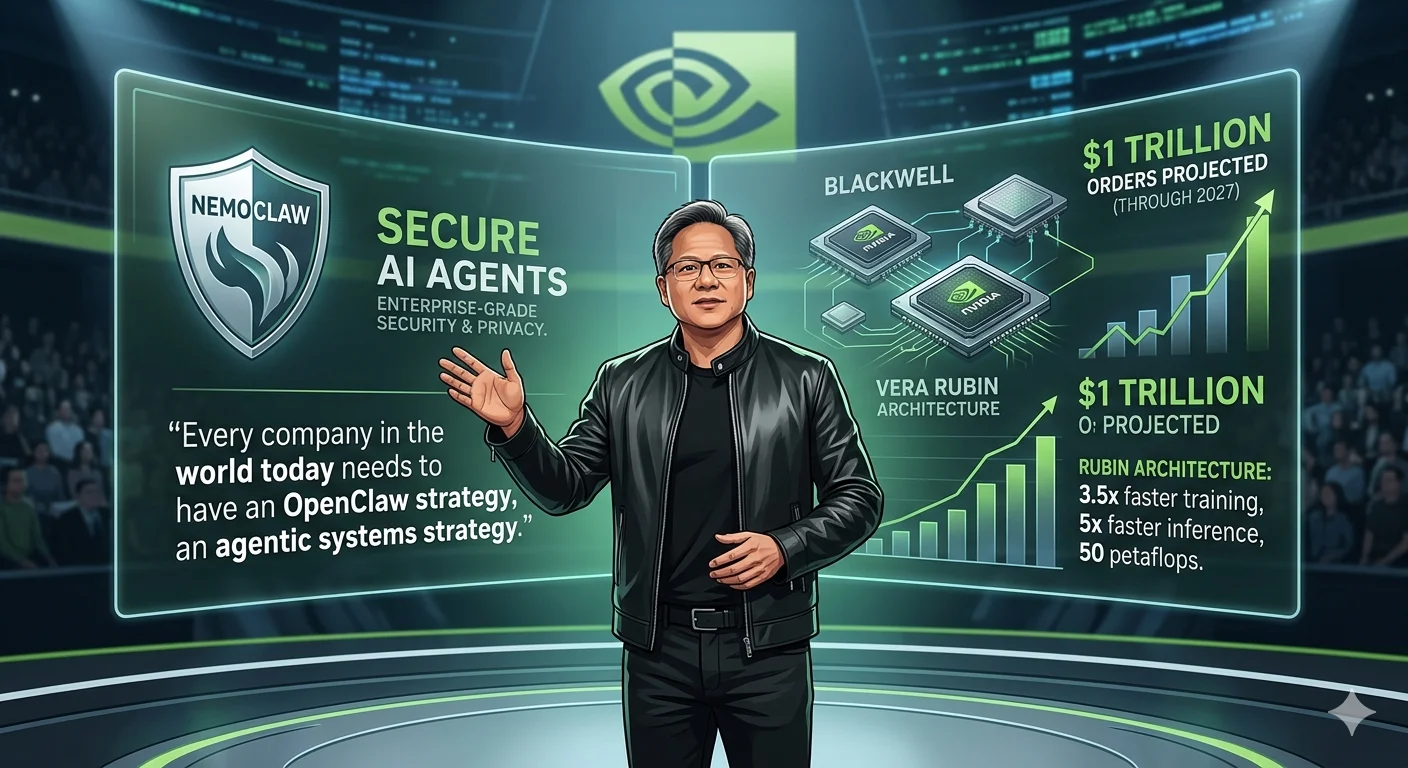
This vision is defined by two massive pillars: the staggering $1 trillion demand projection for Blackwell and Vera Rubin architecture, and the launch of NemoClaw, a breakthrough platform designed to solve the "last mile" of AI adoption—security.
The Rise of NemoClaw: Securing the Agentic Frontier:
Every company in the world today needs to have an OpenClaw strategy, Huang declared to a packed audience, drawing parallels to the early days of the internet and cloud computing. Just as businesses once scrambled to define their Linux, HTTP, and Kubernetes strategies, they must now navigate the world of "agentic systems."
To facilitate this, Nvidia has introduced NemoClaw, an enterprise-grade AI agent platform built on top of the popular open-source OpenClaw framework. Developed in collaboration with OpenClaw creator Peter Steinberger, NemoClaw is designed to provide the robust privacy and security features that corporations require before they can fully trust AI agents with sensitive internal data.
The primary goal of NemoClaw is to turn OpenClaw into a secure platform that enterprises can deploy with a single command. While the original open-source framework allowed for the local execution of AI agents, Nvidia’s version adds a "production-ready sandbox" that gives CEOs and CTOs total control over how these agents behave.
This is not just a software play; it is a strategic move to ensure that Nvidia’s version of OpenClaw could solve its biggest problem: security. By baking enterprise-grade protections directly into the stack, Nvidia is positioning itself as the indispensable gatekeeper of the AI-driven workplace.
A Hardware-Agnostic Approach to Intelligence:
Flexibility is the cornerstone of Nvidia's software strategy, as evidenced by NemoClaw’s design. Despite being the world's leading GPU manufacturer, Nvidia has made this platform hardware agnostic, meaning it does not strictly require Nvidia GPUs to function.
This allows developers to tap into any coding agent or open-source model—including Nvidia’s own NemoTron—to build and deploy agents across diverse environments. Whether accessing cloud-based models on local devices or integrating with the existing NeMo software suite, NemoClaw is built to be the "connective tissue" of the modern AI enterprise.
Nvidia is currently describing NemoClaw as an early-stage alpha release, urging developers to expect "rough edges" as they build toward a more polished ecosystem. However, the message to the industry is clear: the era of fragmented AI experiments is over. Following OpenAI’s launch of the Frontier platform and recent Gartner reports emphasizing the need for AI governance, Nvidia is moving fast to dominate the infrastructure layer.
“OpenClaw gave the industry exactly what it needed at exactly the time,” Huang noted, suggesting that this open-source stack will be the foundation upon which the next decade of corporate productivity is built.
The Trillion-Dollar Hardware Boom:
While software provides the brain, the Blackwell and Vera Rubin chips provide the brawn, and the financial projections for this hardware are nothing short of astronomical. Huang stunned investors by revising his previous demand estimates upward at a dizzying pace.
While Nvidia saw roughly $500 billion in demand for its Blackwell and upcoming Rubin chips through 2026 just last year, that figure has already doubled. “Right here where I stand, I see through 2027, at least $1 trillion,” Huang announced, marking a monetary reflection of an AI business that is growing at a rate rarely seen in industrial history.
The Rubin computing chip architecture represents the new state of the art in AI hardware. Officially entering production earlier this year, the Rubin architecture is a powerhouse of efficiency and speed, designed to outperform its Blackwell predecessor by significant margins.
Nvidia reports that the Rubin architecture will operate 3.5x faster on model-training tasks and 5x faster on inference tasks, reaching performance peaks as high as 50 petaflops. With production expected to ramp up in the second half of the year, Nvidia is effectively cornering the market on the high-performance computing necessary to run the very agents that NemoClaw manages.
Conclusion: The Convergence of Silicon and Software:
The future of Nvidia is no longer just about selling silicon; it is about providing the entire operating system for the AI era. By combining the raw power of the $1 trillion Rubin architecture with the secure, governed environment of NemoClaw, Jensen Huang is ensuring that Nvidia remains at the heart of the global economy.
As enterprises move from curiosity to full-scale deployment, the integration of high-speed hardware and secure, open-source software will be the differentiator. The message from GTC is undeniable: the world is building on Nvidia, and the agentic revolution has officially begun.
Support our research
Independent analysis fueled by you.