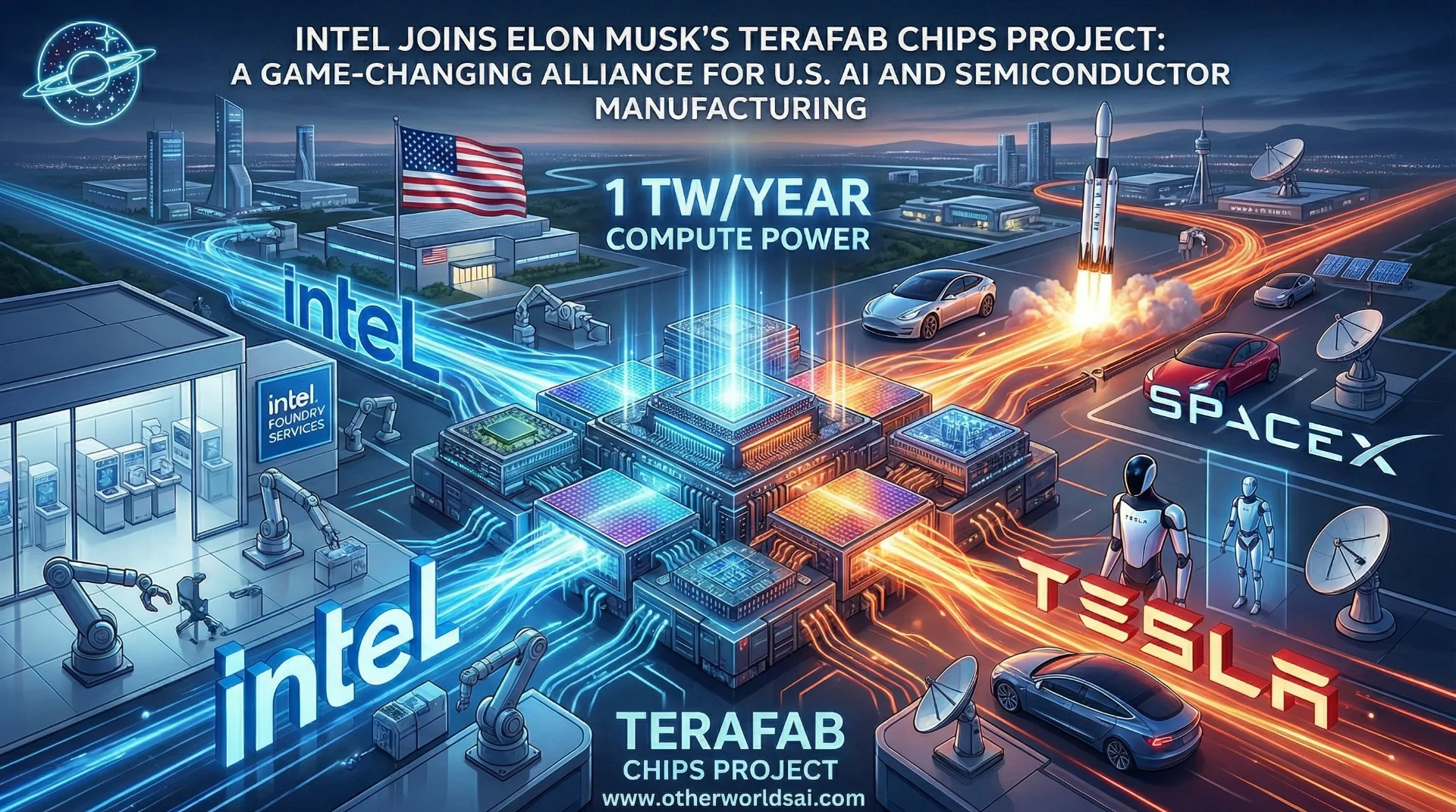

Intel Joins Elon Musk's Terafab Chips Project: A Game-Changing Alliance for U.S. AI and Semiconductor Manufacturing:
Powering 100 Million Robots: Why Tesla needs Intel to realize the Optimus dream.
Introduction: A New Era in U.S. Semiconductor Manufacturing:
In a landmark development for the U.S. technology and AI industries, Intel has officially signed on to Elon Musk's ambitious Terafab chips project — a bold initiative aimed at producing a staggering 1 terawatt per year (1 TW/year) of compute power to fuel the next generation of artificial intelligence and robotics. This strategic partnership brings together Intel's world-class semiconductor fabrication expertise with the visionary engineering ambitions of SpaceX and Tesla — two of Elon Musk's most transformative companies.
The announcement has sent shockwaves through the global semiconductor and AI industries, raising critical questions about the future of U.S. chip manufacturing, domestic AI infrastructure, and the race to build the world's most powerful computing ecosystems.
What Is Terafab? Understanding Elon Musk's Chip Megaproject:
Terafab is an audacious semiconductor initiative first announced by Elon Musk in March 2026. The project represents a formal collaboration between SpaceX and Tesla — two leading companies under Musk's leadership — with the goal of developing cutting-edge chips for: AI compute infrastructure, SpaceX's proposed space-based data center network, satellite systems, autonomous Tesla vehicles, and humanoid robots and advanced robotics platforms.
The scale and ambition of Terafab are extraordinary. Targeting 1 TW/year of compute production, the project aims to fundamentally reshape how AI and robotics industries access processing power — domestically, at scale, and with American manufacturing at its core.
Intel's Role in Terafab: Foundry Power Meets AI Ambition:
Intel's entry into the Terafab partnership fills the most critical gap the project faced: actual chip fabrication capability. In an official corporate post on X (formerly Twitter), Intel stated:
"Our ability to design, fabricate, and package ultra-high-performance chips at scale will help accelerate Terafab's aim to produce 1 TW/year of compute to power future advances in AI and robotics."
Intel's involvement is significant for several strategic reasons. The company has been actively seeking large anchor customers to revitalize its Intel Foundry Services (IFS) business — and with SpaceX and Tesla now on board, Intel has secured two of the most high-profile clients in the technology world. Intel brings decades of semiconductor manufacturing experience, cleanroom infrastructure, and packaging capabilities that neither SpaceX nor Tesla currently possess.
Why This Partnership Matters: The Challenge of Building a U.S. Chip Fab:
Building a world-class semiconductor fabrication facility is among the most complex and capital-intensive undertakings in modern industry. Industry experts consistently note that: A new chip fab typically requires more than $20 billion in investment. Construction and commissioning can take several years. Each facility requires an enormous cleanroom housing thousands of ultra-precise lithography machines. Specialized talent, supply chains, and materials must be coordinated across global networks.
Without Intel, the Terafab vision would have faced enormous execution risk. SpaceX and Tesla, despite their engineering brilliance, have no prior experience in semiconductor fabrication. The involvement of Intel — once the undisputed leader in U.S. chip production — provides the technical credibility and manufacturing infrastructure that the project desperately needed.
Intel's Market Comeback: Stock Surge and Strategic Pivot:
The Terafab announcement provided a significant boost to Intel's stock price. Shares rose more than 3% on the news, with Intel trading at $52.28 — approximately 2.9% higher than its opening bell price as of 2 p.m. ET on the day of the announcement.
Intel's stock performance reflects investor optimism about the company's strategic repositioning. In recent years, Intel has struggled to maintain its historical dominance in the semiconductor sector. Rivals such as Nvidia and AMD have surged ahead, particularly in the AI chip market, while Intel has faced manufacturing delays and profitability pressures.
The company has also seen many leading chip designers adopt the "fabless" model — outsourcing manufacturing to foundries like TSMC — further eroding Intel's competitive moat. The Terafab deal signals that Intel is actively fighting back by positioning itself as the go-to U.S.-based foundry for next-generation AI silicon.

Meta's Next Big Bet: This New App Lets You Build Games Simply by Typing a Prompt
Broader Implications: U.S. AI Infrastructure and Chip Independence:
The Intel-Terafab partnership has profound implications for U.S. national technology strategy. As AI demand continues to accelerate — driven by large language models, autonomous systems, robotics, and space applications — the need for domestic, high-performance compute infrastructure has never been more urgent.
Key strategic takeaways from this development include: the U.S. is doubling down on domestic semiconductor production, AI compute is becoming a critical national infrastructure priority, Elon Musk's companies are positioning themselves as central players in the AI hardware ecosystem, and Intel may be on the verge of a major commercial and reputational revival.
What to Watch Next: Unanswered Questions and Future Milestones:
Despite the excitement surrounding the Intel-Terafab announcement, several important questions remain unanswered. Intel has not disclosed the specific financial terms of its involvement. The exact scope of Intel's contributions to chip design, fabrication, and packaging is still unclear. No timeline has been confirmed for when the first Terafab-produced chips will enter production.
It is also uncertain whether Terafab will use Intel's existing foundry infrastructure or require entirely new facility construction. Investors, technologists, and policy watchers will be closely monitoring future announcements from Intel, SpaceX, and Tesla for more clarity on project timelines, capital commitments, and technical specifications.
Support our research
Independent analysis fueled by you.
Conclusion: Intel, Musk, and the Future of AI Chips:
The Intel-Terafab alliance marks a pivotal moment in the global AI and semiconductor landscape. What began as an ambitious — and perhaps puzzling — announcement from Elon Musk about SpaceX and Tesla building a chip fab now has real-world execution credibility, thanks to Intel's entry into the partnership.
For Intel, this is an opportunity to reclaim its status as America's premier chip manufacturer. For SpaceX and Tesla, it provides the fabrication backbone to realize their AI and robotics ambitions. And for the United States, Terafab could represent a critical pillar in building sovereign, high-performance AI compute infrastructure — reducing dependence on foreign semiconductor supply chains and accelerating the nation's artificial intelligence capabilities.
The race to 1 TW/year of AI compute has officially begun — and Intel just put itself at the center of it.