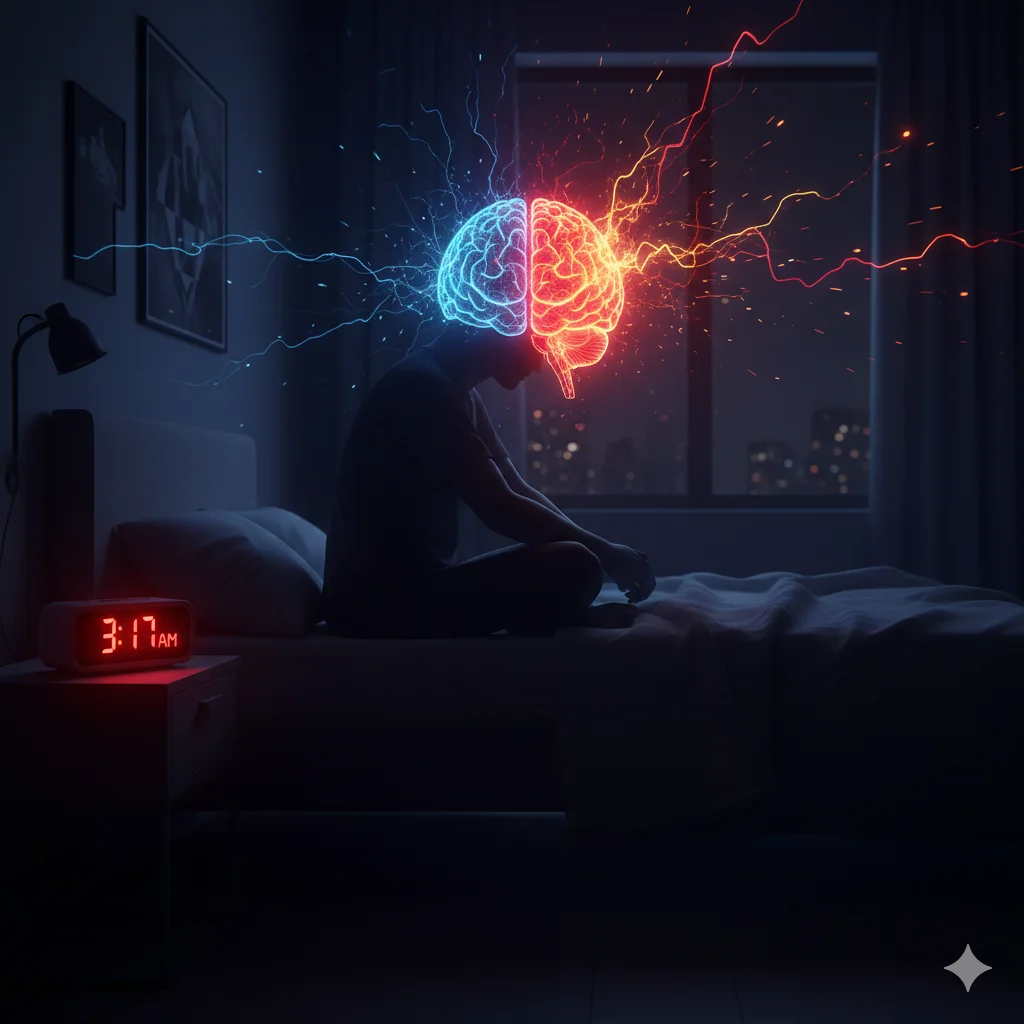

Have you ever experienced those eerie late-night hours:
when your thoughts seem to morph into darker versions of themselves? When a minor stressor at 2:00 PM becomes an existential crisis at 2:00 AM?** If so, you're not alone. Scientists are increasingly warning that the human mind isn't just "tired" past midnight—it’s fundamentally misaligned.
This phenomenon is rooted in the “Mind After Midnight” hypothesis, which suggests that our internal 24-hour biological clock, the circadian rhythm, profoundly dictates our thoughts, emotions, and behaviors. When we stay awake while the sun is down, we aren't just losing sleep; we are operating a brain that has effectively "switched" its programming.
The Biological Red Zone: Why the Night Turns Hostile:
From an evolutionary perspective, humans are diurnal creatures. During the day, our molecular activity is optimized for focus, problem-solving, and social engagement. At night, we were historically at our most vulnerable. To compensate, our brains evolved to be hyper-attuned to negative stimuli after dark—a survival mechanism that once kept us alert to predators but now amplifies modern anxiety.
Neurologist Elizabeth Klerman of Harvard University notes that when we are awake in the middle of the night, our brain's "executive function" (the part that makes rational decisions) powers down, while our "reward and threat" systems stay active. This creates a "perfect storm" for risky behavior, ranging from late-night binge eating to far more tragic outcomes like increased rates of substance abuse and self-harm.
How AI is Proving the Hypothesis:
While the hypothesis was originally based on clinical observation, Artificial Intelligence (AI) is now providing the hard data to back it up. Researchers are using machine learning to analyze "digital phenotypes"—the way we interact with technology at night—to map this mental shift.
-
- Sentiment Analysis and the "Midnight Spike" AI-driven Natural Language Processing (NLP) has analyzed millions of social media posts and therapy transcripts. The findings are staggering: as the clock passes midnight, there is a statistically significant spike in "depressive linguistic markers." AI models can now predict a shift toward hopelessness or impulsivity based purely on the time of day a person is active online.
-
- AI and "Brain Age" Monitoring: Recent 2025 research from institutions like Mount Sinai has utilized Transformer-based AI models (similar to the tech behind ChatGPT) to analyze over a million hours of sleep data. These models have identified a "Brain Age Index" (BAI). When people consistently stay awake past midnight, AI shows that their brain EEG signals begin to look "older" and more degraded, correlating with a much higher risk for cognitive decline and neurodegenerative diseases.
-
- Predictive Risk Modeling: AI is now being used to create "Early Warning Systems." By analyzing data from wearables (like smartwatches), AI algorithms can detect when a person's circadian rhythm is drifting. These systems are being developed to alert healthcare providers when a high-risk individual is awake during the 2:00 AM to 5:00 AM "danger zone," allowing for digital interventions—like AI chatbots—to provide support at the exact moment a person is most vulnerable.
The High Stakes: From Cravings to Crisis:
The dangers of "Midnight Consciousness" are not theoretical. Research shows:
-
Overdose Risk: A study in Brazil used data analysis to show that opioid overdoses were 4.7 times more likely at night.
-
Suicide Risk: There is a threefold increase in suicide risk between midnight and 6:00 AM. AI researchers are currently building models to understand why "nocturnal wakefulness" is a unique risk factor independent of depression itself.
The Takeaway: Trust the Morning:
The synergy between AI research and neurology is sending a clear message: Your "midnight self" is not your "true self." You are operating with a brain that has temporarily lost its ability to regulate emotion and resist impulses.
If you find yourself spiraling into regret or hopelessness after 12:00 AM, remember: It is your biology talking, not your reality. The most productive thing you can do for your mental health isn't to think your way out of a problem at 3:00 AM—it’s to go to sleep and let your "daylight brain" handle it in the morning.
Support our research
Independent analysis fueled by you.