
For decades, the story of human evolution seemed relatively straightforward.
We knew Homo sapiens originated in Africa, ventured out into the world, and eventually became the sole surviving human species. We knew we shared the planet with Neanderthals in Europe and Denisovans in Asia, but they were often viewed as side characters in our grand narrative.
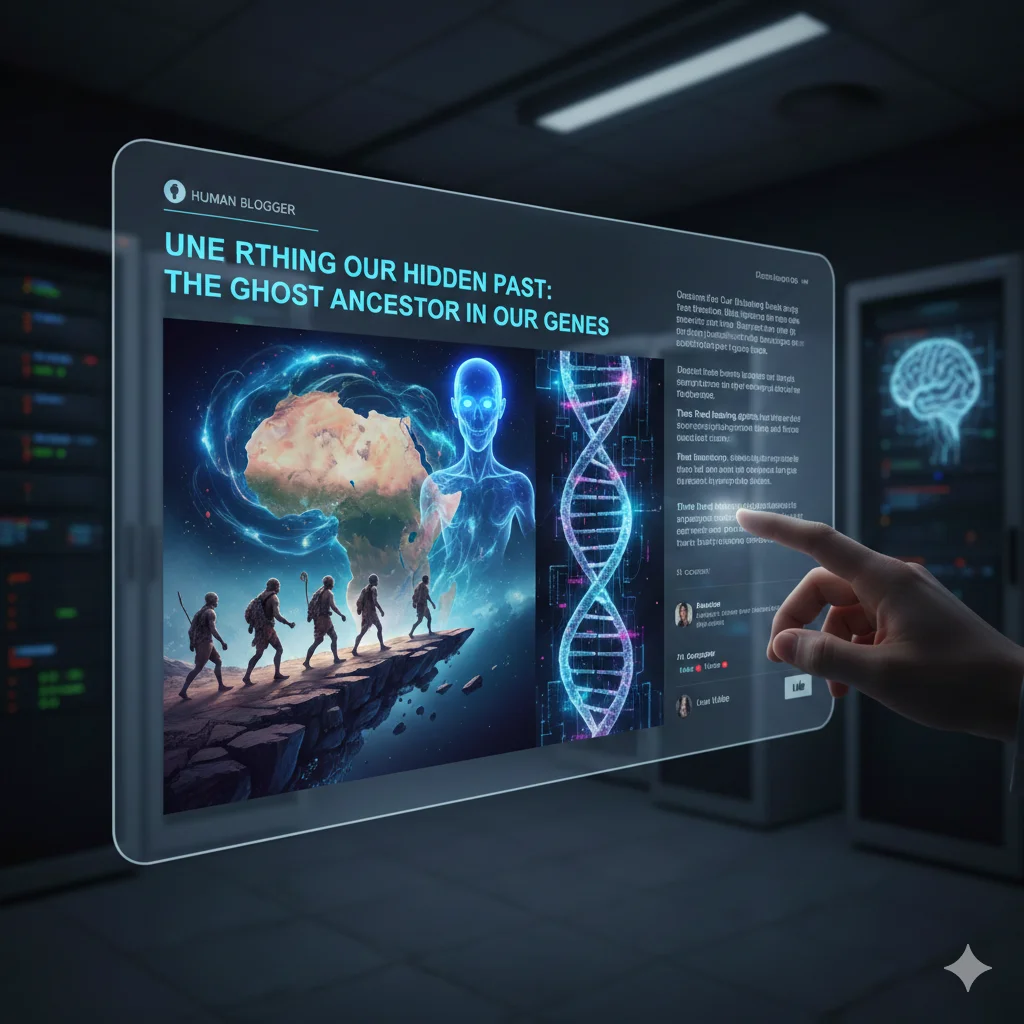
However, a groundbreaking study published in Nature Communications has flipped the script. Using artificial intelligence, scientists have discovered that our ancestors weren't just "passing through" Eurasia—they were part of a complex, bustling prehistoric world filled with "ghost" populations that have no physical fossils to their name.
The Mystery of the "Third Introgression":
The research, led by evolutionary biologist Jaume Bertranpetit, utilized deep learning algorithms to analyze the vast complexities of the human genome. By feeding the AI thousands of ancient and modern genomic sequences, the team asked the machine to find the best statistical fit for how our DNA became so diverse.
The AI came back with a startling answer: The current genetic makeup of modern humans cannot be explained by Neanderthals and Denisovans alone. There had to be a "third introgression"—a period of interbreeding with a previously unknown archaic population.
Who Was the Ghost Ancestor?
While we don't have a skull or a stone tool to attribute to this group, the AI provided a "genetic sketch." This ghost population likely diverged from the Denisovan lineage or was a hybrid group itself.
This theory gained massive credibility due to a 2018 discovery in Siberia’s Denisova Cave. Archaeologists found a bone fragment belonging to a 13-year-old girl nicknamed "Denny." When her DNA was sequenced, the results were staggering: her mother was Neanderthal, and her father was Denisovan. She was a first-generation hybrid.
While Denny herself isn't the "ghost species," she is the "smoking gun" that proves these groups were mixing far more frequently than we ever dared to imagine. If a first-generation hybrid existed, it’s almost certain that entire populations of hybrids—the "ghosts" the AI detected—were roaming the Eurasian Steppe.
The Digital Archaeologist: Why AI?
You might wonder why it took an algorithm to find this. The reason lies in the "noise" of our DNA. Over tens of thousands of years, genetic signals become faint and fragmented. Traditional statistical models are often limited by the bias of the researcher; we only look for what we expect to find. AI, specifically Bayesian inference, works differently. It creates millions of "virtual histories" and compares them to the actual DNA of people living today. It doesn't have expectations; it only cares about the most probable mathematical reality.
The Complicated Web of Humanity:
This discovery suggests that "humanity" isn't a single lineage, but a mosaic. Recent studies in 2019 and 2020 have further mapped these interactions, suggesting that: Neanderthal DNA helps some modern humans with immune system responses and skin adaptation. Denisovan DNA provides high-altitude adaptation for people living in the Tibetan Plateau. The Ghost DNA likely contributed traits we are only just beginning to identify in modern Oceanian and Asian populations.
Why This Matters Today:
Understanding our "ghost" ancestors changes how we view ourselves. We aren't the "pure" survivors of a single line; we are a successful blend of many different types of humans who all contributed to our survival. This AI-driven research proves that the "extinction" of Neanderthals and Denisovans wasn't a total disappearance—they live on within us. As AI continues to sift through our past, who knows what other ghosts it might summon from the depths of our genetic code? We are living in an era where the most important archaeological site isn't a cave in the mountains—it's the sequence of molecules inside every one of our cells.
What do you think? Does knowing you carry "ghost DNA" change how you think about your heritage? Let’s talk in the comments!
Support our research
Independent analysis fueled by you.