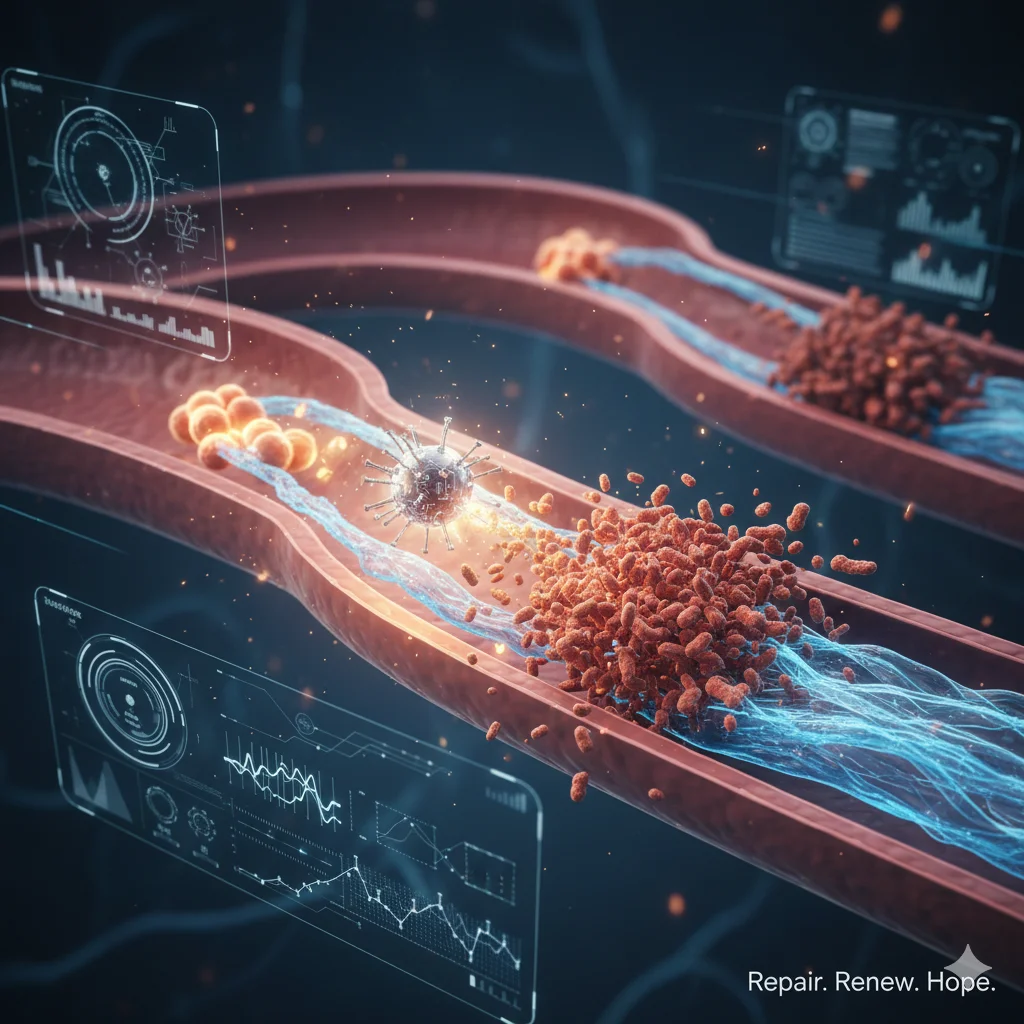

For decades, the battle against Alzheimer’s disease has felt like fighting a fire without a hose.
We could see the damage—the toxic amyloid-beta plaques and tangles—but we couldn't get the "water" (medicine) to where it was needed. The culprit? The Blood-Brain Barrier (BBB). This natural defense system is a tightly woven layer of cells designed to keep toxins out of our most sensitive organ. Unfortunately, it’s so effective that it also locks out 98% of potential medicines.
However, a groundbreaking study published in Signal Transduction and Targeted Therapy has just flipped the script. Instead of trying to break into the fortress, scientists have found a way to fix the fortress’s own waste-management system—and they did it with the help of Artificial Intelligence (AI) and Nanotechnology.
A Radical Shift: From "Invaders" to "Engineers":
Traditionally, drug research has treated the BBB as an obstacle to be bypassed using brute force, such as ultrasound waves or "Trojan Horse" nanoparticles. This new research, co-led by the Institute for Bioengineering of Catalonia (IBEC) and West China Hospital Sichuan University (WCHSU), takes a different approach: Biorestorative Repair.
The team discovered that in Alzheimer’s patients, the BBB isn't just a wall; it's a "clogged drain." It stops toxins from leaving the brain just as much as it stops drugs from entering. By using nanoparticles that act as active engineers, the researchers repaired a protein called LRP1.
This protein acts like a shuttle bus, picking up toxic amyloid-beta and carrying it across the barrier to be flushed out by the body. In Alzheimer’s, these "shuttles" are broken. The new treatment repairs them, allowing the brain to clear itself of plaques naturally. The results in mice were staggering: a 45% reduction in plaques within hours and a full restoration of cognitive function.
The Silent Partner: How AI Made This Possible:
While the biological results are the headline, the "how" involves a massive technological leap. You cannot build a nanoparticle that repairs a specific protein through simple trial and error;** it requires the precision of Artificial Intelligence.**
-
- Generative Design of Nanomaterials: To create the "supramolecular" nanoparticles used in this study, researchers utilize AI-driven generative models. These algorithms can simulate millions of molecular structures to find the exact shape and chemical charge needed to bond with the LRP1 protein without being destroyed by the immune system.
-
- Digital Twin Simulations: Before these particles ever touched a mouse, researchers used AI to create "Digital Twins" of the brain's vasculature. AI models predict how the blood flow changes as the BBB is repaired. This allows scientists to calculate the exact dosage needed to trigger a "clearance cascade"—where fixing one part of the barrier helps the rest of the brain begin to heal itself.
-
- Real-time Imaging and Pattern Recognition: During the study, AI-powered imaging software was used to identify and quantify the reduction of amyloid-beta deposits (marked in red in the study’s microscopic images). AI can spot subtle changes in plaque density that the human eye might miss, providing a more accurate picture of how quickly the brain is responding to treatment.
Caring for Country: A Holistic Perspective:
What makes this research truly unique is the inclusion of an Indigenous perspective. Shannon Kilmartin-Lynch, a researcher at RMIT who has worked on similar sustainable and biological innovations, emphasizes the concept of "Caring for Country." In a medical context, this means viewing the brain as an ecosystem.
Rather than attacking the disease with harsh chemicals, this treatment seeks to restore the natural lifecycle of the brain’s materials. It’s about sustainability at a cellular level—ensuring the brain can maintain its own health for a lifetime.
What Lies Ahead?
While these results are currently in the preclinical stage (mice), the path forward is illuminated by data. As we move toward 2026 and beyond, the next step is Clinical Trial Stratification. Using AI, researchers can analyze the genetic data of human volunteers to find those whose blood-brain barriers are the most "clogged," ensuring that human trials are as effective as possible.
We are moving away from an era of "managing" Alzheimer's and toward an era of restoring the brain. By combining the wisdom of the natural world, the precision of nanotechnology, and the processing power of AI, we are finally finding the keys to the fortress.
Support our research
Independent analysis fueled by you.