
Artificial Intelligence. It's the buzzword of our era,
a technological marvel that promises to reshape every facet of human existence. But as with any revolution, its ultimate impact is a deeply contested issue, sparking intense debate between optimists and realists alike.
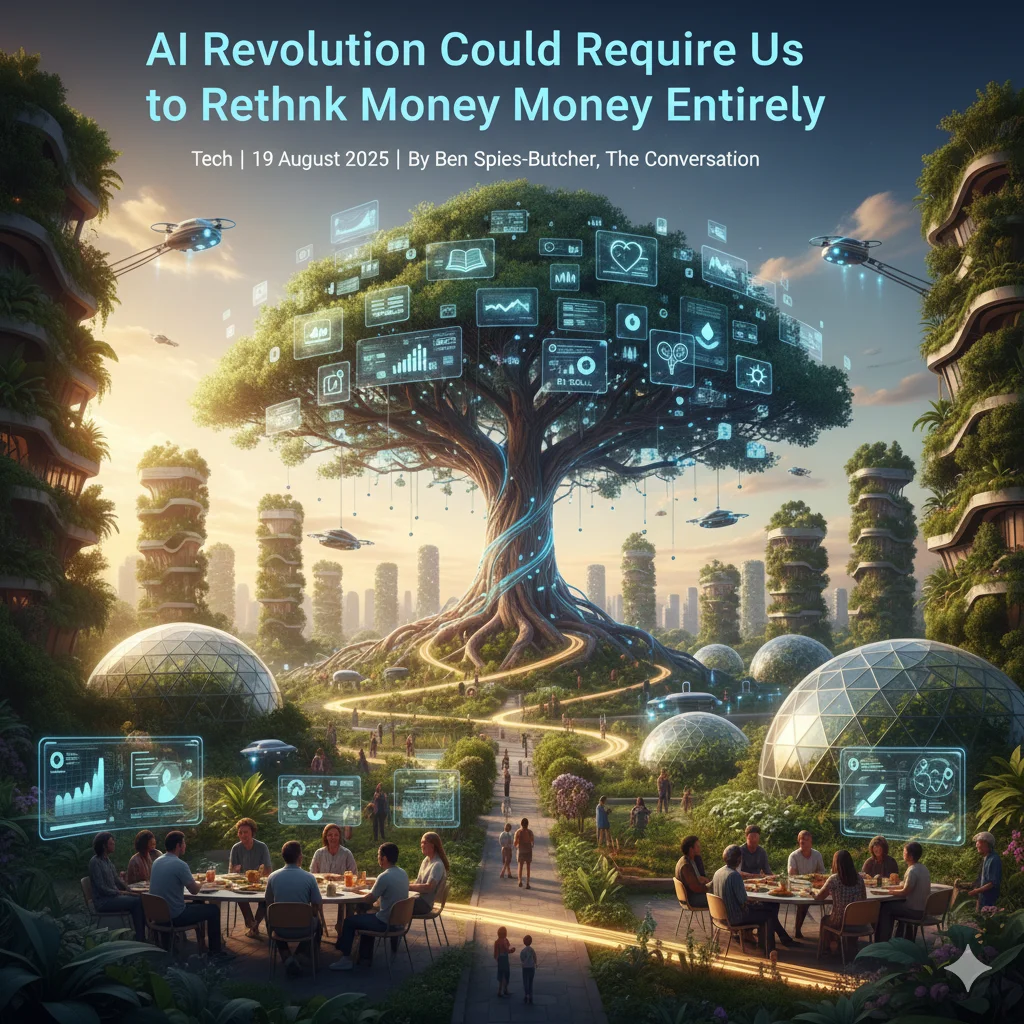
For the techno-optimists, AI heralds a future of unparalleled material abundance. They envision a world where technology enhances human life, solves age-old problems like disease and scarcity, and ushers in an era of ease and prosperity. It's a seductive vision, one where machines do the heavy lifting, freeing humanity to pursue higher callings. But is that outcome truly guaranteed? Even if AI's technical potential is fully realized, and we achieve unprecedented levels of productivity, a fundamental question remains: how will this newfound abundance be shared?
The Paradox of Plenty: A Glaring Contradiction:
We don't need to look far to see the cracks in our current system, even without full AI integration. Consider Australia's food economy, for example. Government data reveals a staggering waste: Australians collectively discard around 7.6 million tonnes of food annually, roughly 312 kilograms per person. Yet, paradoxically, one in eight Australians experiences food insecurity, struggling to afford enough to eat.
What does this glaring contradiction tell us about our ability to distribute resources fairly, particularly as we hurtle towards an AI-driven world? It exposes a crucial flaw: the issue isn't always a lack of resources, but a failure in our distribution mechanisms.
AI Disrupts the Core Logic of Our Economy:
Modern market economics, as defined by Lionel Robbins, is fundamentally about managing scarcity. It studies the relationship between our infinite wants and the finite resources available to satisfy them. In this framework, markets ration scarce resources based on demand, prices signal what's rare, and the imperative to pay for essentials compels most of us to work, thereby sustaining production and economic activity.
However, the promise of AI-driven abundance fundamentally challenges this entire logic. If technology can produce more with fewer inputs, and even solve complex medical, engineering, and social issues, then scarcity may no longer be the primary determinant of value. The traditional economic framework begins to buckle under the weight of potential overabundance.
Adding to this, there's a growing and legitimate fear that advanced AI will render millions of workers redundant. If machines can perform tasks more efficiently and cost-effectively than humans, what happens to those whose labor is no longer needed? Without paid work, how would people earn money, sustain their livelihoods, or participate in markets designed around employment?
Rethinking How We Meet Human Needs: Lessons from Crisis:
Technological unemployment isn't the only problem AI poses for our current economic models. Market economies have historically demonstrated a paradoxical ability to generate mass deprivation amidst plenty – through cycles of unemployment, stagnant wages, or underutilized resources. As the economist John Maynard Keynes observed, recessions and depressions often stem from the system itself, leaving people in poverty even when materials, factories, and willing workers are abundant.
The COVID-19 pandemic offered a stark, real-world lesson. Australia's economic disruption wasn't a market failure but a public health crisis. Yet, the governmental response provided profound insights: measures like increased welfare payments, the removal of work tests, and relaxed means-testing significantly reduced poverty and food insecurity, even as economic output declined.
Globally, similar interventions were witnessed in over 200 countries, with direct cash transfers bolstering citizens. These experiences have reignited interest in pairing technological progress with a Universal Basic Income (UBI) – a guaranteed income sufficient to meet basic needs for everyone. Initiatives like the Australian Basic Income Lab, a collaboration between Macquarie University, the University of Sydney, and the Australian National University, are actively exploring this concept. If implemented, UBI could help societies manage technological disruption while ensuring AI’s benefits are broadly shared, rather than concentrated at the top.
From Welfare to a 'Rightful Share':
The concept of UBI isn't new, but its purpose matters. Some versions might still allow extreme inequality to persist. This is where researchers Elise Klein and James Ferguson introduce a more transformative vision: UBI as a “rightful share,” not merely a welfare handout. They argue that the immense wealth generated by technological innovation and collective human effort – often built on generations of shared knowledge and infrastructure – belongs to everyone, much like a nation’s natural resources.
This idea echoes debates from early 20th-century Britain, where industrialization and automation boosted productivity but also displaced workers. Even earlier, the Luddites famously resisted machines that threatened their livelihoods. While competition drives innovation, it has historically distributed its risks and rewards unequally, often to the detriment of those most vulnerable to change.
Universal Basic Services: A Different Path:
Instead of resisting AI, another powerful approach involves fundamentally reshaping the economic system to ensure technology benefits all. UK author Aaron Bastani envisions a future he calls “fully automated luxury communism,” where technology enables both abundance and leisure. His preferred solution isn’t universal income, but Universal Basic Services (UBS) – providing essentials like healthcare, education, transport, energy, and care directly and free of charge.
This approach would necessitate a radical rethinking of how AI is applied – essentially socializing technology to meet collective needs rather than solely serving private profit motives. Imagine AI systems managing smart grids for free energy, optimizing public transport, or delivering personalized education to everyone.
Abundance Doesn’t Guarantee Utopia – Our Choices Will:
Whether through basic income or basic services, these proposals underscore a critical truth: AI alone will not create utopia. As Peter Frase wisely warns, the intersection of technological progress and ecological limits could lead to vastly different futures – shaped not just by what we produce, but by how society decides to distribute it.
The immense influence of billionaire-led tech companies points to another chilling possibility. Yanis Varoufakis describes this as “technofeudalism,” where control over digital platforms and data replaces traditional markets and democracy with a new, authoritarian rule. In such a future, a handful of tech giants could wield unprecedented power, effectively becoming the new feudal lords of the digital age.
Waiting for AI to magically deliver a technological nirvana misses the fundamental point: we already possess the means to feed everyone and eradicate poverty. The challenge we face isn't technological; it's profoundly political and social. We don’t need AI to tell us that. The choice to build a more equitable, abundant future remains firmly in our human hands.
Support our research
Independent analysis fueled by you.