
As we move into 2026, the financial post-mortem of the past year reveals a staggering reality:
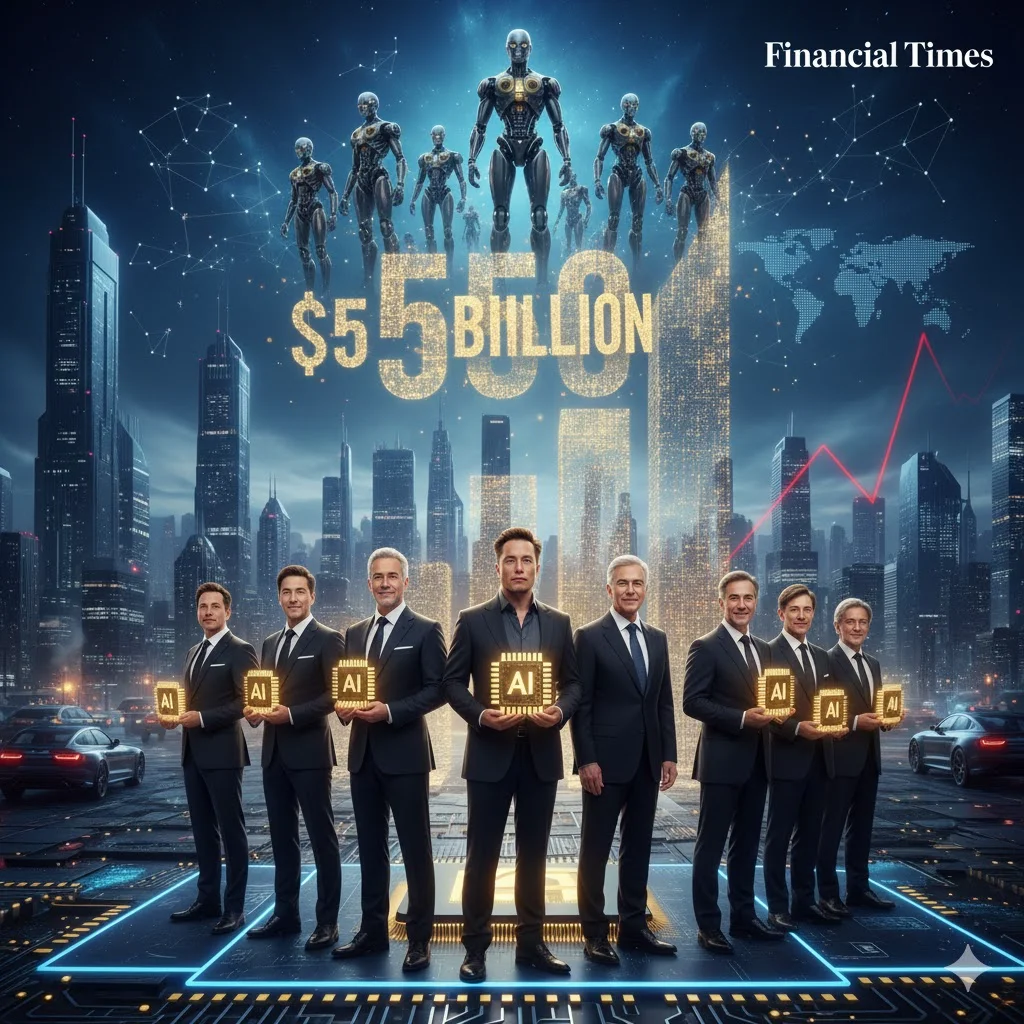
2025 wasn't just the year of artificial intelligence; it was the year AI became a historic wealth engine. According to data cited by the Financial Times and Bloomberg, the top technology billionaires in the United States saw their collective fortunes swell by more than $550 billion in 2025 alone.
This massive surge propelled the combined net worth of the top 10 U.S. tech titans to a jaw-dropping $2.5 trillion. To put that in perspective, if these ten individuals formed a country, their combined wealth would rival the GDP of major world economies like India or Brazil.
The Architects of the AI Boom:
The rally was largely fueled by investor mania for anything related to AI—from the hardware that powers it to the software that executes it. Several figures emerged as the primary beneficiaries of this "Intelligence Age" gold rush:
-
Elon Musk: Retaining his title as the world's richest individual, Musk's net worth skyrocketed by nearly 50%, ending the year at approximately $645 billion. While Tesla remained a cornerstone of his wealth, his AI venture, xAI, and the massive hype surrounding his "Grok" models provided the momentum needed to cross the unprecedented $500 billion mark in October 2024.
-
Larry Ellison: The Oracle co-founder emerged as a surprise superstar of the AI era. Ellison saw a historic single-day gain of $89 billion after Oracle announced a monumental $300 billion data center deal with OpenAI. By year-end, Ellison's strategic pivot to AI cloud infrastructure solidified his place among the world's wealthiest.
-
Jensen Huang: As the "godfather" of AI chips, the Nvidia CEO saw his fortune rise to $158 billion. With Nvidia becoming the first company to reach a $5 trillion market valuation, Huang’s wealth has become a direct proxy for the world's demand for processing power.
-
The Google Duo: Larry Page and Sergey Brin capitalized on Alphabet’s aggressive integration of AI into search and advertising, with Page’s wealth climbing to $270 billion and Brin’s to $251 billion.
Market Momentum: AI as the Engine:
The broader market reflected this tech-heavy concentration. The S&P 500 finished the year up approximately 16.4%, a gain largely attributed to the "Tech+" cohort. While the index saw a "V-shaped" recovery after early-year tariff volatility, the underlying strength of AI-related earnings provided the necessary buoyancy to reach record highs.
Beyond the household names, 2025 minted roughly 50 new billionaires. These "AI upstarts" emerged from the sectors of automated coding, foundation models, and humanoid robotics, proving that the wealth creation isn't just limited to the legacy giants.
The Shadow of Success: Wealth Concentration and Inequality:
While the innovation is undeniable, the sheer speed of this wealth accumulation has reignited a fierce global debate. Critics and economists, including those at the IMF and UNDP, warn of a "New Era of Divergence."
The concern is twofold:
-
Concentrated Ownership: Because the gains are tied to stock valuations and equity, the financial benefits of the AI revolution are flowing primarily to a tiny fraction of the population.
-
Labor Displacement: As AI automates high-wage tasks, there is a fear that wage inequality will sharpen. While AI may displace high-income workers, those same workers are often the ones with the capital to invest in the very technology replacing them, creating a cycle that further widens the wealth gap.
"The central fault line in the AI era is capability. Countries and individuals that invest in skills and computing power will benefit; others risk being left far behind." — Philip Schellekens, UNDP Chief Economist.

Meta's Next Big Bet: This New App Lets You Build Games Simply by Typing a Prompt
Looking Toward 2026:
The AI revolution shows no signs of slowing. Global capital expenditure on generative AI is forecasted to exceed $1.3 trillion by the early 2030s. However, the events of 2025 serve as a watershed moment. We are witnessing the fastest creation of wealth in human history, but we are also facing a critical question: how do we ensure that a technology designed to augment "human" intelligence benefits all of humanity, not just the architects behind the algorithms?
The silence of the cosmic "Great Filter" (as discussed in earlier scientific circles) may be a mystery, but the growing divide on Earth is very much visible.
Support our research
Independent analysis fueled by you.