
OpenAI's Power Play:
How a New Microsoft Deal and a Secret Smartphone Are Reshaping the AI Industry:
Introduction: A Week That Rewrote the AI Rulebook:
In the span of a single news cycle, OpenAI managed to simultaneously resolve a billion-dollar legal standoff, redefine its relationship with Microsoft, and reportedly set its sights on disrupting the smartphone industry. Two major announcements — one reshaping the future of cloud AI infrastructure, the other hinting at hardware ambitions that could rival Apple — paint a vivid picture of an AI company that is no longer content playing by anyone else's rules. For enterprises, developers, and anyone watching the AI industry closely, these developments carry enormous implications.
The Microsoft Deal Renegotiated: OpenAI Breaks Free From Exclusivity:
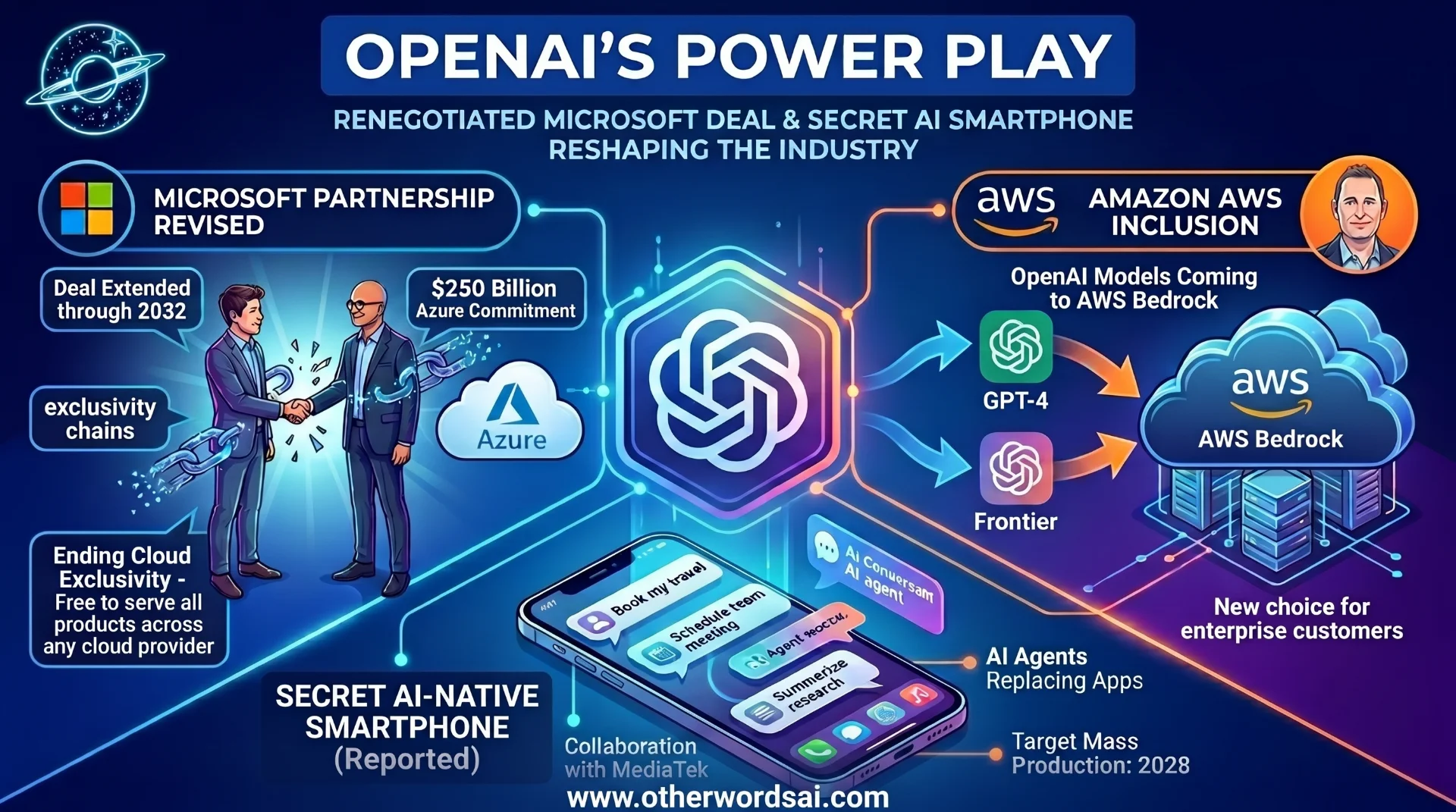
The most consequential development is a sweeping renegotiation of the partnership between Microsoft and OpenAI. What was once an open-ended, exclusive arrangement — one that gave Microsoft unrivaled access to all of OpenAI's products and intellectual property until the hypothetical moment of Artificial General Intelligence — has now been replaced with a clearly defined, time-limited agreement running through 2032.
Microsoft remains OpenAI's 'primary cloud partner,' and the two companies continue to deepen their commercial relationship. The new terms confirm that OpenAI products will ship 'first on Azure, unless Microsoft cannot and chooses not to support the necessary capabilities.' Azure will continue serving the bulk of OpenAI's cloud workloads, and OpenAI separately committed to purchasing an additional $250 billion worth of Microsoft Azure cloud services.
For Microsoft shareholders, that single line functions as a major reassurance. But the true significance of this renegotiation lies in what OpenAI has gained: the freedom to serve all its products across any cloud provider. This single change resolves what had quietly become one of the most legally precarious situations in Silicon Valley — OpenAI's $50 billion deal with Amazon.
"OpenAI can now serve all its products to customers across any cloud provider."
The Amazon Conflict: How a $50 Billion Deal Nearly Triggered a Lawsuit:
To understand why this Microsoft renegotiation matters so profoundly, one must revisit the messy sequence of events that began in February 2026. Amazon announced an investment of up to $50 billion in OpenAI — a staggering figure comprising a $15 billion initial commitment and an additional $35 billion tied to unspecified conditions.
In exchange, OpenAI made promises to Amazon that turned out to be legally incompatible with its existing Microsoft agreement. OpenAI committed to co-developing a 'stateful runtime technology' on AWS Bedrock — the infrastructure layer that powers AI agents capable of sustained memory and context. More critically, OpenAI agreed that AWS would hold exclusive rights to serve OpenAI's new agent-making tool, Frontier. That exclusivity clause collided head-on with Microsoft's prior contract, which gave Azure exclusive API access to all OpenAI products.
Microsoft responded swiftly and publicly, issuing a pointed statement the same day Amazon's deal was announced. The company emphasized that it maintained its exclusive license to OpenAI's IP and that 'Azure remains the exclusive cloud provider of stateless OpenAI APIs.' The Financial Times subsequently reported that Microsoft was actively weighing legal action to enforce its contractual rights — a lawsuit that would have been catastrophic for all parties involved in the AI ecosystem.
"Any stateless API calls to OpenAI models that result from a collaboration between OpenAI and any third party — including Amazon — would be hosted on Azure."
What Microsoft Gets in Return: Revenue Share and Shareholder Value:
Far from being a loss for Microsoft, the new agreement comes with meaningful financial benefits for the Windows giant. Under the revised terms, Microsoft is no longer required to pay a revenue share to OpenAI — a clause that had been quietly costing the company on each customer it served. Meanwhile, OpenAI will continue paying a revenue share to Microsoft through 2030, subject to a cap.
The financial upside for Microsoft is already visible in its quarterly results. Last quarter alone, Microsoft reported making $7.5 billion from its investment in OpenAI in a single quarter. Furthermore, Microsoft retains approximately 27% ownership in OpenAI's for-profit entity, meaning it financially benefits from every deal OpenAI strikes — including the ones on AWS.
Microsoft's growing relationship with Anthropic adds another dimension to the story. Even as OpenAI courts Microsoft's competitors, Microsoft has developed a close partnership with OpenAI rival Anthropic, using Claude AI to power its own agentic products. In an era of multi-cloud and multi-model strategies, these cross-investments are becoming the norm rather than the exception.
Amazon Celebrates: OpenAI Models Coming to AWS Bedrock:
Amazon CEO Andy Jassy wasted no time celebrating the Microsoft-OpenAI deal publicly. In a post on X, Jassy welcomed the agreement and confirmed that OpenAI's models would become available on AWS Bedrock — the managed AI service that allows enterprises to access foundation models from multiple providers.
For Amazon, this represents a major expansion of its AI model marketplace and a direct competitive challenge to Azure's AI dominance.
For enterprise customers, the implications are transformative. Organizations building on AWS infrastructure — long excluded from native OpenAI API access — will now be able to access OpenAI's GPT models, Frontier, and stateful agent technologies directly through Bedrock. This dramatically expands the competitive landscape for enterprise AI solutions and gives cloud buyers more negotiating power than ever before.
Timeline: The Rapid Evolution of the Microsoft-OpenAI Partnership:
Here is a condensed timeline of how this historic partnership has evolved:
-
October 2025: Microsoft and OpenAI renegotiate to allow OpenAI to run non-API products on other clouds, helping OpenAI fend off Elon Musk's lawsuit.
-
November 2025: OpenAI and Amazon sign a multi-year agreement for $38 billion in AWS cloud services.
-
February 2026: Amazon announces up to $50 billion in OpenAI investment; Microsoft publicly disputes the AWS-exclusive terms for Frontier and stateful tech.
-
March 2026: The Financial Times reports Microsoft is considering legal action to enforce its exclusive contract.
-
April 2026: Microsoft and OpenAI announce a revised deal with a 2032 end date, ending exclusivity and allowing OpenAI to serve all products on any cloud. Microsoft drops its revenue share obligations.
OpenAI's Secret Hardware Ambition: An AI-Native Smartphone:
Even as OpenAI resolves its cloud strategy, a separate and equally explosive development is taking shape in the hardware space. Industry analyst Ming-Chi Kuo — long known for his accurate reporting on Apple hardware plans — has released a note suggesting that OpenAI is developing a smartphone in collaboration with chip giants MediaTek and Qualcomm, with Luxshare serving as co-design and manufacturing partner.
The device would not be a conventional smartphone. Rather than relying on traditional app ecosystems controlled by Apple and Google, Kuo suggests the OpenAI phone would replace apps with AI agents — autonomous software entities capable of completing tasks end-to-end without user intervention. This vision aligns with broader predictions from tech visionaries: Nothing CEO Carl Pei declared at SXSW that apps will eventually disappear, replaced by AI-driven task execution.
The strategic logic behind a dedicated hardware device is compelling from a data perspective. An app running within Apple's iOS or Google's Android is fundamentally constrained in the system access it can obtain. By owning the hardware stack, OpenAI could access far richer contextual data about users' daily habits, enabling more personalized and capable AI assistance. Kuo notes the device would blend on-device AI models with cloud AI models to handle a wide spectrum of tasks efficiently.
"OpenAI would be able to use AI in all kinds of features without restrictions."
Specifications, Timeline, and What to Expect:
The OpenAI smartphone is still in its early stages, and a concrete launch remains years away. Kuo reports that final hardware specifications and component supplier selections are expected to be confirmed by the end of 2026 or in the first quarter of 2027, with mass production targeting 2028.
However, OpenAI's Chief Global Affairs Officer Chris Lehane has separately indicated that the company is on track to announce its first hardware product in the second half of 2026 — widely reported to be a pair of uniquely designed AI earbuds, suggesting a phased hardware rollout strategy.
With ChatGPT approaching one billion weekly active users, the commercial logic of a hardware play is undeniable. A daily-use device purpose-built for AI interaction would deepen OpenAI's relationship with consumers far beyond what a mobile app can achieve. It would also allow OpenAI to collect the kind of longitudinal, contextual behavioral data that could supercharge the next generation of its models.
What This Means for the AI Industry: Competition, Choice, and Cloud Strategy:
Taken together, these two developments signal a fundamental transformation in how AI companies are positioning themselves in the market. OpenAI is no longer simply a model provider dependent on a single cloud hyperscaler. It is rapidly becoming a vertically integrated AI platform company — one that competes at the cloud layer, the model layer, the software layer, and now the hardware layer simultaneously.
For enterprise IT leaders and cloud architects, the Microsoft-OpenAI-Amazon realignment opens up genuine multi-cloud AI strategies. Organizations can now access OpenAI's frontier models on their cloud of choice — whether Azure, AWS, or in the future, Google Cloud — without sacrificing access to the most capable AI systems available. This competitive dynamic is expected to drive down prices and accelerate innovation across the entire cloud AI stack.
For consumers, the prospect of an AI-native smartphone promises a fundamentally different relationship with technology. Rather than navigating a grid of apps, users could interact with a unified AI layer that understands context, executes multi-step tasks, and adapts to individual behavior over time. The question is whether consumers — and regulators — will embrace a device architecture that gives a single AI company unprecedented access to personal data.
Conclusion: OpenAI Is Playing to Win on Every Front:
From cloud infrastructure to consumer hardware, OpenAI is making calculated, aggressive moves to establish dominance at every layer of the AI value chain. The renegotiated Microsoft deal resolves a legal minefield while giving OpenAI the multi-cloud freedom it needs to compete at scale. The reported smartphone project — still years from launch — signals that OpenAI's ambitions extend far beyond software into the physical devices that billions of people use every day.
The biggest winners today are enterprises and consumers, who now have more choice, more competition, and more leverage than ever before. As Microsoft, Amazon, Google, and OpenAI compete ferociously to serve them, the pace of AI innovation is set to accelerate even further.
In this fast-moving landscape, staying informed about deals, partnerships, and hardware roadmaps is no longer optional — it is a competitive necessity.