
Amazon's AI Power Play: OpenAI Lands on AWS Bedrock While Amazon Reinvents the Shopping Experience:
A $50 Billion Power Play: Inside Amazon’s Massive Bet to Steal OpenAI from Microsoft:
In one remarkable week, Amazon redefined its role at the center of the artificial intelligence universe — not once, but twice. First, AWS Bedrock began offering OpenAI's most advanced models just hours after Microsoft lost its exclusive rights to the technology.
Then, Amazon launched a first-of-its-kind AI-powered audio shopping experience that lets customers hold real-time conversations with AI shopping experts directly from product pages. Together, these announcements signal that Amazon is not merely participating in the AI revolution — it is actively leading it.
The End of an Era — Microsoft Loses Its OpenAI Monopoly:
The Microsoft-OpenAI relationship, once considered the most powerful alliance in the tech industry, has been quietly crumbling. A revised agreement announced in late April 2026 officially ended Microsoft's exclusive rights to OpenAI's products — and the moment that news broke, Amazon was ready to pounce.
Amazon CEO Andy Jassy moved swiftly. Within hours of the Microsoft announcement, Jassy posted on X calling it a
"...a very interesting announcement." — Andy Jassy, Amazon CEO.
It was understated, deliberate, and perfectly timed. By Tuesday, AWS had officially launched full OpenAI model support on its Bedrock platform — making Amazon one of the fastest movers in capitalizing on OpenAI's newly liberated distribution rights.
What Just Landed on AWS Bedrock — OpenAI's Full Lineup:
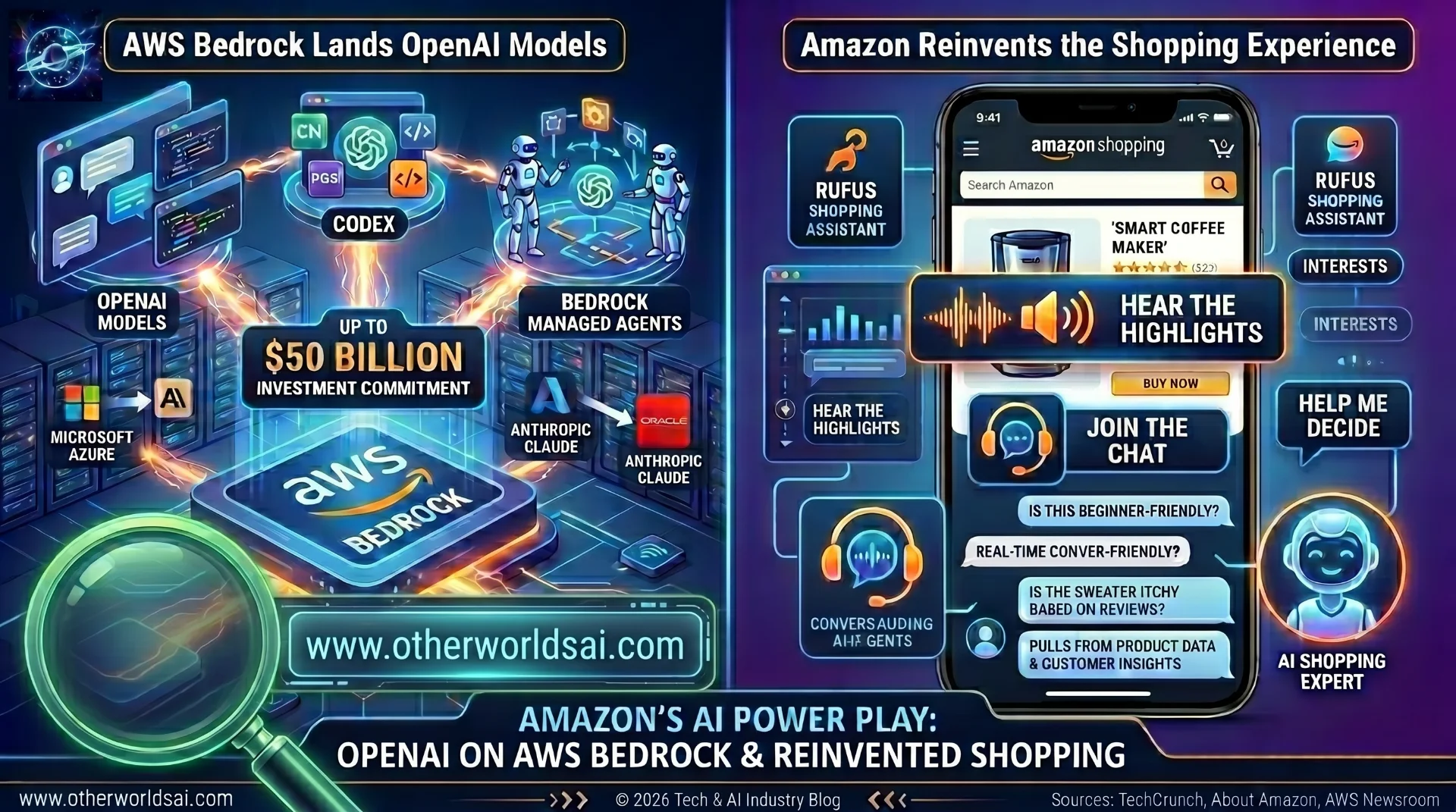
AWS Bedrock — Amazon's fully managed AI platform for building and deploying AI-powered applications — is now home to OpenAI's most powerful tools. The newly available capabilities include:
-
OpenAI's Latest LLMs: The most advanced large language models, now available for enterprise and developer use through Bedrock.
-
Codex: OpenAI's AI-powered code generation service, enabling developers to write, debug, and accelerate software development at scale.
-
Bedrock Managed Agents: A brand-new platform purpose-built for creating OpenAI-powered AI agents with enterprise-grade features.
Bedrock Managed Agents is the most significant of these launches. Specifically designed to leverage OpenAI's reasoning models, it offers advanced features including agent steering, workflow orchestration, and robust security controls — everything a modern enterprise needs to deploy autonomous AI agents at scale.
"This is the beginning of a deeper collaboration between AWS and OpenAI." — Amazon That promise of a deeper collaboration is backed by real money. The OpenAI-Amazon relationship is anchored by a staggering up-to-$50 billion investment commitment — one of the largest private funding arrangements in history — making this partnership far more than a cloud hosting deal.
The Great AI Alliance Shuffle — Microsoft Moves to Anthropic, OpenAI Moves to AWS:
The tech landscape is undergoing a dramatic realignment of loyalties. As OpenAI deepens its relationship with AWS and Oracle, Microsoft — long considered OpenAI's most committed backer — has been forging its own path with Anthropic, the AI safety company behind Claude.
Microsoft is now building a new AI agent offering powered by Claude, further cementing the reversal of allegiances that would have seemed unthinkable just two years ago. Each of the world's most powerful tech companies is finding comfort in the arms of their former partner's biggest rival.
For businesses and developers, this reshuffling creates both opportunity and uncertainty. AWS, Microsoft Azure, and Google Cloud are all aggressively competing to become the dominant platform for AI model deployment — and with OpenAI now available on Bedrock, Amazon has just gained a decisive competitive edge.
Amazon Reinvents Online Shopping — Introducing "Hear the Highlights":
On the same day that the OpenAI-Bedrock deal went live, Amazon launched something equally transformative on the consumer side: an AI-powered audio shopping experience that fundamentally changes how customers interact with product pages.
"Hear the Highlights" delivers short, intelligent audio summaries on millions of product listings directly within the Amazon Shopping app. Customers simply tap the "Hear the Highlights" button beneath a product image to receive a concise, AI-generated overview covering key features, customer feedback, and relevant product details — saving the time typically spent scrolling through lengthy descriptions and reviews.
"Join the Chat" — Where Conversational AI Meets Shopping:
The real breakthrough, however, is "Join the Chat" — the interactive layer built on top of the audio experience. Once a customer begins listening to a product summary, they can tap the "Join the Chat" icon to ask specific questions via text or voice, receiving real-time conversational responses from what Amazon calls "AI-powered shopping experts."
The experience is designed to mirror speaking with a knowledgeable in-store associate. Whether a customer wants to know if a coffee maker is beginner-friendly, or whether a sweater tends to feel itchy based on customer reviews, the AI pulls together product data and real customer insights to deliver precise, relevant answers.
"Customers can ask questions and actually steer where the conversation goes. Every question they ask influences what comes next, making the experience a conversation customers can join and customize." — Amazon
Critically, the AI never repeats itself. Each response builds on the previous exchange, creating a genuinely dynamic and personalized dialogue — not a static FAQ. And the audio continues playing even as users browse other products, ensuring a seamless, uninterrupted experience.
Amazon's Full AI Shopping Ecosystem — A Look at the Bigger Picture:
"Hear the Highlights" and "Join the Chat" are not standalone experiments — they are the latest additions to a rapidly growing lineup of AI-powered shopping tools that Amazon has been building over the past year. Together, these tools form a comprehensive AI shopping ecosystem:
• - Rufus: Amazon's generative AI shopping assistant that helps customers research products, compare options, and make informed decisions. Rufus notably drove record sales on Black Friday 2025.

Anthropic’s Surprise Double Launch Directly Targets OpenAI and Google’s AI Dominance
• - Interests: A personalized AI feature that continuously tracks user preferences and automatically surfaces new items aligned with each shopper's unique tastes.
Support our research
Independent analysis fueled by you.
• - "Help Me Decide": An AI-powered recommendation tool that analyzes a user's search history, browsing behavior, and purchase patterns to suggest the most relevant products.
• - "Hear the Highlights" + "Join the Chat": The newest additions — bringing real-time, conversational AI directly into the product discovery experience.
The pattern is clear: Amazon is systematically replacing passive, text-based product browsing with active, AI-guided conversations — transforming the shopping journey from a solo activity into an assisted, personalized experience.
What This All Means — The Bigger Implications for AI and E-Commerce:
Amazon's twin announcements reveal a company operating on two powerful fronts simultaneously — infrastructure and consumer experience — and excelling at both.
On the cloud infrastructure side, AWS Bedrock is rapidly evolving into a true multi-model AI marketplace. With OpenAI models now joining the roster alongside other foundation models, Bedrock gives developers and enterprises the broadest possible choice when building AI applications — without locking them into any single provider.
On the consumer experience side, Amazon's AI shopping tools demonstrate how generative AI can move beyond novelty to become genuinely useful — helping real customers make better decisions faster, in a format that feels natural and human.
Perhaps most importantly, the OpenAI-AWS deal reinforces a broader truth about the AI industry: alliances are fluid, exclusivity is fragile, and the companies that move fastest when windows open are the ones that will define the next decade of technology.
Amazon is no longer just a cloud provider or a retailer. It is becoming the operating system of the AI economy.