
Chen Mei — February 6, 2026
The industry's focal point has shifted. For the last three years, we have been obsessed with "Generative" AI—the ability for a machine to produce text, code, or pixels. But with the release of Claude Opus 4.6, Anthropic has signaled the end of the generative era and the birth of the Autonomous Agency era.
This isn't an incremental dot-release. It is a pivot. As we analyze the telemetry from the launch week, we are moving from predictive text to Long Horizon Autonomy. We are witnessing the birth of Labor as a Service (LaaS).
I. The "Completely Vertical" Line: Agentic Autonomy
The most striking visual from the Anthropic release wasn't the model's chat UI; it was a log-scale graph of Autonomy Time Horizons. For years, LLMs were characterized by their "burstiness"—they could solve a discrete task in seconds but would fall apart if asked to manage a project for an hour.
Opus 4.6 marks the moment that line went vertical.
The Time Horizon Breakthrough
Autonomy is the new benchmark. Specifically, Opus 4.6 is designed to sustain agentic tasks for longer time horizons, operating reliably in massive codebases and catch its own mistakes through refined self-review. We are seeing models like GPT 5.2 and now Opus 4.6 hitting thresholds of 8.2+ hours of autonomous, successful execution.
This is the end of the "Chat-and-Wait" workflow. We are moving toward "Specify-and-Review."
The Vertical Climb: Autonomous Success Horizons
Chart data for "The Vertical Climb: Autonomous Success Horizons": Opus 4.1: 0.15 h; Opus 4.5: 1.2 h; GPT 5.2: 6.5 h; Opus 4.6: 8.2 h.
II. The 1 Million Token Moat: Decoding the Beta of Infinity
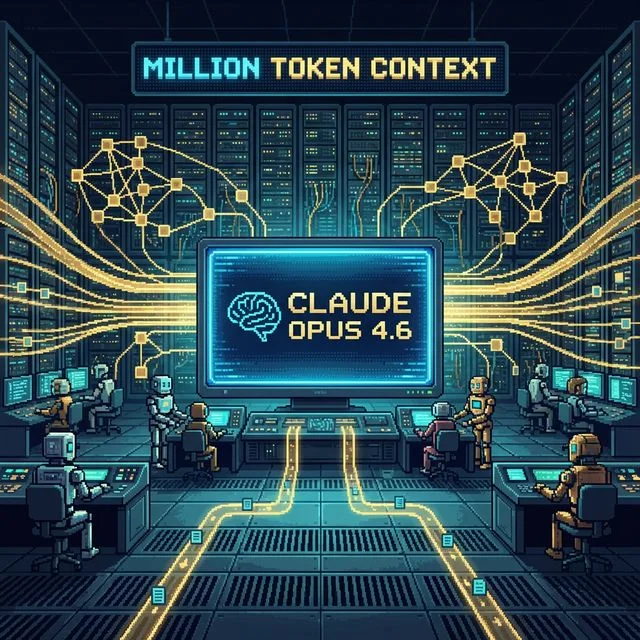
Until today, Google’s Gemini stood alone in the "Million Token" club. Anthropic’s entry into this tier is a watershed moment for AI Implementation in the enterprise. While the industry average has hovered around 200K, Opus 4.6’s 1 million token context window (currently in beta) changes the fundamental unit of work.
The Geometry of Logic at Scale
Historically, expanding context windows led to a "Dilution of Intelligence." A model would lose track of a variable defined on page 5 by the time it reached page 5,000. Opus 4.6 employs a new attention mechanism that Anthropic describes as "tracking information over hundreds of thousands of tokens with less drift."
In the Needle in a Haystack (MRC V2.8) evals, Opus 4.6 maintained a staggering 93% accuracy at 256K tokens and held 76% at the full 1 million mark. This isn't just a retrieval feat; it’s a reasoning feat. By keeping the entire context available without "context rot," Opus 4.6 can identify "buried details" that even the highly capable Opus 4.5 would miss. Unlike typical LLM gains that "plateau" at the top of the curve, Opus 4.6 shows an upward inflection, suggesting that Anthropic has unlocked a new scaling law for high-token knowledge retrieval.
Humanity's Last Exam: The AGI Frontier
To test the extreme edges of reasoning, we look to Humanity's Last Exam (HLE)—a benchmark designed by leading AI researchers to be unsolvable by models through simple pattern matching or data contamination. It requires genuine multi-hop synthesis.
Humanity's Last Exam: Multi-Hop Reasoning
Chart data for "Humanity's Last Exam: Multi-Hop Reasoning": Physics: 21, 42; Economics: 28, 51; Bio-Ethics: 19, 38; Logic: 32, 59.
The fact that Opus 4.6 is nearing 60% on complex logic puzzles that stump many postgraduate humans is the clearest indicator yet that we are exiting the "Stochastic Parrot" era and entering the era of the "Digital Expert."
The Coding Inflection Point
For a developer, this is the difference between "sampling the codebase" and "the AI is the codebase." It allows for:
- Global Code Review: Highlighting architectural inconsistencies across thousands of files simultaneously.
- Legacy Refactoring: Ingesting an entire monolithic 1990s codebase and rewriting it into modern microservices in a single session.
- Zero-Shot Documentation: Generating a 500-page technical manual by "reading" the entire repository and understanding the hidden intent behind the logic.
Agentic Coding: SWE-bench Verified (Opus 4.6)
Chart data for "Agentic Coding: SWE-bench Verified (Opus 4.6)": Opus 4.5: 42; GPT 5.2: 61; Gemini 3 Pro: 58; Opus 4.6: 72.
III. The SAS Apocalypse: When Software Becomes Labor
On the day of the Opus 4.6 release, the tech sector experienced what is now being called the SAS Apocalypse. $300 billion in market capitalization evaporated from the world's leading Software-as-a-Service companies. The catalyst? Anthropic’s release of plugins for Claude Co-work.
From SaaS to LaaS (Labor as a Service)
Software historically acted as a tool that helped a human do labor. You used Salesforce to manage leads; you used Excel to crunch numbers. But when Claude can enter Microsoft Excel, navigate a PowerPoint deck, or orchestrate a complex financial audit autonomously, the "Software" part becomes invisible. The product is no longer the dashboard; the product is the Result.
We are transitioning from SaaS to LaaS (Labor as a Service). The value has migrated from the interface to the inference.
The Displacement of Middle Management
If an AI agent can coordinate with other agents (via Agent Teams) to complete a project—assigning tasks, synthesizing results, and debugging its own mistakes—what happens to the "coordinator" class of employees? The SAS Apocalypse wasn't just about stock prices; it was the market's realization that the Orchestration Layer of business is being automated.
Box AI Evals: Complex Work Reasoning
Chart data for "Box AI Evals: Complex Work Reasoning": Report Draft: 36, 75; Due Diligence: 45, 51; Public Sector: 68, 75; Life Sciences: 39, 64; Legal Case: 45, 51.
Move Over Nvidia: Anthropic and Samsung Team Up to Break the AI Chip Monopoly
IV. Agent Teams: The Orchestration of Swarms
One of the most misunderstood features of Opus 4.6 is Agent Teams. This is not just a "sub-agent" feature. It is a new architecture for Agentic AI.
Sub-Agents vs. Agent Teams: A Technical Divorce
In a standard sub-agent model, one "Lead" spawns children who report back to the parent. The child has no independence. In Agent Teams, you are spinning up multiple fully independent Claude instances, each with its own context window, that can communicate directly with each other and you.
- Parallel Exploration: One agent reviews a new feature, another researches the legacy dependency, and a third runs a debugging hypothesis.
- Cross-Layer Coordination: One agent handles the frontend logic while another manages the database schema, with a "Team Lead" session synthesizing the integration.
The Cost of Autonomy
Note that this architectural shift is computationally expensive—or as the launch transcript bluntly puts it: "GPU go burr." Anthropic is transparent about the "token tax" of Agent Teams. However, the ROI of AI here is the elimination of the sequential bottleneck. What took 30 minutes in a chatbot now takes 5 minutes in a swarm.
V. Inference Elasticity: Adaptive Thinking and "Slash Effort"
In a major UX breakthrough, Anthropic introduced Adaptive Thinking. The model can now dynamically adjust its "thinking time" based on the complexity of the task.
Support our research
Independent analysis fueled by you.
The Depth vs. Speed Dial
Historically, models were one-speed. Whether you asked for a "Hello World" or a proof of the Riemann Hypothesis, the model used roughly the same amount of computation per token. Not anymore.
Users can now use a /effort flag to explicitly control the balance between intelligence, speed, and cost.
- High Effort: Reserved for "Move 37" style reasoning—root cause analysis, multi-layered debugging, and philosophical synthesis.
- Low Effort: Optimized for speed and cost-efficiency in simpler data-munging tasks.
The Intelligence Flywheel
By giving the user—and the AI—control over its own "brain cycles," Anthropic is maximizing the Intelligence Flywheel. The model "thinks more deeply and more carefully, revisits its reasoning before settling on an answer." This produces better results on harder problems, but avoids the "token bloat" that previously plagued high-overhead models.
VI. Benchmarking the King: Reality vs. The Lab
When we look at the hard data, Opus 4.6 isn't just winning—it's creating a new bracket.
GD Val and The Knowledge Peak
In GD Val (Knowledge Work), Opus 4.6 achieved an ELO of 1666, a 200-point jump over its predecessor. To put this in perspective, Google’s Gemini 3 Pro sits at 1195. We are seeing a divergence where Anthropic's "Opus" class is outperforming the flagship models of trillion-dollar tech giants.
Industry Standard: GD Val Knowledge ELO
Chart data for "Industry Standard: GD Val Knowledge ELO": Gemini 3 Pro: 1195 ; GPT 5.2: 1462 ; Opus 4.5: 1466 ; Opus 4.6: 1666 .
The Vending Bench: Economic Mastery
The most telling stat is Vending Bench, where models are tasked with managing a literal vending machine to maximize profit. This involves inventory management, predictive demand analysis, and dynamic pricing.
- Opus 4.5: $5,000 Profit
- GPT 5.2: $3,500 Profit
- Opus 4.6: $8,000 Profit
This isn't about being "good at talking." It's about being "good at winning." Opus 4.6 demonstrates an economic intuition that suggests it can handle direct, unguided business logic better than any human-written algorithm.
VII. The "Fenic" Shadow: Preparing for Sonnet 5
While we celebrate the Opus 4.6 milestone, the industry is already looking at the "leaked" internal project known as Fenic—Claude Sonnet 5. Rumors suggest Sonnet 5 will be "better than Opus 4.5 while being 50% cheaper and significantly faster."
If Opus 4.6 is the "Cerebral Giant," Sonnet 5 is the "Speed Demon." The coordination between these two models—Opus for the heavy architectural "thinking" and Sonnet for the high-speed "execution"—will form the binary star system of future AI startups.
VIII. Managing the Transition: Why Microsoft is Terrified
Substantial upgrades to Claude in Excel and the release of Claude in PowerPoint (research preview) highlight a direct territorial invasion. Anthropic isn't building another "Office Suite." They are building the intelligent layer that runs inside their competitors' tools.
Microsoft, for all its Copilot investment, is now facing a model that performs "Agentic Search" (Browse Comp benchmark score of 84—a 20-point jump) and "Terminal Tasks" (65.4% success) with a reliability that makes old RAG systems look like toys.
Capability Comparison: Multi-Agent Efficiency
Chart data for "Capability Comparison: Multi-Agent Efficiency": Agentic Search: 84, 78; Terminal Reasoning: 65, 65; Multi-Agent Coordination: 92, 75; Autonomy Horizon: 88, 72.
Anthropic vs OpenAI: Which AI is Better at Controlling Your Desktop?
IX. Practical Strategy: How to Deploy Opus 4.6 Today
Deploying a model this powerful requires a shift in engineering philosophy. You cannot treat Opus 4.6 as a "faster 3.5." You must treat it as a Managing Director.
- Leverage Agent Teams for Research: Don't just ask for a report. Spawn a team where one agent finds the data, another fact-checks it against the 1M token context, and a third synthesizes the final brief.
- Utilize Slash Effort: For routine API integrations, stick to low effort. For architectural refactors, go high.
- Prompt for Labor, not Completion: Instead of "write this function," use "own this repository's security posture and patch any vulnerabilities you find over the next 4 hours."
Conclusion: The Post-Software Strategy
As the final whistle blows on the era of SaaS, we must realize that we aren't just losing software; we are gaining an entire workforce. Opus 4.6 is the first true "Employee model." It manages teams, catches its own bugs, maximizes profit in simulated economies, and reasons across a million tokens.
The scoreboard is changing. For business leaders, the strategy is no longer about which software to buy, but which Labor Swarms to deploy. Welcome to the era of the Intelligent Bowl, played not on a field of grass, but in the infinite landscape of silicon context.