
Inside the Breakup: Why Perplexity AI is Walking Away from its Massive Snapchat Deal:
Snap and Perplexity's $400M AI Deal Is Over — What Went Wrong and What It Means for AI Partnerships:
One of the most high-profile AI integration deals in social media history has quietly collapsed. Here's what happened, what Snap's Q1 2026 earnings reveal, and what this means for the future of AI-powered search partnerships.
The Breakup: Snap Confirms End of Perplexity Partnership:
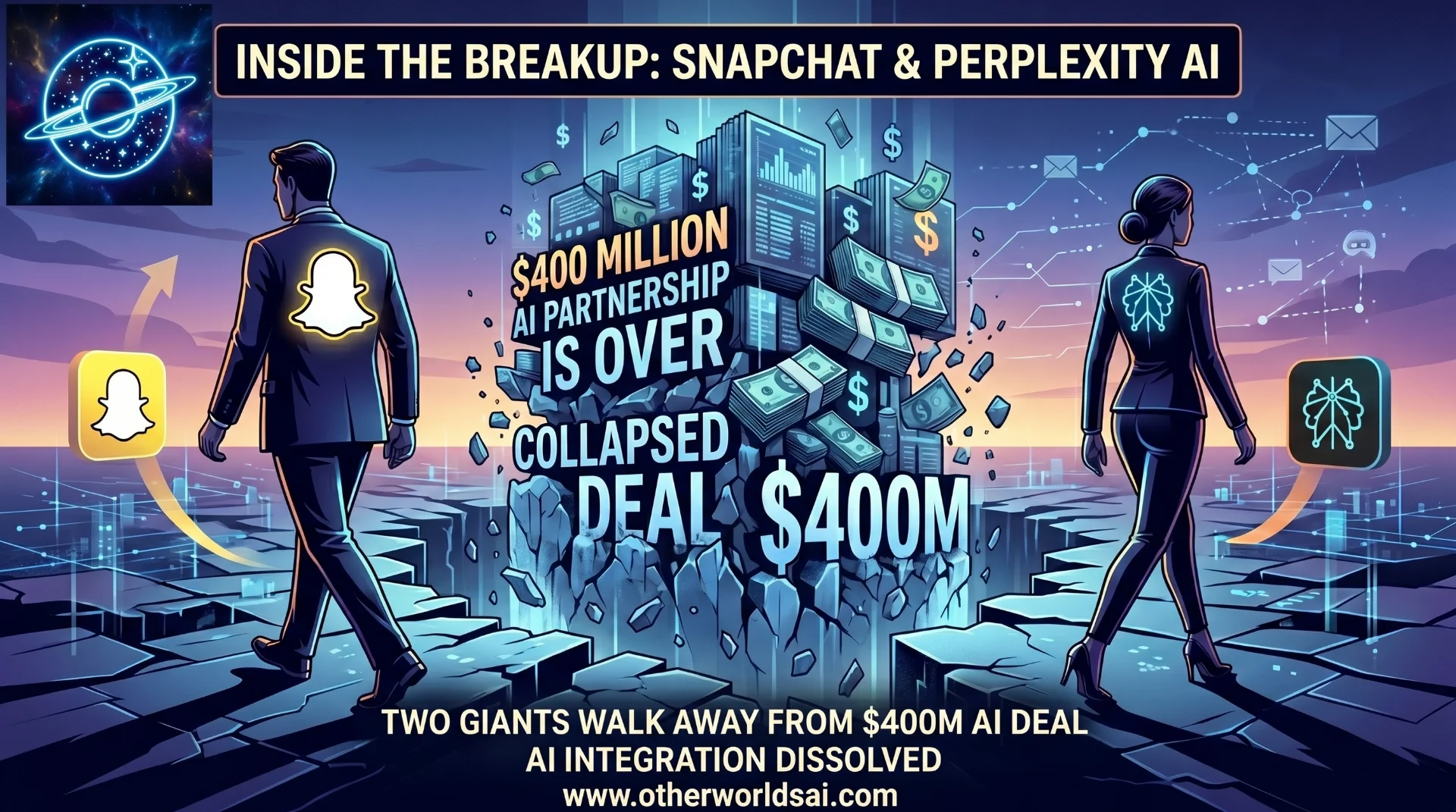
One of the most anticipated AI integrations in social media is officially off the table. Snap confirmed in its Q1 2026 earnings report that its partnership with Perplexity AI has come to an end. The two companies, in Snap's own measured language, "amicably ended the relationship in Q1" — a quiet conclusion to a deal that, just six months ago, was being heralded as a landmark moment for AI-powered search inside social platforms.
The financial stakes were significant. Under the original agreement announced in November 2025, Perplexity was set to pay Snap $400 million in cash and equity over one year in exchange for having its conversational AI search engine integrated directly into Snapchat's Chat interface.
Snap's current sales guidance, it confirmed this week, now "assumes no contribution from Perplexity" — a meaningful gap given that Snap had told investors the partnership would begin contributing to its financials in 2026.
Perplexity did not respond to requests for comment. The silence from one of AI's fastest-growing startups speaks to the sensitivity of the situation — and leaves open the question of who ultimately walked away, and why.
What the Deal Was: AI Search Inside Snapchat:
When Snap first announced the Perplexity partnership alongside its Q3 2025 earnings, it was positioned as a bold bet on the future of AI-enhanced discovery. The vision was straightforward but ambitious: Perplexity's conversational AI search engine would be embedded directly into Snapchat's "Chat" interface, giving Snapchat's nearly one billion users the ability to ask questions and receive intelligent, conversational answers without leaving the app.
CEO Evan Spiegel framed it as a natural extension of Snap's core identity. At the time of the announcement, Spiegel said the deal reflected Snap's vision to use AI to enhance discovery on the platform, adding that the company looked forward to "collaborating with more innovative partners in the future." The language was forward-looking, optimistic — and, in hindsight, notably hedged.
Limited testing did take place. Perplexity's integration was rolled out to select Snapchat users, with documentation even appearing briefly on Snap's help center. But the pilot never progressed to a broader rollout, and the warning signs were visible as early as February 2026, when Snap disclosed in its Q4 2025 earnings that the two companies had "yet to mutually agree on a path to a broader roll out." Three months later, the deal was gone entirely.
Snap's Q1 2026 Earnings: Growth Amid Disruption:
Despite the high-profile partnership collapse, Snap's Q1 2026 earnings painted a more resilient picture than many expected. The company reported that Snapchat's global daily active users (DAU) rose 5% year-over-year to 483 million, while monthly active users (MAU) also grew 5% to reach 965 million.
Growth was attributed to new features across the platform, including Snap Map and its Lenses augmented reality (AR) filters — two products that have become increasingly central to Snap's engagement strategy.
Spiegel struck an optimistic tone in his earnings statement. "In Q1, we returned to growth in daily active users, accelerated revenue growth, expanded margins, and generated strong free cash flow," he said, adding that the company remains focused on disciplined execution and its long-term opportunity in intelligent eyewear — specifically Snap Specs — with more announcements expected at AWE on June 16th.
The user growth numbers are encouraging, but the loss of $400 million in expected revenue is not a trivial footnote. For a company that has long faced questions about its long-term monetization strategy, the collapse of one of its most commercially significant AI deals adds a layer of uncertainty to an otherwise improving quarter.
Snap's AI Layoffs: Cutting Workforce While Betting on Technology:
The Perplexity news lands in the context of broader, painful changes at Snap. In April 2026, the company announced it was laying off roughly 16% of its global workforce — approximately 1,000 full-time employees. The reason cited was telling: advancements in AI are enabling the company to do more with fewer people. It is, in other words, the same technology Snap was trying to integrate from Perplexity that is now being used to justify cutting the humans who build and maintain the platform.
This tension — AI as both a partnership opportunity and a cost-cutting tool — reflects a broader dynamic playing out across the tech industry. Companies are simultaneously racing to embed AI into their products and using AI's productivity gains as justification for reducing headcount. For Snap, both are happening at once, making the Q1 2026 period one of the most consequential in the company's history.
What This Means for AI Search and Social Media Partnerships:
The Snap-Perplexity collapse raises important questions about the viability of AI search integrations inside social platforms. The model — paying a social platform for access to its user base in exchange for embedded AI functionality — sounded compelling on paper.
In practice, it appears that the two companies could not agree on how to scale the product beyond a limited pilot, and the commercial logic that made the deal attractive in late 2025 didn't survive contact with the operational realities of 2026.\
For Perplexity, the end of the Snap deal is a notable setback, but not necessarily a fatal one. The company has been aggressively expanding its AI agent capabilities — including Perplexity Computer, its autonomous digital worker product — and has positioned itself as far more than a search engine. The $400 million it would have paid Snap represents a significant capital allocation that can now presumably be directed elsewhere.
For Snap, the question is what comes next in its AI strategy. Spiegel's reference to Snap Specs and intelligent eyewear at AWE hints at where the company believes its AI future really lies — not in embedding third-party search into a chat interface, but in building an entirely new hardware-software platform where AI is native from the ground up. That is a far longer and riskier road than a partnership deal. But it may also be a more defensible one.
Conclusion: A $400M Lesson in AI Partnership Complexity:
The Snap-Perplexity deal was, for a brief moment, a symbol of what AI-powered social media could look like. A nimble AI search startup plugging directly into one of the world's largest youth-facing social platforms, with nearly a billion users and a real-time communication channel perfectly suited for conversational AI. The vision was coherent. The execution, apparently, was not.
The episode is a reminder that in the AI economy, signing a deal and delivering a product are two very different things. As AI companies rush to embed their technology into established platforms, the real challenge isn't commercial negotiation — it's product alignment, user experience design, and the patient work of finding mutual agreement on what "broader rollout" actually looks like.
Snap and Perplexity couldn't get there. The next AI partnership to try will need to learn from that.