
Pit AI: The Stockholm Enterprise AI Startup Backed by a16z That's Redefining Business Automation:
Stockholm Rising: Why Global Investors are Flocking to the Swedish AI Scene:
Founded by Voi co-founders and powered by a $16M seed round from Andreessen Horowitz, Pit is building the AI product team enterprises never knew they needed — and doing it straight out of one of Europe's most exciting startup cities.
The New Enterprise AI Startup Everyone Is Talking About:
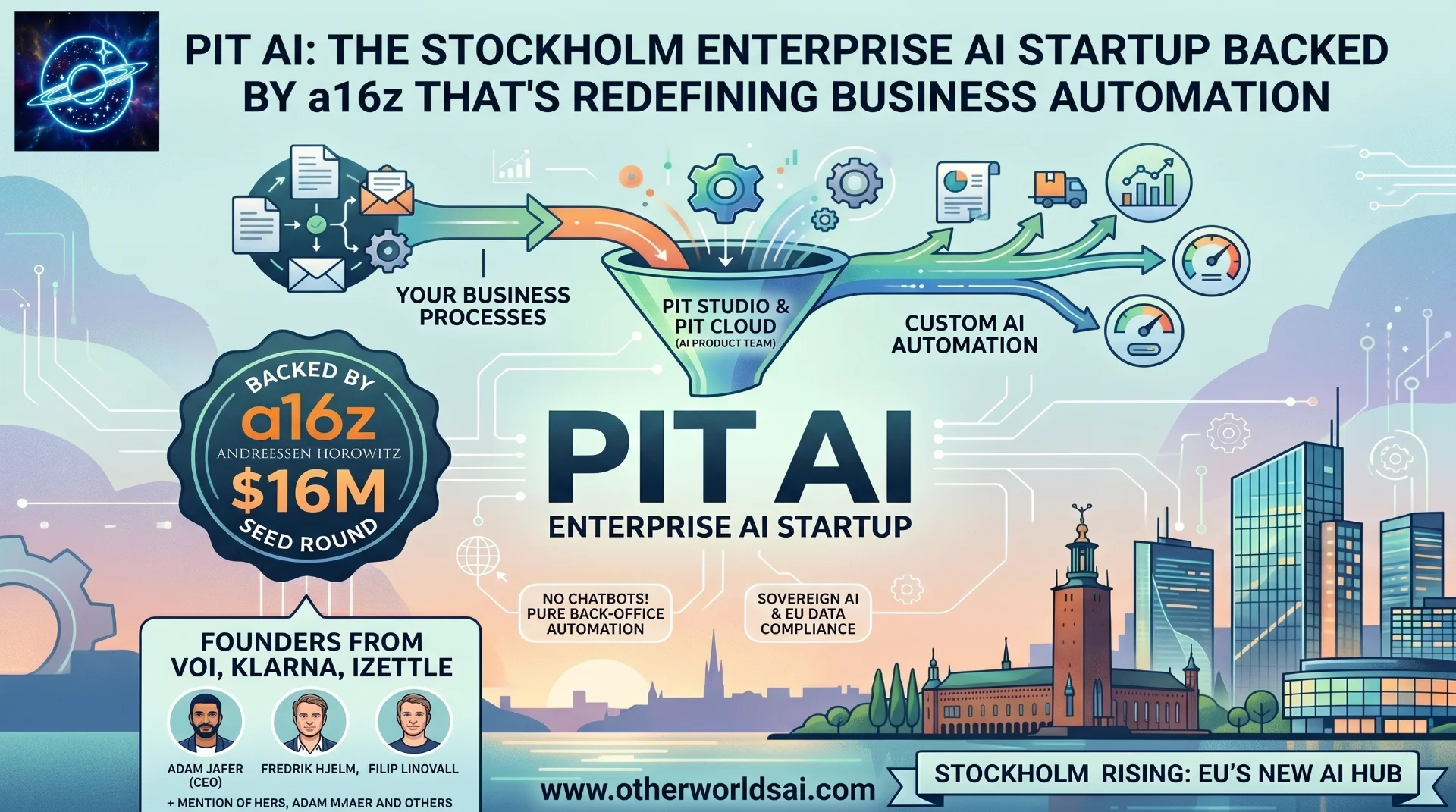
Stockholm has quietly become one of Europe's most powerful launchpads for AI companies, and Pit — the bold new venture founded by the co-creators of scooter giant Voi — is the latest proof of that. With a freshly closed $16 million seed round led by Andreessen Horowitz (a16z), Pit has arrived on the global stage with a clear mission: to give enterprises their own AI product team, without the cost and complexity of building one from scratch.
What makes Pit different isn't just the headline-grabbing funding or the famous backers. It's the fact that the company has built a product philosophy that rejects the one-size-fits-all approach of most enterprise AI tools. Instead, Pit learns how each client's business actually runs — and then builds custom AI-powered software to automate their specific internal processes. Whether you're tracking the rise of AI automation startups, watching the European tech scene, or looking for the next unicorn out of the Nordics, Pit is a name you need to know.
The Founding Team — Voi's Co-Founders Reunite for a Bigger Bet:
Every great startup has an origin story, and Pit's is one of reunification. Three of Voi's four original co-founders — Adam Jafer, Fredrik Hjelm, and Filip Lindvall — have come together to build something entirely new. They are joined by Andreas Hjelm, Fredrik's brother and an engineer at Pit, alongside seasoned engineers from two of Europe's most celebrated fintech companies: iZettle and Klarna.
Adam Jafer, now Pit's CEO, spent seven years at Voi, scaling the company from startup to a 1,000-person operation active in 13 countries. It was during this journey that he had the insight that would eventually become Pit. As AI models evolved from simple text generators into genuinely agentic systems capable of executing real-world tasks, Jafer saw that the opportunity wasn't just internal to Voi — it was universal.
"The aha moment for the bigger opportunity was when the models were no longer just chatbots that generate text, but became more agentic and could do things." — Adam Jafer, CEO of Pit
Fredrik Hjelm, meanwhile, continues as Voi's CEO — a role he is not stepping away from. But as a co-founder and well-connected entrepreneur, his involvement with Pit is already proving decisive. It was his long-standing relationship with the a16z team — built during their visits to Stockholm to scout European tech — that opened the door to what became Pit's landmark seed round.
The a16z Investment — Why Andreessen Horowitz Is Betting on Stockholm:
$16 million. Led by a16z. Closed without a lengthy fundraising process. That is the headline — but the story behind it is even more telling.
Pit's seed round is led by a16z partners Alex Rampell and Gabriel Vasquez, with co-investment from Lakestar, executives from major American technology companies, Nordic family offices, and Pit's own founders. The transatlantic composition of this cap table is a powerful signal: global investors are paying serious attention to what is happening in Stockholm.
According to Jafer, Pit didn't spend much time pitching other firms. The founders knew who they wanted as partners, and the feeling was mutual. Fredrik Hjelm has explained publicly that the relationship with a16z — including Ben Horowitz, Gabriel Vasquez, and Jen Kha — was built over years, not months. When the time came to raise, they picked each other.
Stockholm is already home to Lovable, another AI startup that has attracted a16z's attention, and Pit deepens the case that Sweden's capital is cementing itself as one of the premier AI startup ecosystems in Europe. For a16z, which has been actively hunting for the next European unicorn, the investment in Pit is a statement of conviction in both the company and the city.
The Product — An AI Product Team as a Service:
Pit's core proposition is deliberately different from the flood of AI agent builders and vibe-coding platforms that have crowded the market. Rather than giving enterprises a toolkit and wishing them luck, Pit positions itself as an end-to-end AI product team — a service that handles everything from process discovery to software delivery.
The product strategy is built on two complementary pillars: Pit Studio and Pit Cloud, working together to take a business from workflow documentation to fully automated, governance-ready software.
-
Pit Studio: The collaboration interface where enterprise employees walk Pit through their internal workflows. The system listens, learns, and identifies what can be automated — then builds custom AI software to handle exactly those tasks.
-
Pit Cloud: The infrastructure layer that delivers those AI-generated applications with the governance, security certifications, and auditability that large enterprises require. This is the piece that separates Pit from consumer-grade AI tools — it is built for CIOs, not just early adopters.
What Pit is not building is customer-facing AI or conversational chatbots. The focus is entirely on back-office and internal operations — the repetitive, process-heavy functions that consume enormous amounts of employee time without adding strategic value. As Jafer put it directly:
"Nothing customer facing, no conversational AI, just pure back-office, service, and support functions that we turn into automations so that you can give back time to people to focus on your core business." — Adam Jafer, CEO of Pit
Target Market — Industrials, Enterprise, and the Back-Office Revolution:
Pit began testing its model in January with pilot customers across telecom, healthcare, and logistics, focusing exclusively on automating internal processes. The early results validated the commercial approach, and the company is now moving into full-scale commercial deployment.
The company is going after the large enterprise segment — a market that demands outcomes, not promises. To meet this demand, Pit is hiring forward-deployed solution engineers who embed directly with client teams, driving adoption from the inside. This mirrors a broader trend among serious enterprise AI companies that recognize technology alone is not enough — successful deployment requires human expertise alongside the software.
"They're looking to buy outcomes. They want processes to go faster. They want to see productivity unlock and time unlock." — Adam Jafer
Pit's success metrics go beyond simple cost savings. While time and money efficiency are tracked, the company also measures quality of work improvements — including reductions in human error. The framing is important: Pit is not pitching itself as a job-cutting tool. The promise to enterprise buyers is about moving people upstream — freeing workers from repetitive back-office tasks so they can focus on higher-value, more strategic work.
The European Advantage — Sovereign AI and Model-Agnostic Architecture:
Pit's European identity isn't just a story — it's a commercial advantage. As EU enterprises face growing pressure to keep sensitive data on European infrastructure, and as regulators push for transparency and accountability in AI systems, Pit's model-agnostic architecture positions it uniquely well. The company can deploy using whichever AI and cloud vendors best suit a client's needs — including EU-based models running on EU-based compute.
"EU models running on EU compute is top of mind for almost every CIO we're meeting." — Adam Jafer
This is not a niche concern — it is rapidly becoming a baseline requirement for enterprise AI procurement across critical sectors including healthcare, finance, defence, and public infrastructure. Pit's flexibility on the infrastructure layer means it can serve clients with the most stringent data sovereignty requirements without compromising on capability.
Geographically, Europe's industrial heartland is Pit's natural hunting ground. "We're going after industrials, and there's plenty of that in Europe," Jafer noted. The combination of deep process complexity, high labour costs, and a culture of operational precision makes European industrials an ideal early market for the kind of high-quality, auditable automation Pit is building.
Controversy and Candor — The Posts That Sparked a Conversation:
Not everything about Pit's early days has been smooth. A LinkedIn post by Jafer declaring that Pit's team had no junior engineers — because AI agents now handle what juniors used to do — went viral for all the wrong reasons. The backlash was swift, and Jafer has since stepped back from the claim. "It may have started like that, but you need a good mix as you scale," he acknowledged with candour.
Separately, a post by Hjelm on X referencing the founding team as "tech bros from Voi and Klarna" drew attention to questions about gender diversity at the company. Hjelm quickly added that women were part of the team — a clarification that wasn't immediately obvious from the company's public profiles at the time. Pit has since spoken publicly about having women in communications and other roles, and the founding team has acknowledged the need to continue building a more diverse organisation as it grows.
These episodes reflect the growing pains of a startup moving fast in a spotlightely-filled environment.** For Pit,** they also signal an important maturation: the company is learning that the narrative it tells publicly matters as much as the product it ships privatThese episodes reflect the growing pains of a startup moving fast in a spotlightely.
Stockholm Rising — Why This City Is Producing Europe's Next AI Champions:
The rise of Pit is inseparable from the rise of Stockholm as a world-class tech hub. Home to global giants like Spotify and Klarna, and now an emerging powerhouse for AI-native companies, the Swedish capital is drawing the attention of the world's top investors. a16z has made multiple bets in the city. Lovable has become a global AI sensation. And now Pit is adding its name to a list that is growing longer every year.
What makes Stockholm so fertile for startups like Pit is a combination of rare factors: a deep pool of world-class engineering talent, a culture of bold ambition paired with operational discipline, strong government support for tech entrepreneurship, and a growing network of experienced founders who have already scaled companies globally and are now channelling that expertise into the next generation of ventures.
Pit is not just a Stockholm startup. It is a symbol of what Stockholm has become: a city where the world's next great technology companies are being built.
Key Takeaways — What You Need to Remember About Pit AI:
-
• Pit has raised a $16M seed round led by a16z, positioning it as one of Europe's most-watched enterprise AI startups.
-
• The founding team reunites Voi co-founders with top engineers from iZettle and Klarna, bringing unmatched operational and technical depth.
-
• Pit's model — an AI product team as a service — is a deliberate departure from DIY AI toolkits, targeting outcomes-driven enterprise buyers.
-
• Pit Studio and Pit Cloud together deliver custom AI automation software with enterprise-grade governance and auditability.
-
• EU sovereign AI is a core differentiator: Pit's model-agnostic infrastructure meets the compliance requirements of Europe's most demanding industries.
-
• Stockholm is cementing itself as Europe's AI capital, and Pit is the latest — and perhaps most ambitious — proof of that.