
The global technology landscape in 2026 has experienced a transformation so profound that it will be studied for decades.
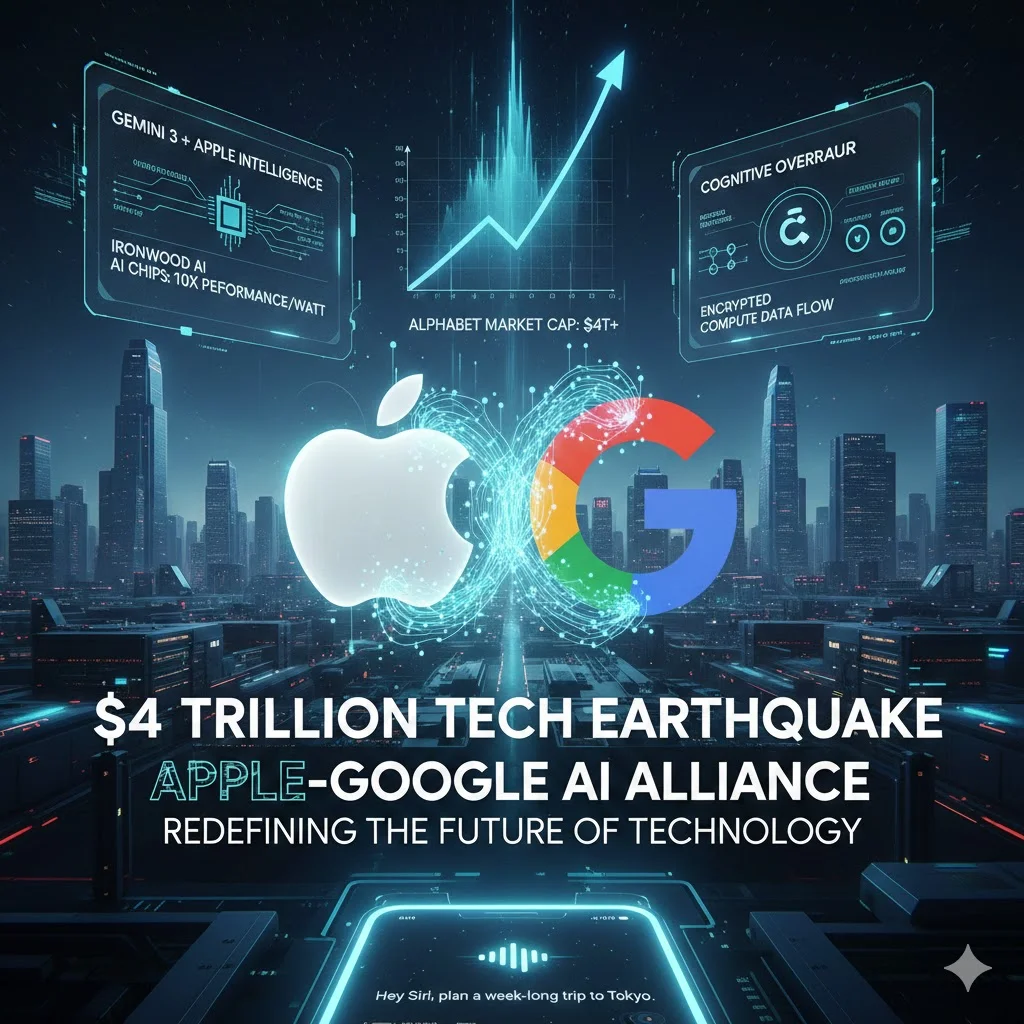
In a move that few could have predicted, Apple and Google—two companies that have spent nearly twenty years competing across every major digital frontier—have formed a landmark multi-year alliance in artificial intelligence. This unprecedented collaboration signals a fundamental shift in priorities across Silicon Valley, proving that in the race for AI dominance, strategic pragmatism now outweighs long-standing rivalry.
For years, the industry was defined by Apple vs. Google: iOS vs. Android, Safari vs. Chrome, Apple Maps vs. Google Maps. Their ecosystems were intentionally walled off, and cooperation was minimal. However, the explosive rise of generative AI, multimodal intelligence, and AI agents has changed the rules entirely. The stakes are no longer about apps or platforms—they are about who controls intelligence itself.
At the center of this shift is one defining headline: Google’s Gemini 3 is now the core intelligence engine behind Apple Intelligence, a move that has propelled Alphabet’s valuation beyond an astonishing $4 trillion market capitalization. But the real story runs much deeper than stock prices.
The Resurrection of Siri Through Gemini 3:
For much of the past decade, Siri struggled to keep pace with competitors. While OpenAI launched Sora, and Google advanced rapidly in multimodal reasoning and large language models, Siri often failed at basic conversational continuity. Apple faced a critical challenge: its ecosystem needed a dramatic leap in intelligence, not incremental improvements.
The integration of Gemini 3 provides exactly that. This is not a simple voice assistant upgrade—it is a cognitive overhaul. Gemini’s massive context window allows Siri to understand documents, emails, photos, calendar events, and user intent in real time.
For example, commands like:
“Hey Siri, summarize the document I was reading on the train and send it to the marketing team”
were previously impossible. With Gemini 3, Siri can now retrieve context, analyze content, generate summaries, and execute actions across apps, delivering a genuinely human-like interaction. This marks Siri’s evolution from a reactive assistant into a true AI agent.
Ironwood AI Chips: The Silent Powerhouse Behind the Alliance:
While Gemini 3 dominates headlines, the real strategic advantage lies beneath the surface: Google’s Ironwood AI chips, the seventh generation of its Tensor Processing Units (TPUs).
In artificial intelligence, software is only as powerful as the hardware it runs on. Ironwood chips are optimized specifically for AI inference, the process of generating responses from large language models. Unlike traditional processors that overheat and drain power, Ironwood delivers a 10× improvement in performance-per-watt.
For Apple—whose brand is built on efficiency, thermal control, and battery longevity—this was the decisive factor. By routing complex AI workloads through Google’s Ironwood-powered data centers, Apple can offer advanced “always-on” AI features without compromising iPhone battery life or device performance.
This hardware advantage effectively positions Google as the AI infrastructure backbone of the modern digital world.
Anthropic’s Surprise Double Launch Directly Targets OpenAI and Google’s AI Dominance
Alphabet’s $4 Trillion Moment: From Search Giant to AI Infrastructure Leader:
Wall Street’s response to the Apple–Google partnership was immediate and emphatic. For years, investors feared that AI chatbots would disrupt Google’s search dominance. Instead, Google has redefined itself.
This alliance proves that Google is no longer just a search company—it is the world’s premier AI infrastructure provider. By securing Apple, a platform with over 2 billion active devices, Google has locked in a massive, long-term revenue stream.
This validation pushed Alphabet past the $4 trillion valuation threshold, placing it alongside Nvidia and Microsoft as one of the most powerful companies in history. The message to investors is clear: Google owns the pipelines through which the future of AI will flow.
Privacy and Private Cloud Compute: Walking the Tightrope:
Unsurprisingly, privacy concerns dominate user discussions. If Google powers Apple’s AI, does Google gain access to personal data?
According to Apple’s technical documentation, the answer is no. The partnership operates through Apple’s Private Cloud Compute (PCC) architecture. Data sent to Ironwood-powered servers is blinded, encrypted, and processed statelessly. Once the response is generated, the system wipes all memory instantly.
This approach allows Apple to preserve its “Privacy First” philosophy while leveraging Google’s “Intelligence First” AI capabilities, creating a rare balance between innovation and user trust.
Support our research
Independent analysis fueled by you.
What the Apple–Google AI Alliance Means for Users:
By the end of 2026, everyday computing will look radically different. We are moving beyond apps into an era of AI agents. Instead of opening multiple applications, users will issue high-level goals:
“Plan a week-long trip to Tokyo.”
A Gemini-powered Siri will handle flights, hotels, itineraries, scheduling, and budgeting—learning continuously from user preferences.
Conclusion: The Dawn of the Ubiquitous AI Era:
The Apple–Google alliance represents far more than a business agreement. It marks the official beginning of the Ubiquitous AI Era, where intelligence is embedded seamlessly into every device and interaction.
Meta's Next Big Bet: This New App Lets You Build Games Simply by Typing a Prompt
Two historic rivals have stopped fighting for ecosystem dominance and started building the future together. And in doing so, they have reshaped the global technology landscape forever.