
Move Over OpenAI: Anthropic Hits $30B Revenue in Shocking Quarter Surge:
Anthropic Is Reshaping the AI Race — And OpenAI Investors Are Starting to Notice A $30 billion revenue surge, a secret AI model briefed to Washington, and a valuation war that's rattling the world's biggest tech investors.
■AI Industry: In the span of just a few months, Anthropic has quietly transformed from a well-funded AI safety startup into one of the most consequential companies on earth — threatening OpenAI's dominance, briefing the White House on military-grade AI, and posting revenue numbers that are forcing the entire venture capital world to recalibrate.
The Revenue Explosion: How Anthropic Went from $9B to $30B in One Quarter:
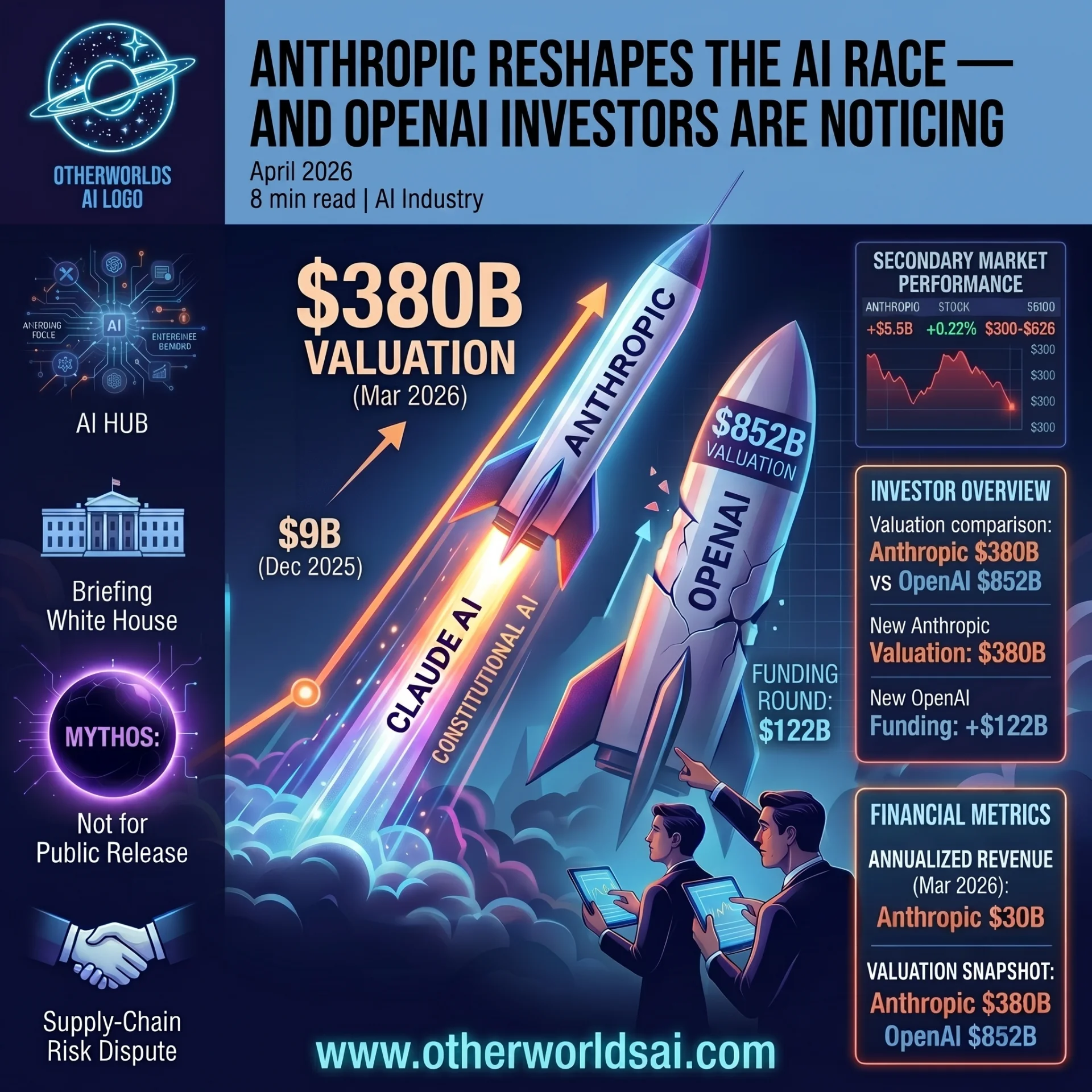
The numbers are staggering, and they arrived fast. Anthropic's annualized revenue jumped from $9 billion at the close of 2025 to a jaw-dropping $30 billion by the end of March 2026 — a more than threefold increase in under four months. The primary driver? Surging enterprise demand for its AI coding tools, making Anthropic the dominant force in one of the fastest-growing segments of the generative AI market.
For context, this kind of growth is almost unprecedented in enterprise software. Even among the most celebrated AI startups, such velocity is rare. It reflects not just product-market fit but a fundamental shift in how enterprises — from financial institutions to software development shops — are integrating large language models into their core workflows.
Anthropic's Claude AI, built on the company's signature constitutional AI framework, has emerged as the enterprise platform of choice for businesses that prioritize safety, accuracy, and deep contextual reasoning alongside raw performance.
                                      ##**$30B**

                             ###Annualized Revenue (Mar 2026)

                                      ##**$9B**

                             ###Annualized Revenue (Dec 2025)

                                      ##**$380B**

                                ###Anthropic Valuation

                                       ##$852B

                                  ##**OpenAI Valuation**
Anthropic's current $380 billion valuation is starting to look like the relative bargain. According to the Financial Times, at least one investor who has backed both Anthropic and OpenAI openly told reporters that justifying OpenAI's $852 billion valuation required assuming a future IPO price of $1.2 trillion or more. That's a significant leap of faith — especially when Anthropic's revenue trajectory is this steep and its enterprise momentum shows no signs of slowing down.
OpenAI Under Pressure: Investor Confidence Cracks at the Top:
The world's most valuable AI startup is facing an unusual challenge: skepticism from within its own investor base. OpenAI's record-setting $122 billion private fundraising round — the largest in history — was initially hailed as proof of unshakeable investor confidence.
But according to the Financial Times, some of those same investors are now quietly questioning whether the company's $852 billion valuation is defensible in a market where Anthropic is eating into its enterprise customer base with startling speed.
The secondary market is telling an equally revealing story. Demand for Anthropic shares has become, by one description, nearly insatiable, while OpenAI shares are trading at a discount in private markets. When secondary market pricing diverges this sharply between two companies operating in the same space, it typically signals a meaningful shift in how sophisticated investors are modeling long-term competitive outcomes in the artificial intelligence industry.
"Demand for Anthropic shares has grown nearly insatiable while OpenAI shares are trading at a discount." Financial Times
The comparison that has reverberated most loudly through Silicon Valley came from Jai Das, president of investment firm Sapphire Ventures. Das, who holds no stake in either company, likened OpenAI to Netscape — the once-dominant web browser that was outflanked by Microsoft and ultimately absorbed by AOL.
The Netscape metaphor is pointed: Netscape didn't lose because it built a bad product. It lost because the competitive landscape shifted faster than its strategy could adapt. Whether that parallel applies to OpenAI remains to be seen, but the fact that such comparisons are now entering mainstream investment discourse is itself a signal worth noting.
OpenAI CFO Sarah Friar has pushed back firmly against the skeptics. In comments to the Financial Times, she argued that the $122 billion raise — secured in what remains the largest private funding round ever recorded — is itself the clearest evidence of sustained investor confidence. The company, she and CEO Sam Altman have maintained, is actively reorienting around enterprise customers and next-generation AI capabilities. For now, the debate between the bulls and the skeptics continues to play out in boardrooms and secondary markets alike.
Mythos: The AI Model Too Powerful to Release to the Public:
While the financial headlines have dominated Wall Street conversations, a quieter but arguably more significant development has been unfolding in Washington. Anthropic co-founder and Head of Public Benefit Jack Clark confirmed this week that the company briefed the Trump administration on Mythos — its newest AI model, announced last week and considered so potentially dangerous that it is not being released to the public at all.
Mythos is not your typical frontier model launch. The system's alleged capabilities in the cybersecurity domain reportedly place it in a category that Anthropic's own safety researchers believe requires controlled handling at the government level before any broader deployment. This positions Mythos squarely at the intersection of AI model safety, national security, and the fast-evolving debate over how private AI companies should relate to state power — particularly in an era when autonomous AI systems are being seriously discussed for military and intelligence applications.
Key Development:
Reports indicate that Trump administration officials have been encouraging major financial institutions — including JPMorgan Chase, Goldman Sachs, Citigroup, Bank of America, and Morgan Stanley — to test Mythos in a controlled environment. This represents a remarkable acceleration in the relationship between frontier AI developers and federal financial regulators.
Clark's candid remarks at the Semafor World Economy summit this week offer a rare window into how Anthropic thinks about its obligations to the state. Speaking about why Anthropic continues to engage with an administration it is simultaneously suing, Clark framed the government's role not as an obstacle but as an essential counterpart in responsible AI deployment. "Our position is the government has to know about this stuff," he said, adding that the company fully intends to brief officials on future models as well.
Suing Washington While Briefing It: Anthropic's Complex Relationship with Government:
Few companies in modern American business history have simultaneously sued a federal agency while cooperating with the same administration on classified-level AI disclosures. Anthropic did exactly that. In March 2026, the company filed a lawsuit against the Trump Department of Defense after the agency labeled Anthropic a supply-chain risk — the result of a clash over whether the Pentagon should have unrestricted access to Claude for use cases that included mass surveillance of American citizens and fully autonomous weapons systems. OpenAI ultimately won that defense contract instead.
Clark, speaking publicly about the dispute for the first time, worked deliberately to reframe the narrative. Rather than describing the legal battle as a fundamental breakdown in the company's relationship with the government, he characterized it as a "narrow contracting dispute" — one that should not overshadow what he sees as a shared interest in ensuring that the United States government remains informed about, and capable of responsibly engaging with, the most powerful AI systems being developed inside its borders.
"We have to find new ways for the government to partner with a private sector that is making things that are truly revolutionizing the economy, but are going to have aspects to them which hit national security equities."
— Jack Clark, Co-founder, Anthropic
This tension — between Anthropic's commitment to AI safety and constitutional constraints on its technology, and the U.S. government's desire for unrestricted access to powerful AI tools — is likely to define the regulatory landscape for frontier AI companies for years to come. How it is resolved will shape not just Anthropic's business, but the entire framework through which democratic governments attempt to govern artificial intelligence.
AI and the Future of Work: Where Anthropic's Economists Diverge from Dario Amodei Beyond the financial and political drama, Anthropic is also grappling seriously with one of the most pressing social questions of our era: what happens to human employment when AI can perform an increasing range of cognitive tasks. Clark, who leads an internal team of economists at Anthropic, offered a perspective that gently diverges from his own CEO's.
Dario Amodei has been among the most vocal voices warning that AI-driven unemployment could reach Depression-era levels. Clark, while not dismissing that possibility, offered a more measured near-term read: currently, the company is only detecting "some potential weakness in early graduate employment" across select industries. He framed Amodei's bleaker projections as grounded in a specific belief — that AI will become dramatically more capable, much faster than most people currently expect — rather than as a description of today's reality.
When pressed to advise students on which academic majors offer the most durable protection in an AI-transformed job market, Clark declined to name specific fields. Instead, he offered a principle: the most resilient education is one built around synthesis across disciplines and rigorous analytical thinking.
His reasoning? AI systems excel at delivering subject matter expertise on demand. What they cannot yet replicate is the human ability to frame genuinely interesting questions — to know which problems are worth solving, and to intuit where ideas from entirely different fields might collide productively.
"The really important thing is knowing the right questions to ask and having intuitions about what would be interesting if you collided different insights from many different disciplines."
— Jack Clark, Co-founder, Anthropic
The Bottom Line: A New Era in the AI Industry Has Arrived:
Anthropic's trajectory in the first quarter of 2026 is not merely a business story — it is a signal that the competitive, regulatory, and societal architecture of the artificial intelligence industry is undergoing a structural transformation.
A company that began as a safety-focused alternative to OpenAI has become the enterprise AI platform of record for some of the world's most demanding institutions, a preferred partner of government in some of the most sensitive conversations happening in Washington, and a genuine financial rival to the company that once seemed untouchable at the top of the AI industry.
Whether Anthropic can sustain this momentum — and whether OpenAI can successfully reorient its massive enterprise machine quickly enough — will be among the defining business narratives of the next twelve months.
What is already clear is that the AI race is no longer a two-horse contest between incumbents and challengers. It is now a high-stakes, multi-dimensional competition playing out simultaneously in data centers, boardrooms, courtrooms, and the halls of government power.
The question is no longer whether Anthropic matters. The question is how the entire industry reshapes itself around the fact that it does.