
Talal Zia — April 18, 2026
In a move that has fundamentally reset the valuation floor for the entire technology sector, reports have emerged of a massive, vertically integrated merger between SpaceX and xAI. The resulting entity, valued at a staggering $1.25 trillion, represents the first true "Space-AI" conglomerate in human history.
While the financial world is fixated on the price tag, the technical reality is far more significant: Elon Musk is moving the "brain" of Grok off-world.
For years, the primary bottleneck for Artificial General Intelligence (AGI) has been terrestrial: energy consumption and regulatory friction. By merging SpaceX's launch capabilities with xAI’s model architecture, Musk is attempting to bypass the power grid entirely by deploying Orbital Compute Clusters powered by high-efficiency solar arrays in Low Earth Orbit (LEO).
I. The Orbital Compute Moat
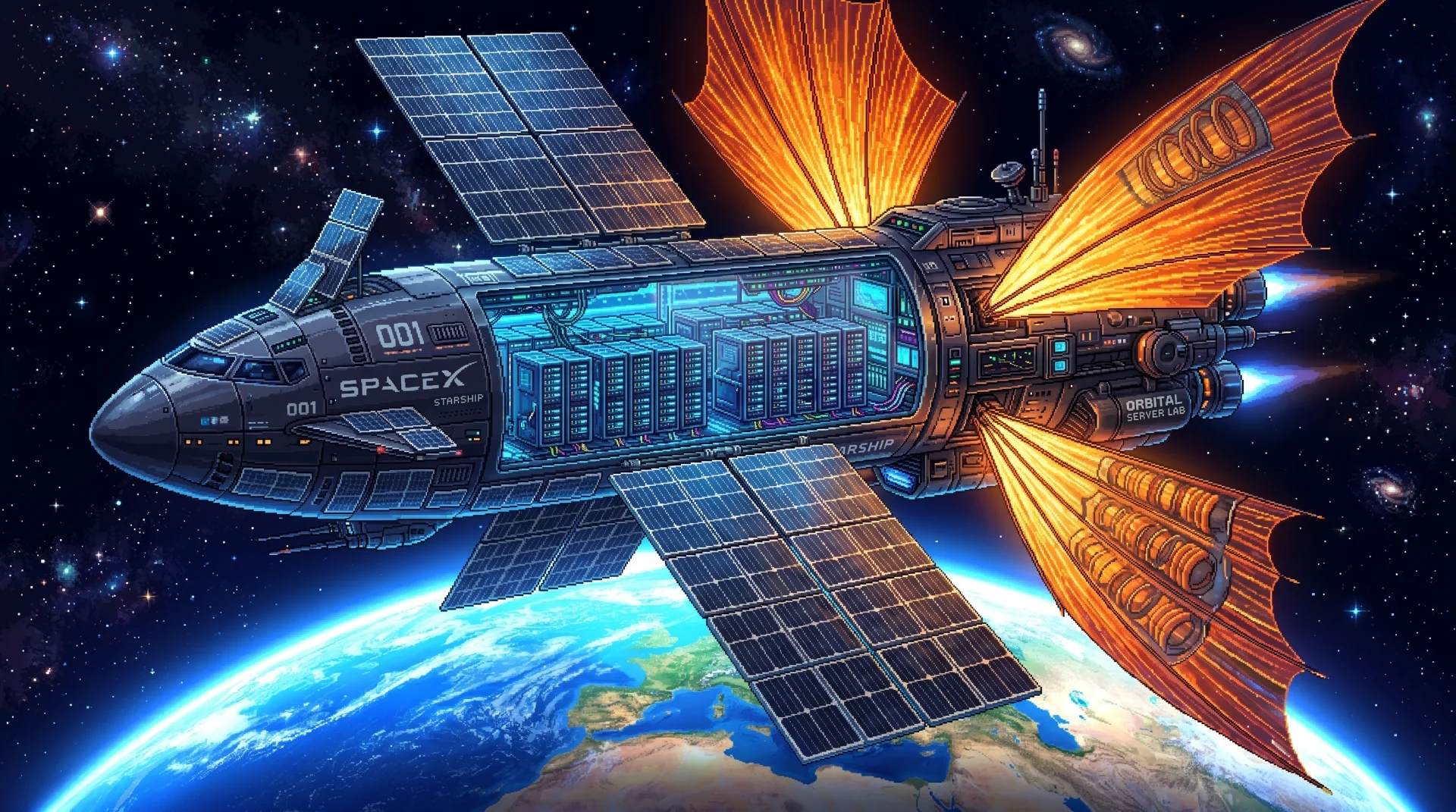
The core of this merger is Project Tera-Orbital. Sources indicate that SpaceX is already retrofitting a fleet of Starship-class vehicles to serve as mobile data centers. These "Server-Ships" are designed to host hundreds of thousands of next-generation H200 and B200 GPUs, cooled by the vacuum of space and powered by massive deployable solar sails.
This isn't just about speed; it's about autonomy. An orbital AI cluster connected via Starlink is immune to terrestrial power outages, localized regulation, and physical tampering. It is the ultimate "Neutral Ground" for a global super-intelligence.
Infrastructure Scalability: Terrestrial vs. Orbital
Chart data for "Infrastructure Scalability: Terrestrial vs. Orbital": Energy Ceiling (MW): 500 MW, 2500 MW; Latency (ms): 45 MW, undefined MW; Deployment Speed (Days): 270 MW, 14 MW; Cooling Efficiency: 65 MW, undefined MW.
II. Vertical Integration: From Rocketry to Reasoning
By controlling the launch vehicle, the satellite network, and the AI model, Musk has achieved a level of vertical integration that OpenAI and Google can only dream of.

Meta's Next Big Bet: This New App Lets You Build Games Simply by Typing a Prompt
- SpaceX (The Body): Provides the physical infrastructure and the delivery mechanism.
- Starlink (The Nervous System): Provides the global, low-latency communication layer.
- xAI (The Brain): Provides the intelligence that manages the entire fleet.
This integration allows for Edge AI at the planetary scale. Imagine a version of Grok that doesn't live in a data center in Iowa, but is distributed across 40,000 Starlink satellites, processing global sensor data in real-time before it even hits the ground.
III. The Grok-3 Trajectory
With the combined resources of SpaceX, xAI is reportedly accelerating the training of Grok-3. Unlike its predecessors, Grok-3 is being trained on "Multimodal Telemetry"—data sourced directly from Tesla’s FSD fleet, SpaceX’s launch sensors, and Starlink’s global traffic patterns.
Support our research
Independent analysis fueled by you.
The resulting model won't just be good at writing jokes; it will be the most "environmentally aware" AI ever built.
Grok Series: The Vertical Climb
Chart data for "Grok Series: The Vertical Climb": Grok-1: 15 Score; Grok-2: 42 Score; Grok-2.5 (Current): 68 Score; Grok-3 (Projected): 96 Score.
IV. The Market Earthquakes
The merger has sent shockwaves through the "Magnificent Seven." If Musk successfully demonstrates that orbital compute is viable, the massive terrestrial data centers currently being built by Microsoft and Amazon could become "stranded assets"—expensive, inefficient relics of a pre-space age.
As the race for AGI intensifies, the high ground is no longer metaphorical. It’s 550 kilometers above our heads.