
Chen Mei — April 18, 2026
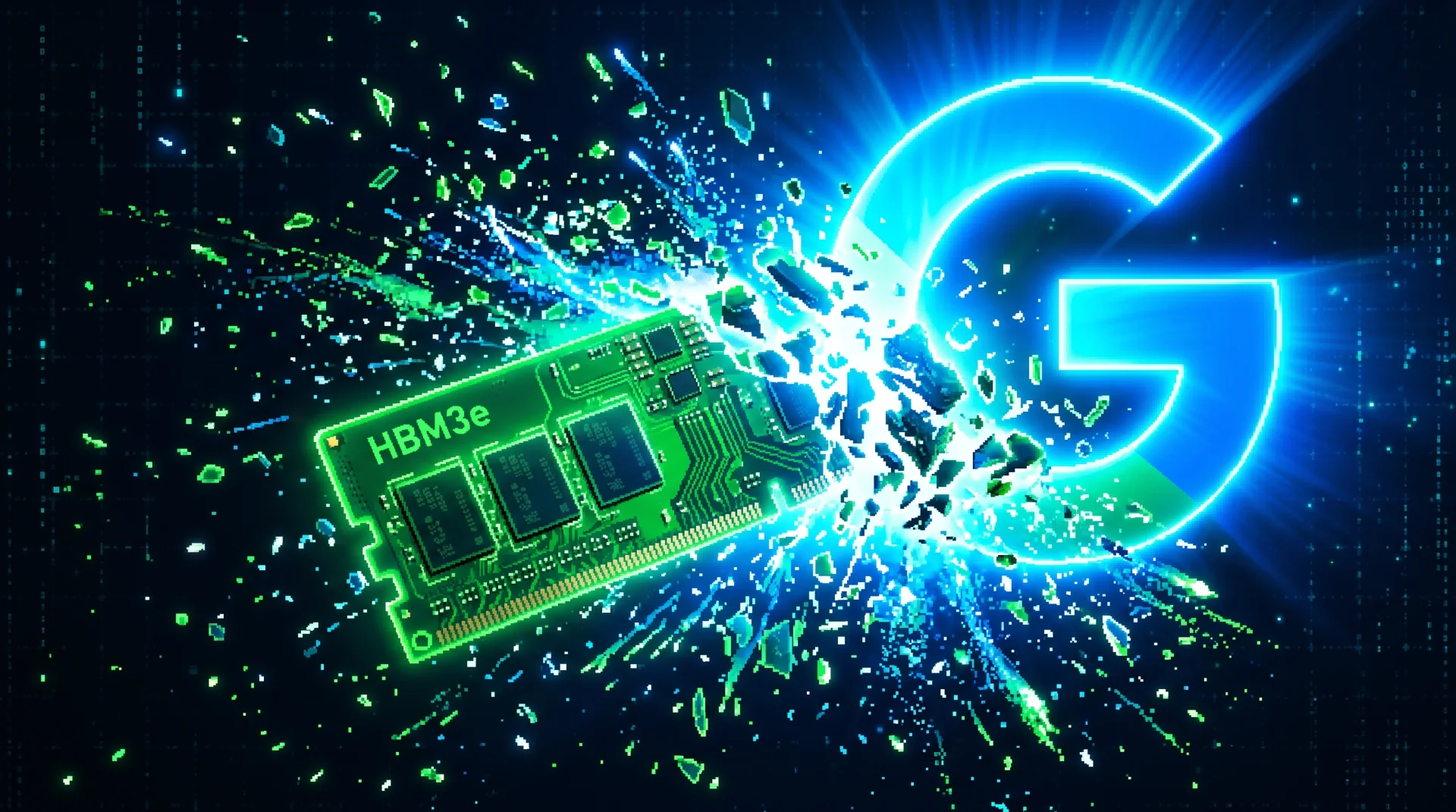
The global hardware market is in a state of absolute shock. Within hours of Google DeepMind's release of the "Turbo-Quant" paper, stock prices for major memory manufacturers—SK Hynix, Micron, and Samsung—plummeted by as much as 22%.
The reason? Google has effectively solved the "Memory Wall."
For the past three years, the AI arms race has been a war of VRAM. To run a trillion-parameter model, you needed a cluster of H100s with hundreds of gigabytes of expensive High Bandwidth Memory (HBM). Google’s new Inference Efficiency Breakthrough changes that math forever. By using a new form of "Lossless Neural Compression," Google has demonstrated that state-of-the-art models can now run on 90% less RAM without losing accuracy.
I. The End of the VRAM Tax
Google's "Turbo-Quant" architecture isn't just another quantization method. It’s a fundamental redesign of how model weights are stored and retrieved during inference. Traditionally, a model’s size was the primary bottleneck for deployment. If a model was 400GB, you needed 400GB of VRAM.
Google has shattered this linear relationship.
The Memory Breakthrough: RAM Requirements
Chart data for "The Memory Breakthrough: RAM Requirements": 100B Parameter Model: 200 GB, 18 GB; 400B Parameter Model: 800 GB, 72 GB; 1T Parameter Model: 2000 GB, 190 GB.
II. Why the RAM Market Crashed
The implications of this 90% reduction are catastrophic for hardware manufacturers who have spent billions scaling up HBM3e and HBM4 production lines.

Anthropic’s Surprise Double Launch Directly Targets OpenAI and Google’s AI Dominance
For the last two years, RAM was the "Digital Gold." Companies were hoarding it to stay competitive. But if a model that previously required an $80,000 GPU cluster can now run on a $2,000 consumer-grade workstation, the demand for high-end enterprise memory evaporates overnight.
- The HBM Glut: We are moving from a memory shortage to a massive oversupply.
- Consumer Democratization: This breakthrough allows "Frontier-level" intelligence to run natively on MacBooks and local PCs, bypassing the need for cloud-based GPU clusters.
- The Efficiency Paradox: As inference becomes cheaper, the value of the "Chips" is being transferred back to the "Algorithms."
III. DeepMind’s Strategic Play
By releasing this research, Google is executing a classic "Commodification of the Complement" strategy. Google has massive internal compute, but they also want to ensure that the AI ecosystem isn't bottlenecked by NVIDIA’s hardware pricing.
Support our research
Independent analysis fueled by you.
By making high-end AI run on low-end hardware, Google is forcing the industry to compete on intelligence, not just on who has the biggest budget for GPUs.
Market Reaction: HBM Price Index
Chart data for "Market Reaction: HBM Price Index": Day 0: 100 Index; Day 1: 88 Index; Day 2: 74 Index; Day 5 (Projected): 42 Index.
IV. The Next Frontier: Local Super-Intelligence
We are entering the era of the "Local Frontier." In the coming months, we expect to see open-source developers port these compression techniques to models like Llama-4 and Mistral.

Meta's Next Big Bet: This New App Lets You Build Games Simply by Typing a Prompt
The "Memory Wall" hasn't just been climbed; it’s been demolished. The question is: what will we do with all that extra RAM?