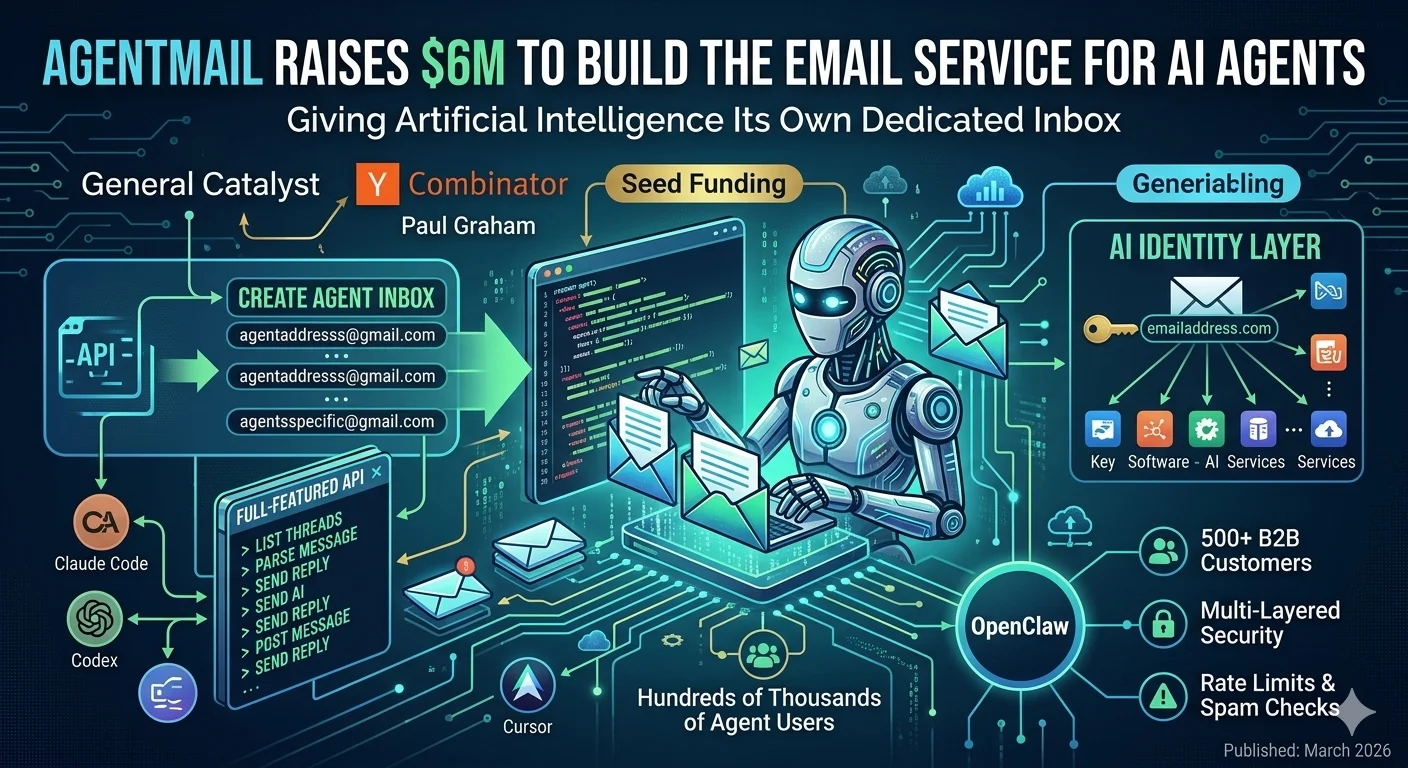

AGENTMAIL RAISES $6M TO BUILD THE EMAIL SERVICE FOR AI AGENTS:
AgentMail vs. Gmail: Why Traditional Email Providers are Failing AI Agents:
How One Startup Is Giving Artificial Intelligence Its Own Inbox
The Rise of AI Agents: From Curiosity to Everyday Reality:
Just a couple of years ago, the idea of an AI agent felt like science fiction. These early systems were little more than glorified chatbots — able to answer questions and handle basic tasks, but far too unreliable, expensive, and limited to earn a place in everyday workflows. The technology was real, but it belonged firmly to the world of early adopters and enthusiastic experimenters.
Today, the story looks remarkably different. Coding agents like Claude Code, Codex, and Cursor kicked off the revolution, winning over developers and programmers who quickly saw how AI could accelerate their work. But the wave did not stop there. People are now deploying AI agents to debug software at scale, build and run marketing campaigns, manage their calendars, and schedule meetings — all without lifting a finger.
Then came the moment that changed everything. When OpenClaw made its blockbuster debut earlier this year, it threw open the doors to AI agents for everyday users — letting anyone run their own personalized, localized agent around the clock. Adoption exploded. The age of the AI agent had truly arrived.
The Big Idea: What Happens When Agents Need Email:
If the tech industry's predictions hold up, AI agents will soon be as numerous as real human beings on the internet. They will use software and services, shop on your behalf, hold conversations, and automate enormous swathes of work that people currently handle manually. The internet of the future may be populated as much by agents as by the humans who created them.
AgentMail, a San Francisco-based startup, has built its entire business around that future. The company recognized a fundamental gap: if AI agents are going to operate independently in the digital world, they need one of the most basic and deeply woven tools of internet life — an email address. So AgentMail did exactly what the name suggests. It built an email service designed specifically for AI agents.
The platform provides a full-featured API that gives AI agents their own dedicated email inboxes. Developers can use it to give agents the ability to hold two-way conversations, parse incoming messages, manage threads, apply labels, run searches, and send replies — all through clean, direct API calls rather than clunky UI interactions.
The Funding: $6 Million and a Star-Studded Backer List:
AgentMail announced on Tuesday that it has closed a $6 million seed funding round — a vote of confidence from some of the most respected names in the venture and technology world.
The round was led by General Catalyst, with participation from Y Combinator, Phosphor Capital, and a remarkable collection of angel investors. Those angels include Paul Graham, the legendary co-founder of Y Combinator; Dharmesh Shah, CTO of HubSpot; Paul Copplestone, CEO of Supabase; and Karim Atiyeh, CTO of Ramp.
Alongside the funding announcement, AgentMail also unveiled a new onboarding API. This allows an AI agent to autonomously sign itself up and create its own inbox — no human required. Developers and operations teams can also manage inboxes, permissions, allowlists, and API keys manually through the platform's human-facing interface.
The Vision: Giving Agents the Gmail Experience — Without the Buttons:
Co-founder and CEO Haakam Aujla built AgentMail with one guiding principle in mind: AI agents deserve the same rich email experience that humans get from services like Gmail or Outlook — just without all the interface elements designed for human eyes and hands.
"When you open Gmail, you have a bunch of threads, and inside each thread, you can have many messages; those messages can have attachments,"** Aujla explained. "You want to be able to label them, search them, filter them, reply, forward. We thought we wanted our agents to be able to do that, but they shouldn't have to click buttons on a screen, because that's pretty clunky for agents to do. They should just be able to make API calls."**
The result is a platform that works seamlessly for both AI and human users. Agents interact entirely through the API, handling email with the speed and precision that code allows. Meanwhile, a clean, fully human-usable interface lets developers and operators read messages, manage multiple agent inboxes, and keep a clear view of everything happening across their systems.
The Growth Story: From Slow Start to Explosive Traction:

The Hidden AI War
Nobody Is Telling You About
Our latest documentary deep-dive into the geopolitical struggle for machine intelligence dominance. Explore the two paths of AI development: open source vs. closed architecture.
The early days of AgentMail were quieter than its founders might have hoped. Launched as part of Y Combinator's Summer 2025 batch, the platform initially found its footing in the B2B world — serving companies that wanted to scale their email communications efficiently. AI agents, at that point, had not yet reached the mainstream, and demand for agent-specific tooling was still building.
Then OpenClaw arrived, and everything changed overnight. When the platform — then known as Clawdbot — burst onto the scene in late January, AgentMail watched its user count triple in a single week. In February, it quadrupled again, as people everywhere began searching for ways to give their agents an inbox and a greater degree of independence.
Today, the numbers tell a compelling story. AgentMail has attracted tens of thousands of human users, hundreds of thousands of agent users, and more than 500 B2B customers. The platform offers a generous free tier alongside paid plans and enterprise subscriptions — a significant advantage over traditional providers like Gmail, which impose strict rate and volume limits on their email APIs.
The Trust Problem: How AgentMail Tackles AI Misuse:
Giving AI agents their own email inboxes is a powerful capability — and an obvious invitation for abuse. Spam, phishing, automated harassment, and large-scale misuse all become easier when bots can send and receive email at scale. AgentMail has not ignored this challenge.
The company has built a multi-layered system to keep its platform safe and trustworthy. By default, agent inboxes are limited to sending just 10 emails per day unless a real human has verified and authenticated the account. The platform actively monitors for unusual spikes in activity and imposes rate limits when it detects suspicious behaviour. Bounce rates are tracked across all accounts, and new inboxes are randomly sampled and scanned for sensitive keywords that could indicate misuse.
These safeguards reflect a broader philosophy about trust in the agentic era. As AI agents take on more responsibility and act more autonomously, the systems that support them must be designed with accountability built in from the ground up — not added as an afterthought.
The Bigger Picture: Email as an Identity Layer for AI:
AgentMail's ambitions stretch well beyond simply routing messages. Aujla sees email not just as a communication tool, but as the foundation of digital identity — and he believes that same foundation should be extended to AI agents.
"We want to give agents the ability to use email in the same way that humans do," Aujla said. "But the idea is, what humans use email for is not even communication. It's your identity. There are several startups that are trying to build new identity protocols for agents, but our thesis is: let's just use what already works for humans, and what's already so deeply integrated into the entire internet."
The implication of that philosophy is profound and practical at the same time. An email address is not just a way to send messages. It is the key that unlocks virtually every software service, platform, and account on the modern internet. Sign-ups, verifications, notifications, password resets — almost all of it flows through email.
"You give an agent an email address," Aujla concluded, and it can now use essentially any software service that already exists."**
Why This Matters: The Infrastructure Beneath the Agentic Web:
AgentMail is building something that sounds simple on the surface but carries enormous strategic weight. Email is not a flashy technology. It is not a new AI model, a breakthrough algorithm, or a jaw-dropping demo. But it is the connective tissue of the entire internet — and until now, it has been built entirely for human users.
As AI agents become a permanent and growing fixture of digital life, the infrastructure beneath them needs to evolve. The tools, platforms, and protocols that power the internet were designed with people in mind. Adapting them for autonomous agents — or building purpose-built replacements — is one of the defining infrastructure challenges of this technological moment.
AgentMail is betting that email is the right place to start. With $6 million in fresh funding, a fast-growing user base, and some of the most respected investors in the industry behind it, the company is well-positioned to build the email backbone of the agentic web.
The future of AI is not just smarter models. It is better infrastructure. And for AI agents that need to act, communicate, and identify themselves across the internet, that future starts with an inbox.