
For decades, the dream of fusion energy has felt like it was always "30 years away."
Scientists have long been captivated by the promise of replicating the process that powers the sun—merging atoms to release near-limitless clean energy. But today, that timeline is being fast-tracked by a powerful new ally: Artificial Intelligence.
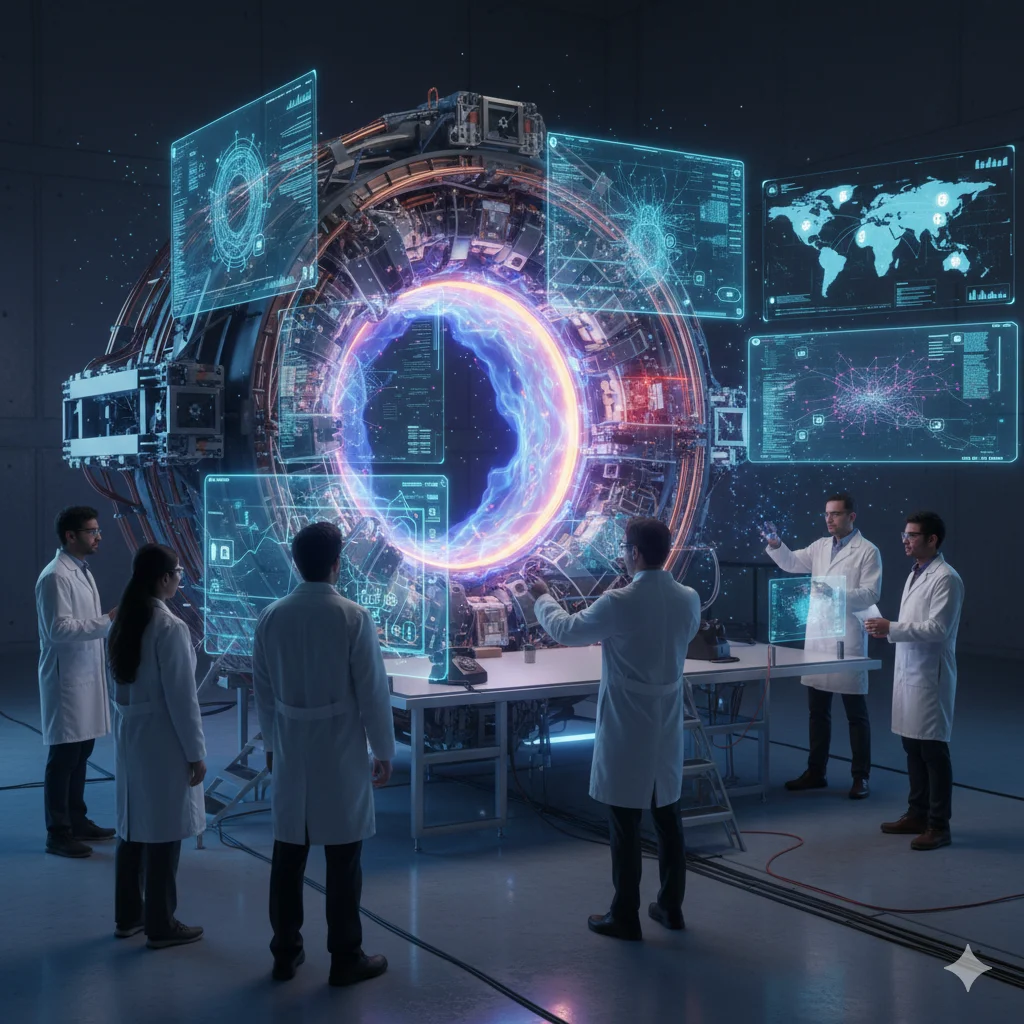
At the U.S. Department of Energy’s Princeton Plasma Physics Laboratory (PPPL), researchers are proving that the path to a commercial fusion reactor isn't just paved with better magnets, but with smarter algorithms.
The Challenge: Taming the "Star in a Bottle"
Fusion isn't just about reaching temperatures hotter than the sun; it’s about controlling that heat. To create fusion on Earth, we use super-hot plasma. This plasma must be confined, heated efficiently, and—most importantly—kept stable.
The problem? Plasma is incredibly fickle. Even a tiny instability can disrupt the reaction, potentially damaging the reactor and ending an experiment in mere milliseconds. Human operators simply cannot react fast enough to these changes. This is where AI moves from being a "helper" to a "necessity."
Why Machine Learning is the Perfect Partner:
Unlike traditional software that follows a rigid set of rules, machine learning systems thrive on data. They analyze massive volumes of information, find hidden patterns, and adapt.
At PPPL, AI is currently being used to:
-
Improve vessel design: Creating better containers for the super-hot plasma.
-
Optimize heating: Finding the most efficient way to reach fusion temperatures.
-
Maintain stability: Keeping the reaction running for longer and longer periods.
A Major Breakthrough: Predicting the Unpredictable:
A recent paper in Nature Communications highlighted a massive milestone. Led by Staff Research Physicist SangKyeun Kim, researchers demonstrated an AI code that could predict and prevent magnetic perturbations (disruptions) across two different fusion devices: the DIII-D in the U.S. and KSTAR in South Korea.
“The results are particularly impressive because we were able to achieve them on two different tokamaks using the same code,” Kim noted. This portability is key; if AI can work on different machines, it can likely work on the commercial reactors of the future.
Decisions Made in Milliseconds:
In the world of plasma physics, speed is everything. According to Egemen Kolemen, an associate professor at Princeton and PPPL appointee, the AI-driven system can predict upcoming disruptions and adjust the vessel's settings before the instability occurs.
This is especially difficult in H-mode (High-confinement mode). H-mode is the "gold standard" for fusion because it eliminates edge turbulence, but it is notoriously difficult to stabilize. The PPPL team achieved stable H-mode operation without instabilities—a first in a reactor setting relevant to future power plants.
From Donuts to Crullers: AI and the Stellarator:
While the donut-shaped tokamak is the most common fusion design, PPPL is also using AI to rethink the stellarator. Stellarators look like twisted crullers and are designed to be inherently more stable, but their complex geometry makes them a nightmare to design manually.
Michael Churchill, Head of Digital Engineering at PPPL, is using machine learning to create "Digital Twins." These are virtual models that update in real-time based on experimental data. By using AI to accelerate high-fidelity simulations like the XGC code—which usually requires exascale supercomputers—researchers can test thousands of designs in the time it used to take to test one.
Coding for a Cleaner Future:
The work doesn't stop at design. Researchers like Stefano Munaretto are using AI to optimize codes like "HEAT," which models how plasma heat interacts with reactor components in 3D. By matching CAD designs with plasma models, they can predict exactly how a reactor’s "divertor" (the part that removes waste heat) will hold up under intense pressure.
The Bottom Line:
At PPPL, machine learning isn't replacing physics; it’s amplifying it. As William Tang, a pioneer in the field, puts it: waiting to treat a plasma disruption after it starts is like trying to treat a fatal cancer that is already too far along. You have to be ahead of the curve.
By combining human expertise with the lightning-fast processing of AI, we are moving fusion out of the realm of scientific theory and into the reality of a scalable, clean power solution.
We are, quite literally, learning how to harness the power of the stars.
Support our research
Independent analysis fueled by you.