
ANTHROPIC IS THE HOTTEST STOCK IN PRIVATE MARKETS —BUT SPACEX'S 2026 IPO COULD CHANGE EVERYTHING:
How a standoff with the Pentagon turned Anthropic into the private market’s favorite AI play.
The Nail-Biting Moment: A Private Market Like No Other:
The private secondary market has never felt more electric — or more unpredictable. Glen Anderson, President of Rainmaker Securities, a firm that facilitates trades in roughly 1,000 private stocks, has watched this space evolve from a niche corner of finance into one of the most competitive arenas in modern investing.
"When I started brokering trades in 2010, you could count the institutional investors focused on late-stage private markets on two hands," Anderson says. "Today, there are thousands." The sheer volume of capital now chasing a limited pool of elite private shares has created a tension that defines today's market — and nowhere is that tension more visible than in the battle between Anthropic, OpenAI, and SpaceX.
Right now, the narrative driving that crowded market has three main characters — and the story is far more complex than the headlines suggest.
Anthropic Stock: Why Demand Is "Almost Insatiable" in 2026:
Ask any broker in the private secondary market what the hardest stock to source right now is, and you'll get the same answer every time: Anthropic. The AI company behind the Claude assistant has become the most sought-after name in a marketplace overflowing with cash and short on available shares.
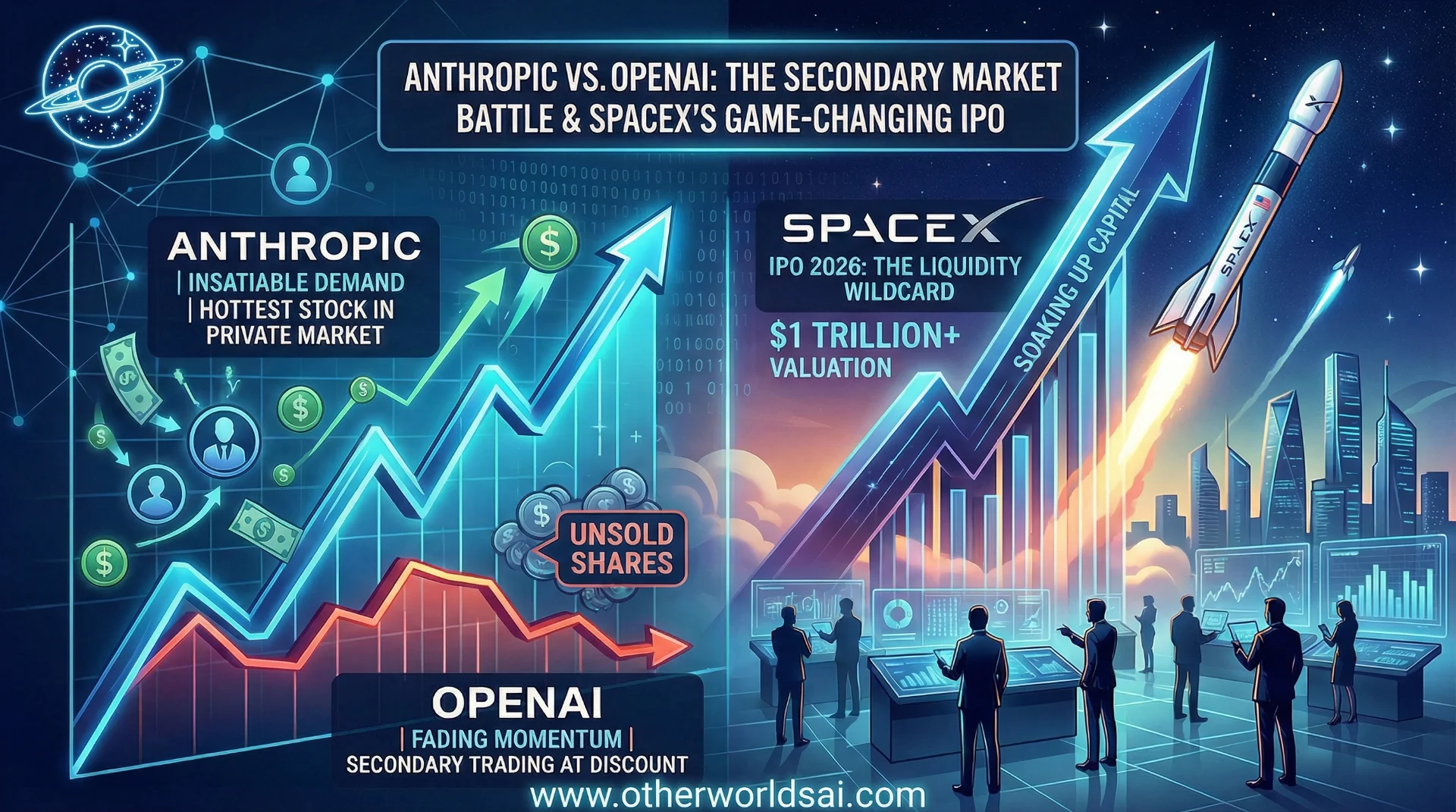
"The hardest stock to source in our marketplace is Anthropic. There's just no sellers," Anderson confirmed in a recent interview. Bloomberg reported that buyers have signaled a staggering $2 billion in cash ready to deploy into Anthropic — even while roughly $600 million in OpenAI shares sat unsold and unable to find takers. Ken Smythe, founder and CEO of Next Round Capital, confirmed seeing the same pressure-cooker dynamic on the buy side.
The numbers tell a story of lopsided conviction — and they beg an obvious question: what triggered this level of demand?
Why Anthropic Became a "Hero" Brand: The DoD Standoff Effect
The turning point, Anderson argues, was Anthropic's very public and very unexpected standoff with the U.S. Department of Defense. What initially appeared to be bad news for the company — a controversy with one of the world's most powerful institutions — unexpectedly became a brand-building moment of rare potency.
"The app got more popular, people rallied around the company as kind of a hero, taking on big government," Anderson explained. "I think it amplified the story and made it even more differentiated from OpenAI." In an era when AI companies are routinely criticized for serving powerful institutions over the public good, Anthropic's perceived independence struck a nerve — and investors noticed.
The result was a feedback loop: more users, more press, more investor conviction, and a secondary market that simply cannot source enough shares to meet demand.
OpenAI vs. Anthropic: The Momentum Shift Investors Are Watching:
For years, the prevailing wisdom in late-stage private markets was elegantly simple: bet on everyone. Institutional investors wanted exposure to all major AI platforms — OpenAI, Anthropic, and others — hedging against genuine uncertainty about which model would ultimately win. That calculus is quietly but unmistakably changing.
Anderson is careful not to frame this as a binary battle. "I wouldn't say it's a one-or-the-other conversation," he notes, acknowledging that many institutional investors still want exposure to both companies. But even he concedes the obvious: the excitement isn't equal. "It's not nearly as vibrant a market as Anthropic right now," he acknowledged when discussing OpenAI's secondary market position.
The momentum has shifted — and in markets, momentum has a way of becoming self-fulfilling.
OpenAI Valuation: Trading at a Discount to Its Own Primary Round
The numbers reveal a gap that's hard to ignore. According to Bloomberg — figures Anderson broadly confirmed — OpenAI shares on the secondary market are currently trading at an implied valuation of approximately $765 billion, a meaningful discount to the company's most recent primary-round valuation of $852 billion. Sellers are accepting less than what the company officially priced its own round at.
OpenAI has responded by asserting greater control over secondary trading. The company flagged caution around third-party brokers and established authorized channels through major banks — including Morgan Stanley and Goldman Sachs — where high-net-worth clients can access OpenAI shares with no carry fees. Goldman Sachs, meanwhile, is still charging its customary 15% to 20% carry on profits for clients seeking Anthropic exposure.
The contrast is striking: Anthropic commands fees that OpenAI cannot. That alone speaks volumes about where investor conviction currently sits.
SpaceX IPO 2026: The $1 Trillion Wildcard Changing Everything
If Anthropic vs. OpenAI is the subplot, SpaceX is the main event — and it's about to rewrite the rules for everyone involved. SpaceX occupies a position in private markets unlike any other company. While most late-stage private firms suffered punishing corrections between 2022 and 2024 — with many shares falling 60% to 70% from their peaks — SpaceX never experienced that crash. Not even close.
"SpaceX has been pretty much consistently up and to the right," Anderson says simply. The rocket and satellite behemoth has achieved something almost no other private company can claim: a decade of uninterrupted appreciation, built not on hype but on disciplined execution and strategic restraint.
The story of how SpaceX got here is a masterclass in private market pricing — and a cautionary tale for the companies that didn't follow the same playbook.
The 100x Return: How Disciplined Pricing Built a $1 Trillion Company:
The numbers behind SpaceX's appreciation are almost hard to believe. In 2015, when Google and Fidelity jointly invested $1 billion in SpaceX, the company was valued at roughly $12 billion. Today, SpaceX is valued at more than $1 trillion — a return exceeding 100x for those early investors who had the conviction to hold.
Anderson credits SpaceX's management with a discipline that most private companies simply lack. "A lot of companies will fall for the temptation to maximize the price of their stock in every round," he explains. "The problem is that that doesn't leave any room for error." SpaceX, by contrast, played conservatively — resisting the urge to squeeze every last dollar from each funding round, leaving enough upside for subsequent investors to still win big.
"Not getting too greedy" turned out to be the most profitable strategy of all — for SpaceX and every investor who came along for the ride.
The IPO Filing: Elon Musk's $50–75 Billion Ambition
SpaceX recently filed confidentially for an initial public offering, setting the stage for what could be one of the largest market debuts in the history of finance. Elon Musk is reportedly targeting a raise of $50 billion to $75 billion**, potentially as soon as June 2026. Only Saudi Aramco's 2019 debut — which valued the energy giant at $1.7 trillion — has come close to this scale.
The immediate effect on secondary markets was electric. "Today, I saw a flood of SpaceX investors coming to me saying, 'Can you give me SpaceX?'" Anderson noted. "It's been a very active buy side." But supply is evaporating fast. The closer a company gets to its IPO, the less incentive existing shareholders have to sell — they can see the liquidity event on the horizon and would rather wait for the public market payday.
The window to buy SpaceX in the secondary market is closing. And that shift is creating ripples that will be felt far beyond SpaceX itself.
The IPO Timing Dilemma: Who Goes Second Loses?
Here's where the story gets uncomfortable for Anthropic and OpenAI. Both companies are reportedly exploring public offerings and have signaled they could move in 2026. But SpaceX, by filing first, is about to test the market's appetite in a historic way — and whoever follows will face a structural disadvantage that no amount of brand strength can fully overcome.
"SpaceX is going to soak up a lot of liquidity," Anderson says flatly. "There's only so much money out there allocated to IPOs." The first mover gets to the trough first. Those who follow face more scrutiny, more skepticism from allocation committees, and potentially far less available capital — regardless of how compelling the underlying business is.
It's a dynamic that plays out in every market vertical, and the AI companies are not immune. Time your IPO too early and you're the one testing market receptivity alone, with no roadmap to follow. Wait for someone else to go first and you may find the biggest institutional checks have already been written — and the appetite for risk has already been satisfied.
In private markets, as in so much of business strategy, timing is not just important. It is everything.
Key Takeaways: What Every Investor Needs to Know Right Now
The private market in 2026 is telling a clear and urgent story — if you know how to read it. Here are the five signals that matter most:**
-
- Anthropic is the hardest private stock to source. With $2 billion in buyer demand against near-zero seller supply, the imbalance is unlike anything most brokers have seen in a single name.
-
- OpenAI secondary shares are trading at a discount to primary. At an implied ~$765 billion valuation vs. an $852 billion primary round, the gap signals hesitation — and an opportunity for those who believe the narrative will reverse.
-
- SpaceX is the greatest private market wealth creation story of the decade. A 100x return from a disciplined, conservative pricing strategy that other private companies would do well to study and emulate.
-
- SpaceX's IPO will absorb enormous institutional liquidity. A potential $75 billion raise doesn't just set a record — it redirects capital that might otherwise flow to Anthropic or OpenAI at their own public debuts.
-
- The IPO order of operations matters enormously. Going second in a liquidity-constrained environment is rarely a winning position, and both AI giants know it.
Final Thoughts: The Race to Go Public Is Also a Race to Go First:
The private market has never been more exciting — or more fraught with consequence — than it is at this precise moment in 2026. Anthropic is riding a wave of genuine goodwill, investor conviction, and product momentum that may be unmatched in the AI sector.
OpenAI still commands enormous institutional attention, even as it cedes ground in the secondary market narrative. And SpaceX is the sleeping giant now fully awake — about to go public and change the rules for everyone playing in this space.
The question was never whether these companies are valuable. They clearly are, in ways that most investors would have considered fantastical just a decade ago. The real question — the one that will define fortunes in the months ahead — is who gets to the IPO window first, who sets the terms, and who gets left managing the aftermath of someone else's record-breaking debut.
In private markets, the boldest move and the best-timed move are often the same move. The clock is running.
Support our research
Independent analysis fueled by you.