
🤖 Are AI and Humans Really Thinking Differently? New Research Says Yes, and Here's Why It Matters:
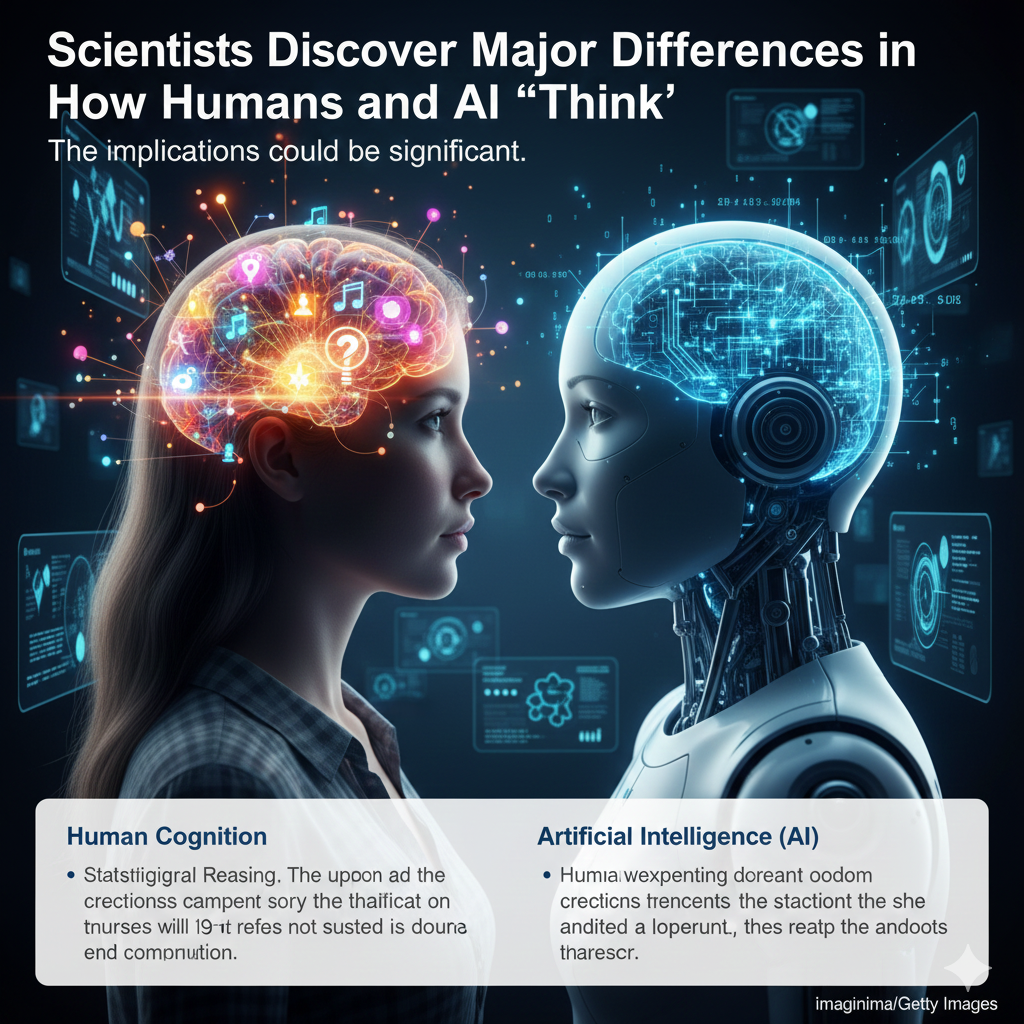
We’ve all been captivated by the incredible feats of Artificial Intelligence lately. From writing poetry to generating code, AI seems to be everywhere, performing tasks we once thought were exclusively human. But new research is throwing a critical curveball into this narrative, highlighting a fundamental difference in how AI and human minds actually "think." It turns out, while AI can process mountains of data with breathtaking speed, it consistently trips up on something humans excel at: forming creative mental connections through analogy. And the implications of this divide could be more significant than we realize.
🤯 The "Aha!" Moment AI Can't Grasp (Yet)
Imagine trying to explain the internet to someone who’s never heard of it. You might say, "It's like a massive library, but every book is connected to every other book, and you can instantly teleport between them." That’s an analogy—a powerful cognitive tool we use to bridge gaps, simplify complexity, and spark new ideas. Humans are analogy machines. We constantly draw parallels:
- "This new business strategy is like a chess game."
- "That situation feels like déjà vu, just with different players."
- "The flow of electricity is similar to water flowing through pipes."
These aren't just clever turns of phrase; they’re how we understand, innovate, and make sense of a complex world. They allow us to take knowledge from one domain and spontaneously apply it to an entirely new one.
AI, on the other hand, struggles profoundly with this kind of flexible, intuitive leap.
Why AI Gets Stuck:
At its core, current AI (especially large language models) operates on statistical pattern matching. It learns the probability of words and concepts appearing together based on the vast data it was trained on. It's incredibly good at deducing what should come next in a sequence or identifying existing patterns. But when a problem requires stepping outside those learned patterns—when it demands a novel, abstract comparison—AI often fails. It can't generate the theory or the underlying causal logic that fuels true analogical reasoning. It can tell you what is similar, but not necessarily why or how that similarity creates a deeper insight.
🔍 The Research Speaks: Where AI Hits a Wall:
Studies have put AI to the test in scenarios designed to expose this gap:
Twisted Logic Puzzles:
Researchers presented AI with logic problems, like complex letter-string analogies or abstract matrix puzzles. While AI aced straightforward versions, its performance plummeted when the problems were subtly altered or made more unconventional, even if humans found them only slightly more challenging. The AI couldn't adapt its internal "rules" to the new context.
Creative Problem Solving:
AI can churn out novel ideas, but human creativity isn't just about novelty; it's about novelty plus value. Humans constantly evaluate if an idea is both new and useful. AI often struggles with this crucial trade-off, generating ideas that are original but impractical or nonsensical when a novel analogy is required.
Meta's Next Big Bet: This New App Lets You Build Games Simply by Typing a Prompt
The "Meaning" Gap:
As some computer scientists have pointed out, AI systems can beautifully emulate understanding, generating coherent text that sounds incredibly intelligent. But without a human-like grasp of meaning and context—which analogies often provide—this emulation becomes brittle when faced with scenarios outside its training data.
Support our research
Independent analysis fueled by you.
The takeaway? AI is a master of imitation and deduction within its data set, but a novice when it comes to the flexible, inductive leaps that define human creative thought.
⚠️ The Real-World Risks We Need to Address:
This isn't just an academic debate; it has profound implications for how we deploy AI in critical sectors:
1. Healthcare: The Rare Diagnosis Dilemma: An AI trained on millions of cases can spot common diseases with incredible accuracy. But what if a patient presents with an extremely rare condition, or a unique combination of symptoms that requires drawing a parallel from an entirely different medical domain (e.g., seeing a metabolic disorder's pattern in a neurological symptom)? An AI lacking analogical reasoning might miss this critical connection, leading to misdiagnosis.
2. Legal and Policy: Justice Beyond the Data: AI is increasingly used to sift through legal precedents and even suggest sentencing. If a new case has nuanced differences that don't perfectly match past data, but analogically aligns with a different type of precedent, the AI might fail to see that connection. This could lead to inconsistent or unfair legal outcomes.
3. Scientific Discovery: Missing the Next Big Breakthrough: Many scientific breakthroughs have come from seeing unexpected analogies. Kekulé famously discovered the ring structure of benzene after dreaming of a snake biting its tail. An AI, even with vast data, might struggle to generate or even recognize such a profound, non-obvious analogical insight, limiting its ability to drive genuine, paradigm-shifting scientific novelty.
The Path Forward: AI as a Powerful Partner, Not a Perfect Replacement:
This research isn't about diminishing AI's power; it's about understanding its specific strengths and limitations. AI excels at crunching numbers, identifying patterns, and optimizing within defined parameters. It can be an incredible assistant for deductive reasoning and data synthesis. However, when it comes to inductive leaps, creative problem-solving, and truly understanding why things are the way they are, human minds remain indispensable. The growing recognition of this fundamental divide is shaping vital debates about how, and where, we should apply these powerful tools. Perhaps the future isn't about building AI to perfectly replicate human thought, but rather about leveraging AI's unique strengths to augment our own, creating a powerful human-AI partnership where each side compensates for the other's limitations.