
Researchers have developed a breakthrough AI-powered electronic tongue
capable of distinguishing between different beverages, assessing food freshness, and detecting potential safety hazards with remarkable accuracy. The innovation represents a major leap forward in food safety technology, combining cutting-edge sensors with artificial intelligence to mimic key aspects of human taste and chemical perception.
This new device not only identifies subtle chemical differences between liquids such as milk, fruit juices, and coffee blends, but also evaluates quality and safety in a matter of minutes — much faster than conventional laboratory analysis. Early results suggest that this technology could transform how industries monitor food spoilage, prevent contamination, and even validate product authenticity.
What Is an AI-Powered Electronic Tongue?
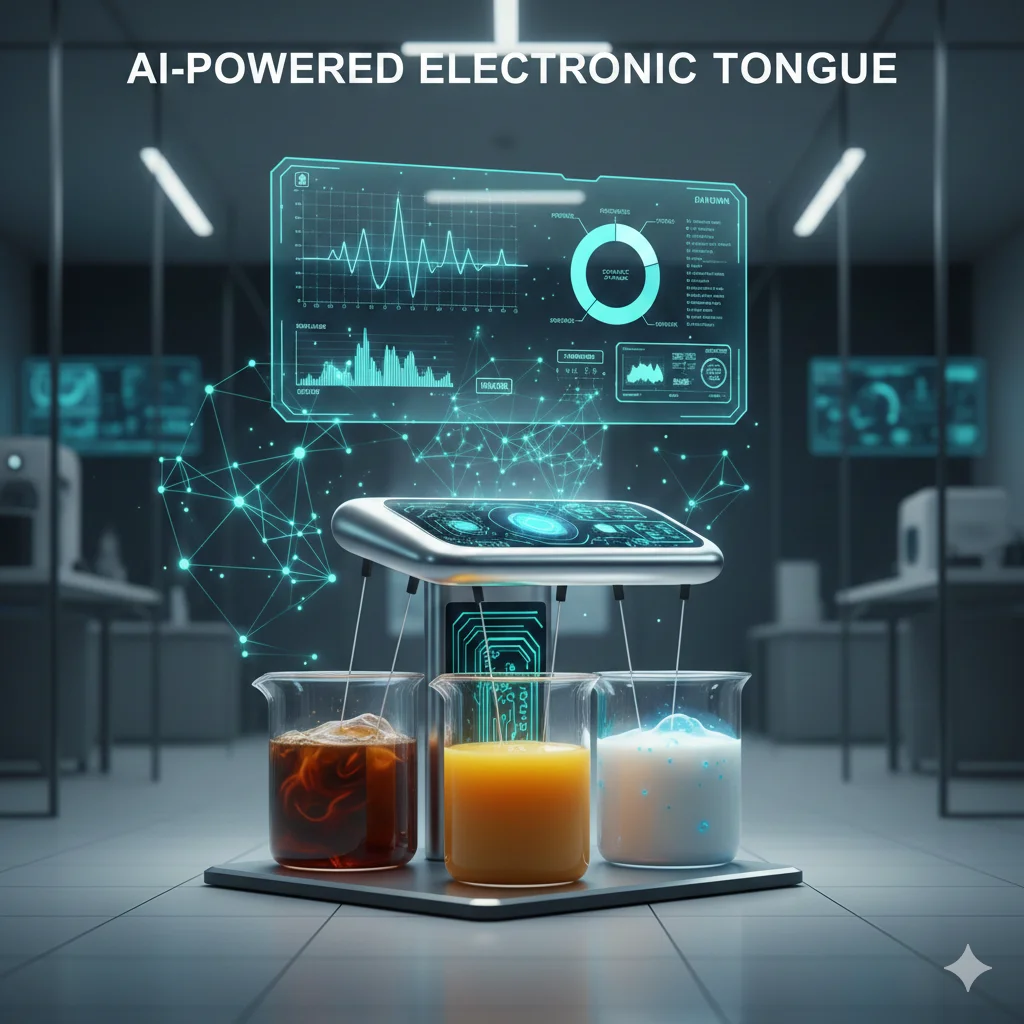
An electronic tongue is a sensor-based system designed to emulate aspects of human taste and chemical detection. In this latest version, researchers at Penn State University integrated advanced materials with artificial intelligence (AI) to create a liquid-testing platform that can differentiate between complex chemical signatures.
At its core, the device uses a graphene-based ion-sensitive field-effect transistor (ISFET) — a highly sensitive chemical sensor capable of measuring ionic changes in a liquid.
These sensors generate electrical signals in response to the presence and concentration of different chemicals. The signals are then interpreted by an AI engine trained on large datasets of known liquids, enabling rapid and accurate classification.
How the AI System Enhances Accuracy:
What sets this AI-powered electronic tongue apart is the way it learns to interpret sensory data. In traditional systems, human experts select specific parameters for analysis.
In this project, researchers discovered that allowing the AI to autonomously define its own evaluation criteria significantly improved performance. When the neural network selected key features from raw sensor outputs, overall classification accuracy climbed from roughly 80 percent to over 95 percent.
This approach, which leverages machine learning to uncover patterns that might elude human analysts, enables rapid and nuanced assessments of complex liquids. It also provides scientists with insights into how advanced AI systems make decisions, offering a rare peek into the inner workings of neural-network-based classification models.
Practical Capabilities: Coffee, Juice, Milk, Water Contamination:
In controlled tests, the electronic tongue has demonstrated the ability to:
- Distinguish between different coffee blends by detecting subtle chemical differences that characterize flavor profiles.
- Evaluate milk quality, including identifying watered-down samples and assessing freshness.
- Detect signs of spoilage in fruit juices, indicating when a drink is no longer safe to consume.
- Detect harmful substances in water, including trace levels of per- and polyfluoroalkyl substances (PFAS) that pose health risks.
These capabilities highlight the device’s potential across multiple applications — from quality control in food production and supply chains to public health monitoring.
Implications for Food Safety and Industry:
The advent of an AI-powered electronic tongue could have wide-ranging benefits:
- Faster Food Safety Testing: Traditional laboratory tests often require hours or days to produce results. The electronic tongue delivers assessments in about one minute, enabling real-time quality checks on production lines and before products reach consumers.
- Cost Efficiency for Producers: By reducing dependency on expensive lab equipment and specialized analysts, food manufacturers could lower testing costs while improving safety standards.
- Enhanced Consumer Protection: The ability to swiftly detect spoilage or contamination could reduce instances of foodborne illness and related recalls.
- Potential Cross-Industry Use: Beyond food, the technology could be adapted for environmental monitoring, water safety, and even medical diagnostics where chemical sensing is critical.
A Glimpse Into the Future of Taste Technology:
By merging advanced sensor materials with machine learning, scientists have moved one step closer to giving machines a form of “taste.” While human taste will always involve rich sensory experiences and context, AI-powered electronic tongues are poised to provide practical and valuable solutions for quality assessment and safety monitoring in ways that could reshape multiple industries.
As this technology continues to mature, future applications may expand into consumer devices, smart kitchen systems, and even personalized dietary feedback tools — bringing sophisticated chemical analysis into everyday life.
Support our research
Independent analysis fueled by you.