
The EV Giant Trades "Cartwheels" for Manufacturing Value as Mind Robotics Hits a $2 Billion Valuation.
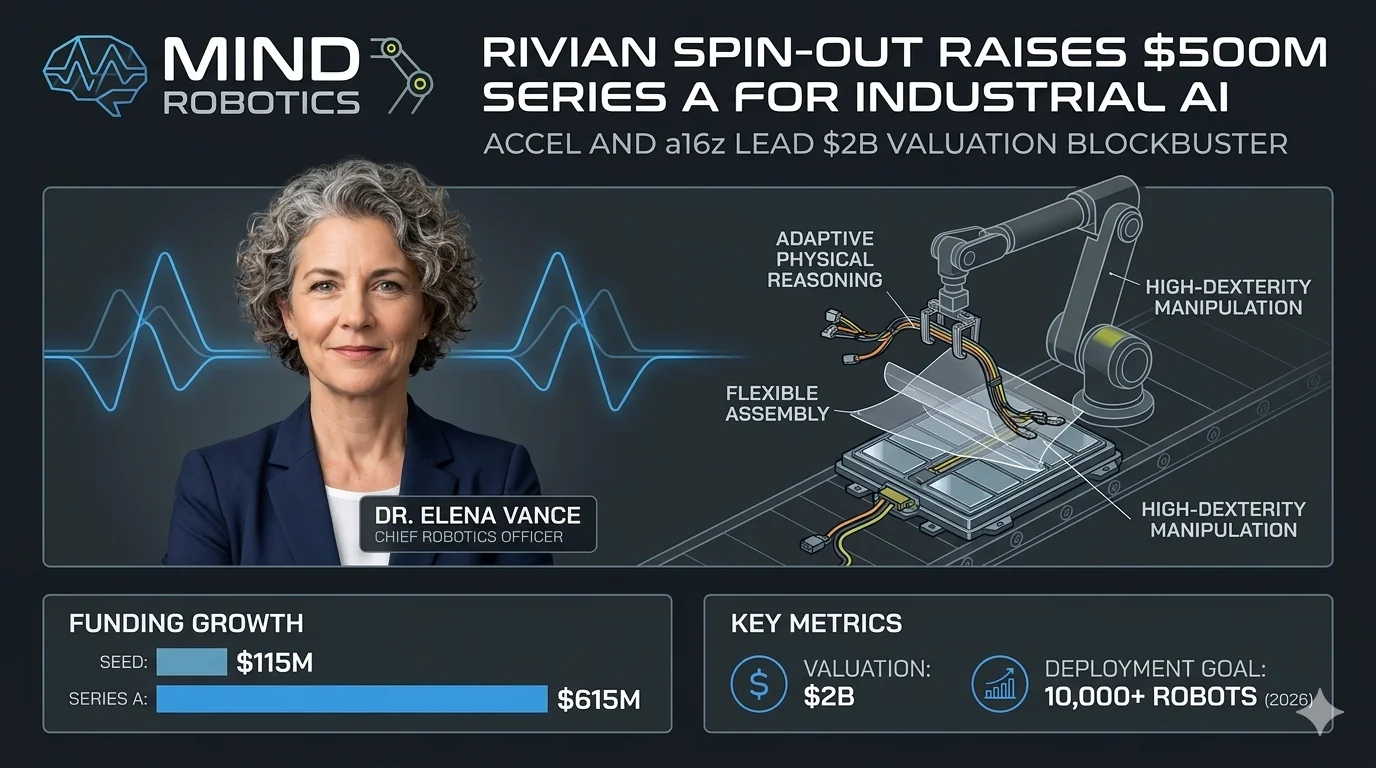
The industrial automation landscape just experienced a massive shift — and Mind Robotics, the high-stakes industrial robotics lab spun out from electric vehicle maker Rivian, has officially raised $500 million in a blockbuster Series A funding round. The financing, co-led by venture capital titans Accel and Andreessen Horowitz, follows a $115 million seed round led by Eclipse in late 2025. In just a few months, Mind Robotics has secured $615 million in total capital, catapulting the startup to a $2 billion valuation.
This rapid scaling represents a new breed of AI startup — one that leverages the physical infrastructure of a parent company to solve real-world industrial problems. While most of the Silicon Valley hype in 2026 has focused on humanoid robots that mimic human movement, Mind Robotics is making a different bet: that the future of the factory floor belongs to smarter, more adaptable versions of traditional machinery.
Closing the "Structural Gap" in Automation:
At its core, Mind Robotics was created to solve a specific problem known as the "structural gap" in industrial automation. Current industrial robotics can perform repeatable, dimensionally stable tasks with extreme precision. However, a large share of factory value-add work requires human-like dexterity, adaptation, and physical reasoning that classical robotics simply cannot address.
Mind Robotics is building the AI foundation — including models, hardware, and deployment infrastructure — to close that gap. Unlike legacy systems that require rigid programming for every single movement, these AI-powered robots use computer vision and physical reasoning to handle variability. Whether it's a slightly misaligned part or a complex wiring assembly, the goal is a machine that can "think" its way through the task just as a human operator would.
The startup's chairman, Rivian CEO RJ Scaringe, has been vocal about the company's practical philosophy. While competitors showcase robots performing backflips or making coffee, Scaringe told The Wall Street Journal that "doing cartwheels does not create value in manufacturing." This utilitarian approach is designed to ensure that every dollar of the $500 million Series A goes toward solving the bottlenecks that actually slow down production lines.
Key Capabilities of the Mind Robotics AI Foundation:
According to technical briefings and recent announcements, the platform focuses on several core pillars of advanced machine intelligence. First, Adaptive Physical Reasoning utilizes large-scale spatial models to understand and react to changes in the physical environment in real-time, moving beyond static pre-programmed paths.
High-Dexterity Manipulation is the second pillar, involving the development of end-effectors and robotic hands that can handle flexible materials, such as wires and fabrics. These materials have traditionally been impossible for robots to manage reliably. Furthermore, Factory-Scale Deployment creates an infrastructure layer that allows thousands of robots to learn from one another, sharing "edge case" data across a global fleet to improve performance.
Integration with Custom Silicon provides the final edge, utilizing high-performance processors—potentially the same custom chips developed for Rivian's autonomous vehicles—to run complex AI models locally on the robot. This ensures that the physical reasoning happens with minimal latency, which is essential for safety and speed on a moving assembly line.
Why Data is the Secret Weapon:
The strategic advantage for Mind Robotics lies in its DNA. By using data harvested from Rivian’s electric vehicle factories, the lab can train its AI models on actual manufacturing challenges rather than synthetic simulations. This "closed-loop" system allows the startup to prove out its robots in one of the most demanding manufacturing environments on earth before scaling to other industries.
The business case for this synergy is undeniable. Rivian is a company that understands the pain points of scaling production from the ground up. By spinning out Mind Robotics, they have created a venue where they can develop solutions for their own assembly lines while building a standalone business that can eventually serve the entire $200 billion industrial automation market.
Custom Silicon and the Rivian Synergy:
The collaboration between the EV maker and its spin-out goes beyond just data. In late 2025, Rivian revealed it had been developing its own custom silicon designed to power autonomous vehicle software. Scaringe recently hinted that these high-performance processors could be sold to Mind Robotics, creating a vertically integrated powerhouse.
"It’s a robotics processor, so it could work really well for that," Scaringe noted in a recent interview. Having access to proprietary hardware gives Mind Robotics a significant edge over startups that rely on off-the-shelf chips, allowing for tighter integration between the AI "brain" and the robotic "body." This vertical integration is a hallmark of the most successful tech companies and could be the key to Mind Robotics' long-term dominance.
The New Playbook for Industrial Giants:
Mind Robotics is the second major spin-out from Rivian in 2025, following Also—an electric mobility company focused on e-bikes and cargo vehicles for Amazon. This strategy of "spinning out" internal labs into independent, venture-backed powerhouses is becoming a blueprint for how large companies can innovate at the speed of a startup.
By spinning these companies out, Rivian allows them to attract top-tier talent with equity incentives and secure massive amounts of external capital that wouldn't be available to an internal department. It also diversifies Rivian's ecosystem, creating a web of interconnected companies that share technology, data, and manufacturing expertise while maintaining a lean operational structure.
Challenges and the Road Ahead:
Despite the massive funding, Mind Robotics faces significant hurdles. The industrial environment is notoriously difficult for AI; unlike a digital chatbot, a robot that makes a mistake in a factory can cause thousands of dollars in damage or safety risks. Precision and safety are non-negotiable when dealing with heavy machinery and human workers.
Competition is also intensifying rapidly. While Mind Robotics is avoiding the humanoid "hype," companies like Tesla, Figure, and Boston Dynamics are all racing toward the same goal of general-purpose robotic intelligence. Mind Robotics will need to prove that its focus on traditional designs and factory-specific AI provides a faster path to ROI than the more visually striking humanoid approach.
Is This the Future of Manufacturing?
The question isn't whether AI will run our factories, but who will build the operating system for it. Mind Robotics is betting that the winning formula combines deep manufacturing experience with cutting-edge AI research.
If they can successfully deploy their fleet of "thinking" robots by the end of 2026 as planned, they won't just be a Rivian spin-out—they will be the backbone of a new era of global manufacturing.