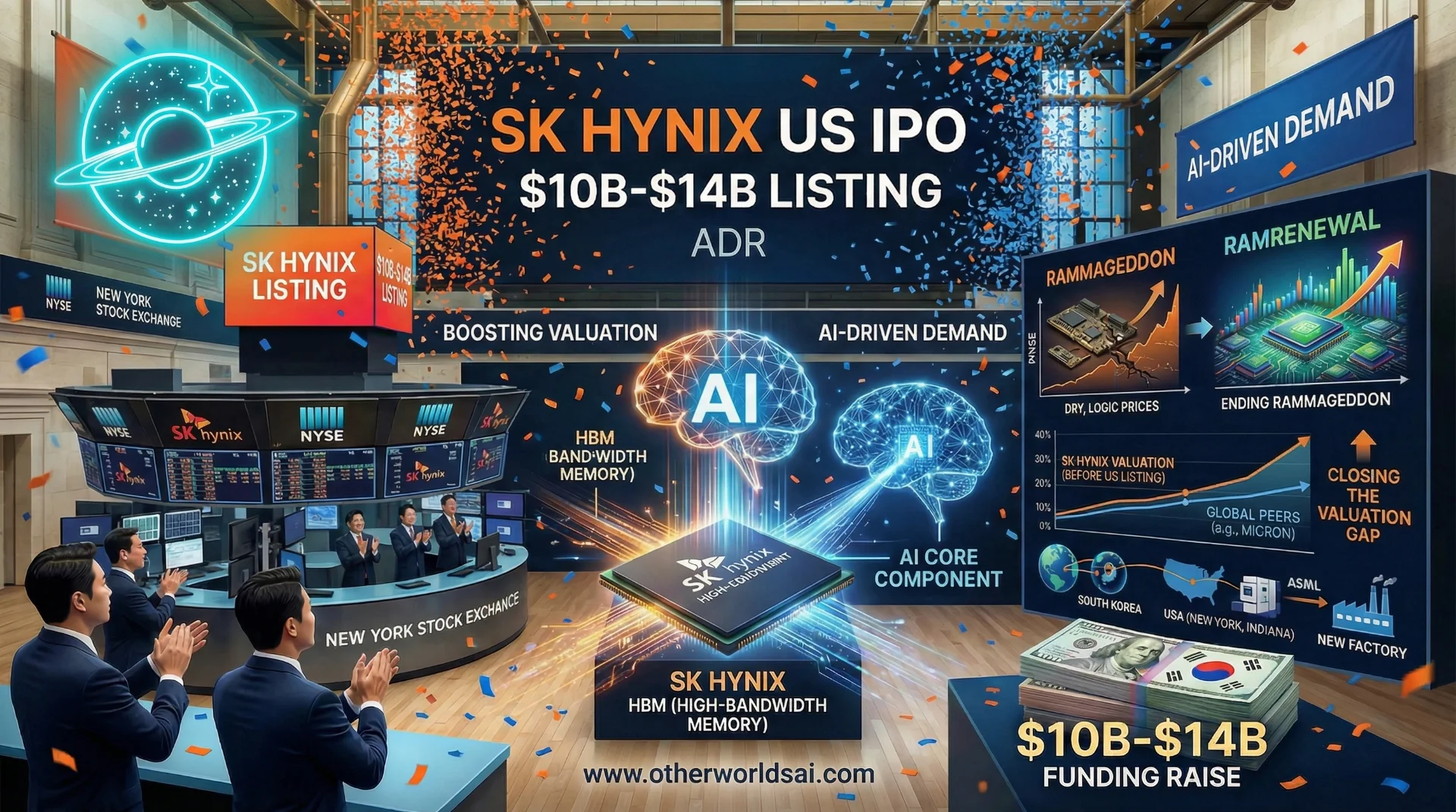

Is the RAM Shortage Over? SK hynix Targets Wall Street to Stop ‘RAMmageddon’
SK Hynix's Blockbuster US IPO: How a Korean Chip Giant Could Help End 'RAMmageddon'
The least surprising move in the AI chip supply chain is the one SK Hynix announced this week.
A $14 Billion US Listing, a Memory Crisis, and a Very Ambitious Korean Chipmaker:
The artificial intelligence revolution runs on memory — and right now, the world does not have enough of it. Soaring demand, constrained supply, and a crisis the industry has grimly nicknamed "RAMmageddon" have turned high-bandwidth memory into one of the most strategically critical commodities on the planet. Against that backdrop, SK Hynix — South Korea's memory chip giant and one of the most important players in the global AI supply chain — has quietly filed the paperwork for a potential US IPO that could raise between $10 billion and $14 billion.
What makes this filing extraordinary is not just its size — it is its timing. SK Hynix has confidentially submitted a Form F-1 with the SEC, targeting a listing in the second half of 2026. The company already trades on the KOSPI in Seoul with a market capitalisation of around $440 billion. But despite its critical role supplying high-bandwidth memory (HBM) to Nvidia and the rest of the AI chip ecosystem, its valuation multiples have historically traded at a discount to US-listed peers. A US listing is designed to fix that.
Did anyone seriously think SK Hynix could keep sitting on the sidelines of the US market forever?
For those tracking the global AI infrastructure race closely, this filing is not just a capital markets event. It is a signal — about how the AI chip supply chain is being restructured, who controls the memory bottleneck, and why Korean semiconductor companies are increasingly looking to Wall Street to close a valuation gap that Seoul has failed to correct on its own.
Who Is SK Hynix: The Memory Giant Powering the AI Revolution:
SK Hynix is not a household name in the way Nvidia or Apple is — but it arguably sits at an equally critical point in the AI supply chain. The company is one of the world's leading producers of high-bandwidth memory (HBM), the specialised chip architecture that allows AI systems to process vast amounts of data at the speeds required by modern large language models. Without HBM, the AI systems built by OpenAI, Google, and Meta simply could not function at scale.
Despite that centrality, the market has not rewarded SK Hynix accordingly. A Seoul-based semiconductor analyst told TechCrunch that the company has historically traded at a discount to global peers — not because of weaker fundamentals, but partly because of where it lists. Geography, not performance, appears to be suppressing its valuation. The US IPO is a direct attempt to correct that structural anomaly by putting SK Hynix in front of the world's deepest and most liquid capital markets.
The TSMC precedent makes the case compellingly. Taiwan Semiconductor Manufacturing Company has at times seen its US-listed shares trade at a premium to its domestic shares — particularly during periods of strong AI-driven demand — suggesting that a cross-listing can genuinely influence how investors price the same underlying business.
The Valuation Gap: Why Seoul Is Not Enough Anymore:
The core argument for SK Hynix's US listing is straightforward — and the numbers support it. The company has comparable, and in some areas superior, production capacity to US-based chipmakers. Its HBM technology is at the cutting edge of what the AI industry requires. Its market cap sits at approximately $440 billion. And yet its valuation multiples remain below those of US-listed semiconductor firms, according to analysts who cover the sector closely.
"SK hynix's US listing could help close a long-standing valuation gap with global peers," the Seoul-based analyst noted, pointing to structural and geographic factors that have historically weighed on the stock's pricing relative to its American counterparts.
The structural constraints around the deal are also worth understanding. SK Square, SK Hynix's largest shareholder, held 20.07% of the company as of December 2025 and is required under Korea's holding company rules to maintain a stake of at least 20%. Based on current share prices, issuing roughly 2% in new shares could raise the targeted $10 billion to $14 billion while keeping SK Square above that ownership threshold — a tightly engineered capital raise designed to maximise proceeds without triggering regulatory complications.
RAMmageddon: The Memory Crisis Driving the Urgency:
There is a reason SK Hynix is moving now, and it goes well beyond valuation. The AI industry is consuming memory at a pace the global supply chain was not built to sustain. Soaring costs for memory and severely limited supply have become one of the primary bottlenecks slowing AI infrastructure builds — affecting not just the hyperscalers and data centre operators, but filtering down to consumer markets including PC gamers. The industry has a name for this crisis: RAMmageddon. And according to Nature, it is expected to persist until at least 2027.
The tech giants are not waiting passively. Google this week introduced a technology called TurboQuant — an ultra-efficient AI memory compression algorithm designed to allow AI systems to operate vastly more efficiently within existing memory constraints. It is a software-level response to a hardware-level problem. But the signals from across the industry are clear: compression algorithms alone will not be sufficient. More physical memory production is necessary, and SK Hynix intends to be the company that provides it.
The Capital Plan: $400 Billion, Indiana, and the ASML Deal:
SK Hynix is not raising $10 billion to $14 billion as a defensive measure — it is gearing up for one of the most capital-intensive expansion programmes in semiconductor history. The company's CEO Noh-Jung Kwak told shareholders at the annual general meeting on March 25 that financial capacity will be key to sustaining growth in the AI era, with the company targeting approximately $75 billion in net cash to support long-term investments.
The scale of what SK Hynix is planning is almost difficult to absorb. The company has announced plans to invest around $400 billion by 2050 to build a semiconductor cluster in Yongin, South Korea. It is constructing new facilities in South Korea and Indiana, with planned investments of approximately $25 billion and $3.3 billion respectively. And this week it announced a $7.9 billion deal to acquire advanced extreme ultraviolet (EUV) lithography scanners from ASML by 2027 — specifically aimed at boosting HBM production for AI applications.
All of this capital expenditure requires funding at a scale that the Korean domestic market alone cannot efficiently provide. The US IPO is not incidental to SK Hynix's expansion strategy — it is the financial foundation on which the entire programme rests.
The Samsung Ripple: How One Filing Is Reshaping Korean Chip Strategy:
The consequences of SK Hynix's filing are already extending well beyond the company itself. Following the announcement, some investors are now pushing Samsung Electronics — South Korea's other semiconductor giant — to consider a similar US listing. Artisan Partners, a major Samsung shareholder, said on Friday that a US listing in the form of an American Depositary Receipt (ADR) could help Samsung boost its valuation and give US retail investors direct access to its stock, according to a Bloomberg report.
The pattern here is familiar. One high-profile cross-listing validates the thesis, reduces the perceived risk for others, and creates competitive pressure on peers to follow. If SK Hynix's US debut is well-received by the market — and the AI-driven demand story makes a compelling case for investors — Samsung may find it increasingly difficult to justify remaining exclusively listed in Seoul while its primary competitor accesses deeper and more generously valued capital markets.
Key Takeaways: The SK Hynix US IPO Story at a Glance:
Here is a summary of the key developments covered in this article:
-
SK Hynix US IPO: South Korea's memory chip giant has confidentially filed a Form F-1 with the SEC, targeting a US listing in the second half of 2026.
-
$10B–$14B raise: The listing is expected to raise between $10 billion and $14 billion through the issuance of roughly 2% in new shares.
-
Valuation gap: Despite a $440 billion market cap and critical HBM production capacity, SK Hynix has historically traded at a discount to US-listed semiconductor peers.
-
RAMmageddon: Soaring AI-driven demand and constrained memory supply have created a global shortage expected to persist until at least 2027.
-
TSMC precedent: Taiwan Semiconductor has at times seen its US-listed shares trade at a premium to its domestic shares, validating the cross-listing strategy.
-
$400 billion expansion: SK Hynix plans to invest $400 billion by 2050 in semiconductor infrastructure, including facilities in South Korea and Indiana.
-
$7.9 billion ASML deal: SK Hynix will acquire advanced EUV lithography scanners by 2027 to boost HBM production for AI.
-
Samsung ripple effect: Following SK Hynix's filing, major investors are now pushing Samsung Electronics to pursue a similar US listing.
Conclusion: The Bet That Was Always Going to Come Due:
At some point, someone at SK Hynix looked at the valuation gap, looked at the capital requirements, looked at the scale of what RAMmageddon demands — and decided the window was now. The Form F-1 was filed. The $14 billion target was set. The Indiana facility is under construction. Maybe the US market would close the gap. Maybe the AI memory supercycle would provide the tailwinds the Seoul listing never could.
The structure of this deal suggests the conviction runs deep. Given everything at stake in the global AI infrastructure race — the memory bottleneck, the capital intensity, the competitive pressure from US-listed peers, and the Samsung investors already watching closely — the idea that SK Hynix could remain permanently undervalued while powering the AI systems that are reshaping the global economy was always an unsustainable position. The US IPO is how SK Hynix corrects that.
For semiconductor investors, AI infrastructure strategists, and technology executives navigating an increasingly capital-intensive landscape, the message embedded in this filing is unambiguous:
the organisations that control the memory supply chain — and secure the capital to scale it — will be best positioned to define the AI decade ahead.
Support our research
Independent analysis fueled by you.