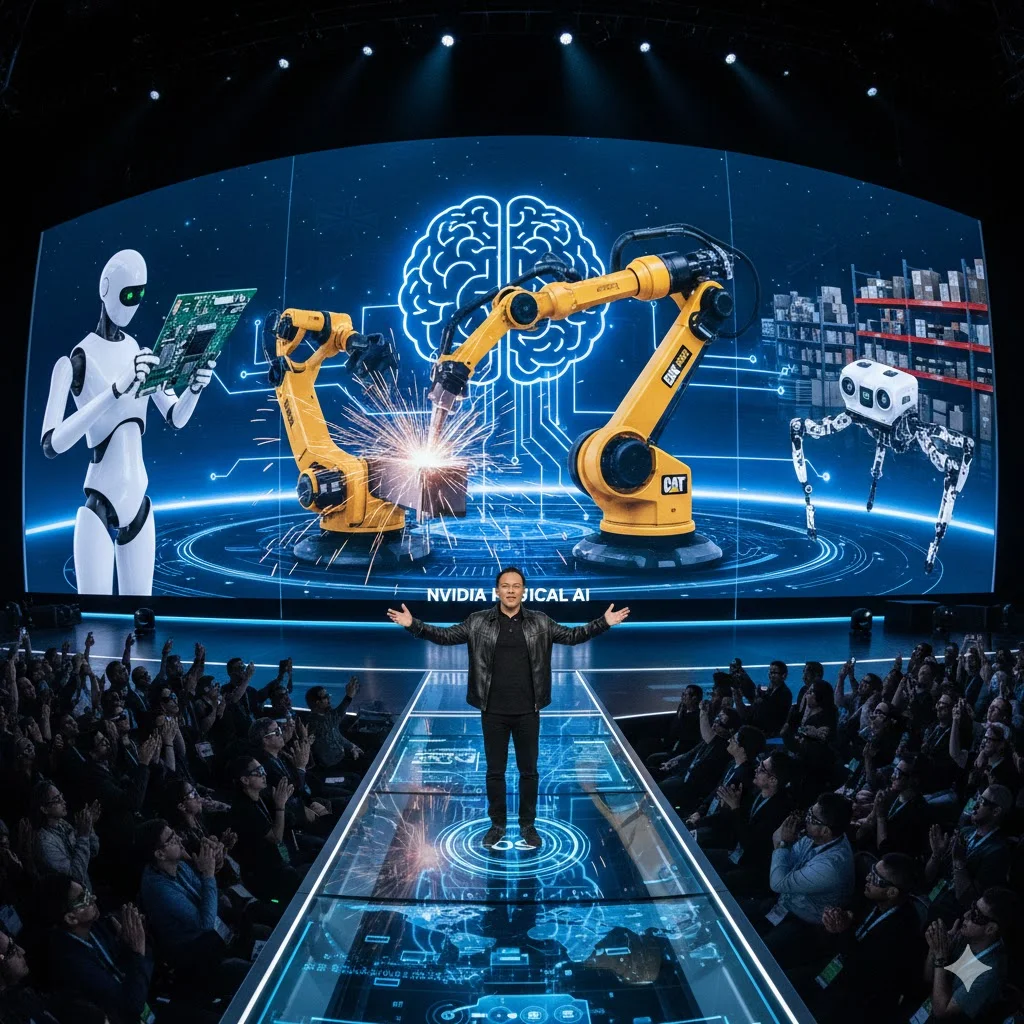
CES 2026 Marks the Turning Point for Robotics and Physical AI:
The robotics industry has officially reached its “ChatGPT moment.”
At CES 2026, Nvidia unveiled what may become the most consequential platform shift in robotics history: a full-stack Physical AI ecosystem that combines foundation models, simulation environments, and next-generation edge AI hardware into a unified, open framework.
Much like Android standardized smartphones and unlocked an entire app economy, Nvidia’s new robotics stack aims to do the same for autonomous machines—from humanoid robots and warehouse automation to industrial manipulators and service robotics.
As artificial intelligence moves off the cloud and into the physical world, Nvidia is positioning itself not merely as a chipmaker, but as the brain and nervous system of the future robotic economy.
From Digital AI to Physical AI: Why This Shift Matters:
Until now, most AI breakthroughs have lived in software: chatbots, copilots, recommendation systems, and large language models. Robotics lagged behind due to three major bottlenecks:
-
Lack of general-purpose robot intelligence.
-
High cost of real-world training and failure.
-
Fragmented hardware and software ecosystems.
Nvidia’s CES 2026 announcements directly target all three.
This marks the rise of Physical AI—AI systems that can perceive, reason, and act in real-world environments with spatial awareness, physics understanding, and autonomy.
The New “Brains” of Physical AI: Cosmos and GR00T:
At the heart of Nvidia’s strategy is a move away from narrow, task-specific robotics toward generalist robots—machines that can adapt to new tasks, environments, and instructions without being reprogrammed.
1. Cosmos World Models: Teaching Robots to Imagine:
Nvidia introduced Cosmos, a family of open foundation models released on Hugging Face, designed to help robots simulate reality before acting.
🔹 - Cosmos Predict 2.5:
A unified multimodal Text-to-World, Image-to-World, and Video-to-World model that generates physics-aware synthetic video. Robots can “mentally simulate” future outcomes—testing actions before executing them in the real world.
🔹- Cosmos Transfer 2.5:
A control-net–style framework that solves one of robotics’ hardest problems: Sim2Real transfer. Skills learned in simulation now transfer reliably to physical robots, reducing costly trial-and-error.
🔹 - Cosmos Reason 2:
A reasoning Vision-Language Model (VLM) that serves as the cognitive core. It enables robots to understand spatial relationships, temporal sequences, and natural-language instructions—bridging perception and action.
Together, Cosmos functions as a world model layer, something robotics has historically lacked.
Isaac GR00T N1.6: The Foundation Model for Humanoid Robots:
The headline reveal at CES 2026 was Isaac GR00T N1.6, Nvidia’s most advanced Vision-Language-Action (VLA) model designed specifically for humanoid robots.
Powered by Cosmos Reason, GR00T enables:
-
Whole-body motor control.
-
Real-time balance and locomotion.
-
Dexterous object manipulation.
-
Human-like motion coordination.
Instead of controlling limbs independently, GR00T treats the robot as a single embodied system, allowing fluid movement similar to biological motion.
This is a major leap toward general-purpose humanoid robots capable of working alongside humans in factories, hospitals, and homes.
Blackwell at the Edge: Jetson T4000 Changes the Economics of Robotics:
World-class Physical AI requires serious compute—but until now, that compute was expensive, power-hungry, and cloud-dependent.
Nvidia addressed this with the Jetson T4000, powered by the Blackwell architecture.
Key Jetson T4000 Specs:
-
1200 TOPS (teraflops) of AI compute.
-
64GB unified memory.
-
40–70W power envelope.
-
$1,999 price point (at volume).
This effectively democratizes high-end robotics, allowing startups, researchers, and industrial firms to deploy advanced AI locally—without cloud latency or massive infrastructure costs.
Jetson T4000 makes real-time, on-device Physical AI commercially viable.
Scaling Robotics Safely: Isaac Lab-Arena and OSMO.
Physical robots are expensive to break. Nvidia’s solution is to shift experimentation into simulation at massive scale.
Isaac Lab-Arena: Open-Source Robotics Simulation.
Hosted on GitHub, Isaac Lab-Arena introduces:
-
Modular “Lego-style” environments.
-
Standardized robotics benchmarks (Libero, RoboCasa, and more)
-
Reproducible evaluation pipelines.
This creates a shared testing standard—something robotics has never had.
Nvidia OSMO: The Command Center:
OSMO acts as a bridge between local development and cloud-scale data generation. Developers can train locally, scale simulations in the cloud, and deploy back to edge hardware seamlessly.
This end-to-end loop dramatically shortens robotics development cycles.
Hugging Face Partnership: Capturing the Developer Ecosystem:
Nvidia’s integration with Hugging Face LeRobot may be one of the most strategically important moves of CES 2026.
-
Connects 2 million robotics developers.
-
Links to 13 million AI practitioners.
-
Enables open experimentation without vendor lock-in.
The open-source Reachy 2 humanoid robot now runs directly on Jetson Thor hardware, allowing developers to swap models, datasets, and control policies transparently.
This openness mirrors Android’s success—and stands in stark contrast to closed, proprietary robotics stacks.
Why Nvidia’s Robotics Strategy Will Shape 2026–2030:
Nvidia is no longer just selling GPUs. It is building the operating system for the physical world. By controlling:
-
🧠 Intelligence (Cosmos, GR00T)
-
🧪 Training & Simulation (Isaac Lab, OSMO)
-
⚙️ Hardware (Blackwell, Jetson)
Nvidia creates a gravitational platform that robotics companies naturally orbit.
Early adopters already include:
-
Boston Dynamics.
-
Caterpillar.
-
NEURA Robotics.
-
Industrial automation leaders and logistics firms.
Meanwhile, robotics has become one of the fastest-growing categories on Hugging Face, signaling explosive developer interest.
Final Thoughts: The Android Moment Has Arrived for Robotics:
CES 2026 may be remembered as the moment robotics finally crossed from research labs into scalable industry.
The race is no longer about building a single impressive robot—it’s about building generalist Physical AI platforms that can adapt, learn, and scale across domains.
With Nvidia’s ecosystem in place, the question is no longer if autonomous robots will become mainstream—but how fast.
The Physical AI era has officially begun.