
Hey everyone,
We hear the term "AI" thrown around a lot these days, right? From self-driving cars to personalized movie recommendations, it feels like artificial intelligence is everywhere. But here's a little secret: not everything we label as AI actually is.
I just read a fascinating article that breaks down the true definition of AI, and it's a game-changer for understanding the tech landscape. It all goes back to a foundational workshop in 1955 at Dartmouth, where researchers envisioned machines simulating "every aspect of learning or any other feature of intelligence."
So, what truly qualifies as AI, and why is it important to know the difference?
The Key Distinction: Learning and Adapting:
The core idea is this: for a system to count as AI, it must be able to learn and adapt. This is crucial. It means that simple automation tools, basic decision-making programs, or statistical models – while incredibly useful – aren't technically AI. They do what they're programmed to do, but they don't learn from new data in the way true AI does.
Think about it: Your calculator is smart, but it doesn't learn from its mistakes. A simple program that sorts emails isn't AI, because it just follows rules.
Two Main Types of AI (and Where We Are Now)
The article highlights two main categories:
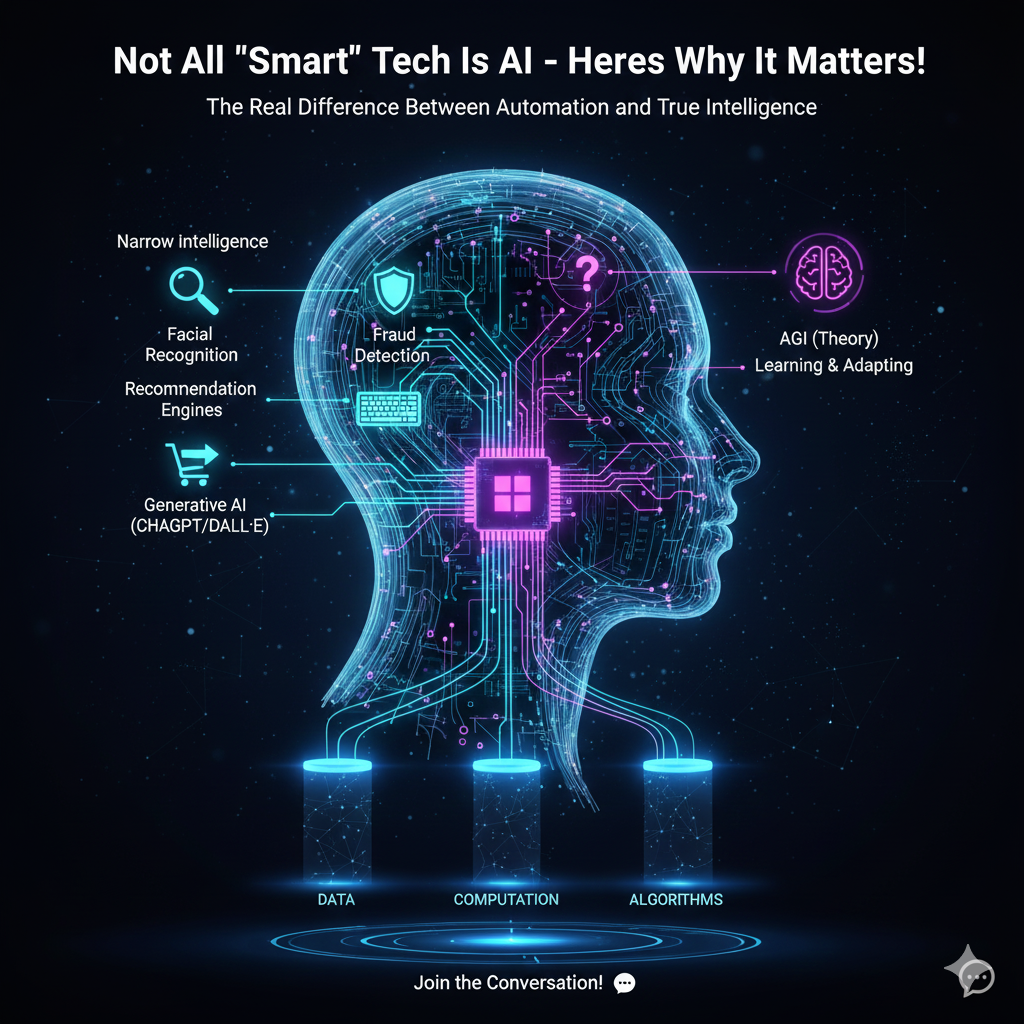
Artificial Narrow Intelligence (ANI): This is what we have today. These systems are brilliant at specific tasks. Think of facial recognition, fraud detection, or even the incredible capabilities of generative AI like ChatGPT and DALL·E 2. They excel in the domain they were trained on, but they can't cross over. ChatGPT can write a poem, but it can't diagnose a patient (not without specific medical training, anyway).
Artificial General Intelligence (AGI): This is the holy grail, the theoretical "human-level" AI we often see in sci-fi. AGI would possess the full range of human cognitive abilities – able to learn any task, reason, and adapt across diverse domains. Crucially, AGI does not exist yet. The challenge is immense: to model the entire world and all human knowledge consistently.
The Power Behind Today's AI Leap:
So, if AGI is still theoretical, why does AI feel so revolutionary right now? It's thanks to massive leaps in what fuels ANI:
Neural Networks & Deep Learning: These mimic the human brain's structure, processing data through layers of nodes. This allows them to "learn" from vast amounts of information and recognize complex patterns.
The "Big Three" Pillars:
- Data: AI thrives on huge, high-quality, and (ideally) unbiased datasets. Think billions of lines of code or online texts.
- Computation: The sheer processing power needed to train these enormous models (like GPT-3's 175 billion parameters!) has become available through cloud computing.
- **Algorithms: **Constant innovation in the designs of these learning models has allowed for unprecedented breakthroughs.
Why Does This Distinction Matter to You?
Understanding the difference helps us set realistic expectations. Today's AI is powerful, but it's still "narrow." It’s a tool designed for specific purposes. This knowledge also empowers us to engage more thoughtfully with discussions around AI's ethical implications, such as data exploitation, misinformation, and job displacement.
The future of AI rests on these three pillars: data, computation, and algorithms. And all signs point to continued, rapid advances. It’s an exciting time, but a discerning eye on what we call "intelligence" is more important than ever.

Meta's Next Big Bet: This New App Lets You Build Games Simply by Typing a Prompt
What are your thoughts? Do you find this distinction helpful? Let's discuss in the comments!
Support our research
Independent analysis fueled by you.