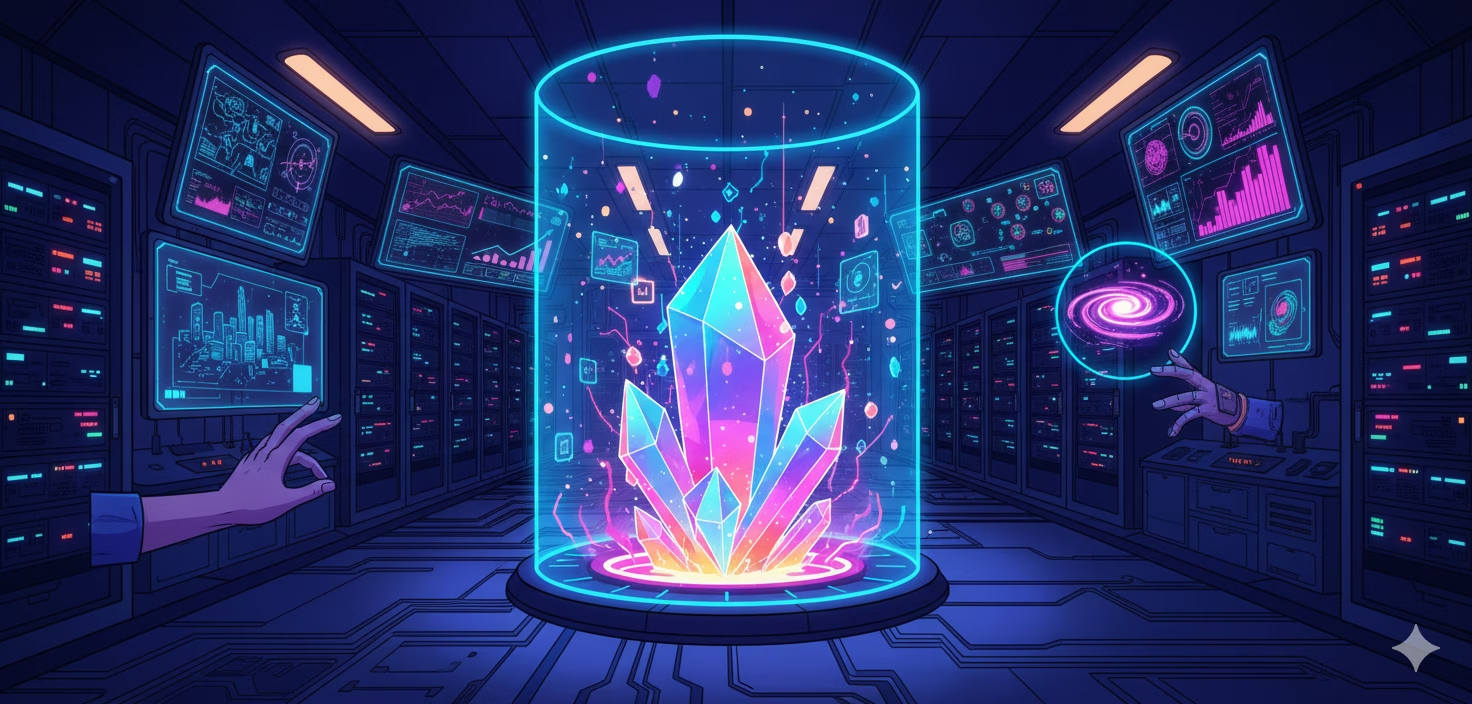
Artificial intelligence has made massive strides in creating realistic images, but one of the biggest roadblocks has always been speed and hardware requirements. Most state-of-the-art models demand powerful GPUs and cloud servers, making them expensive and inaccessible for the average user. That might be about to change. Scientists at South Korea’s Electronics and Telecommunications Research Institute (ETRI) have unveiled a next-generation image generator that is not only eight times faster than OpenAI’s best tools, but also capable of running on low-cost hardware.
How They Did It: Knowledge Distillation:
The breakthrough comes from a technique known as knowledge distillation. Instead of training a massive model from scratch, researchers compress an existing large model into a smaller, leaner version — one that retains nearly the same accuracy but requires far less computational power. In this case, the team condensed Stable Diffusion XL, a cutting-edge but resource-hungry AI, into a highly optimized form that can run with just 8GB of RAM and affordable GPUs.
Why This Is a Big Deal:
- Accessibility – Creators, students, and small businesses can now use advanced AI art tools without investing thousands of dollars in hardware or cloud subscriptions.
- Speed – The system generates images at lightning speed, making it practical for industries like game design, animation, and marketing.
- Democratization of AI – Powerful creative tools are no longer limited to tech giants or elite labs.
Potential Applications:
- Indie game developers could design assets quickly on consumer-grade laptops.
- Artists and designers can experiment in real-time without waiting on cloud queues.
- Education and research institutions in developing regions could gain access to advanced generative AI without massive infrastructure costs.
The Bigger Picture:
This innovation highlights a broader trend in AI: efficiency is becoming just as important as raw power. While companies like OpenAI, Google, and Meta push the boundaries with billion-parameter models, researchers worldwide are finding clever ways to shrink them without sacrificing quality. If these approaches continue to advance, we may soon see consumer devices — even smartphones — running image generators that rival today’s cloud-based giants.