
Netflix May Have Paid $600 Million for Ben Affleck's AI Startup: Inside Hollywood's Biggest AI Acquisition:
The Streaming Giant's Massive Bet on AI Post-Production Could Reshape the Future of Film and TV Creation.
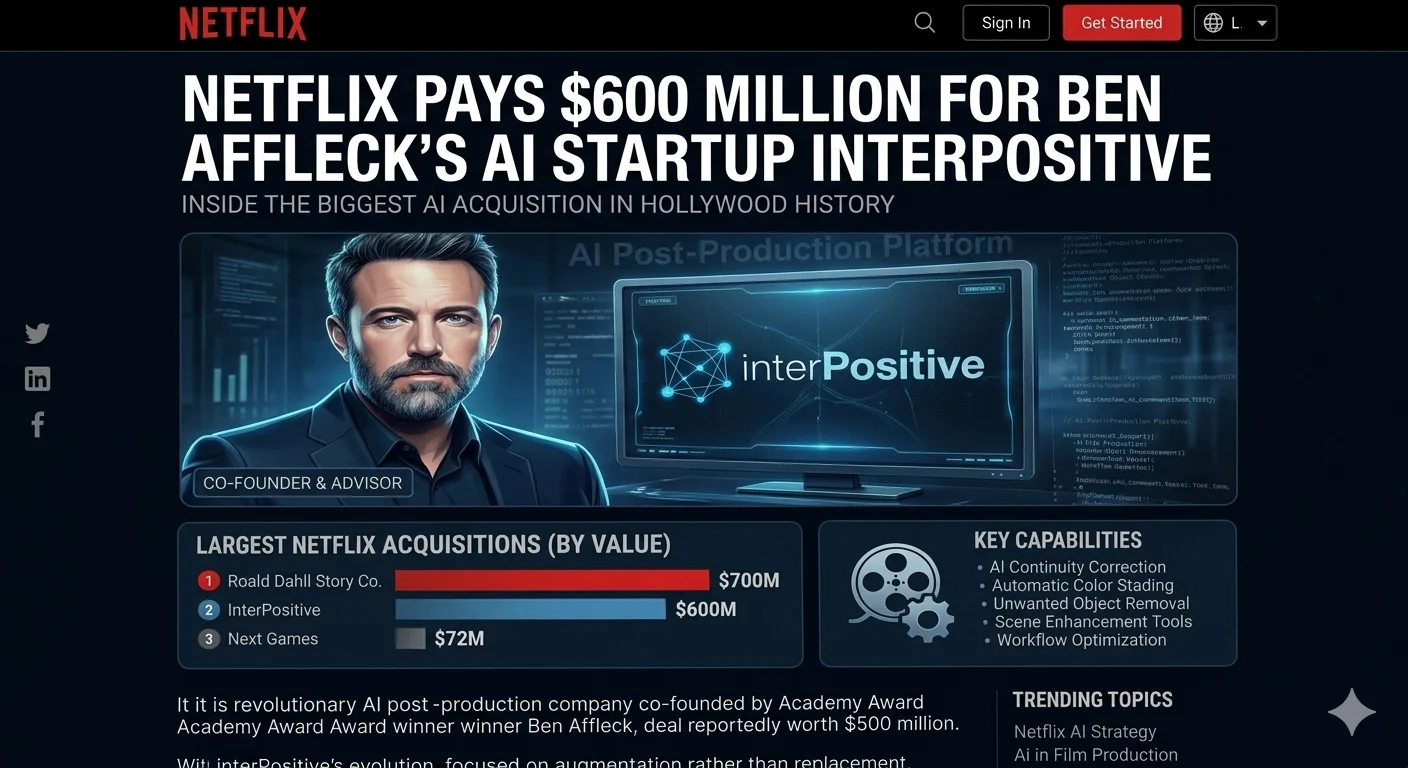
The AI in Hollywood landscape is shifting fast — and Netflix just placed one of the biggest bets in entertainment industry history. Last week, the streaming giant announced the acquisition of InterPositive, an AI-powered post-production company co-founded by Academy Award winner Ben Affleck, in a deal that could be worth up to $600 million according to Bloomberg.
If you've been following the rise of AI in film production,generative AI for video editing, and the growing tension between Hollywood AI adoption and creative workforce concerns, this acquisition represents one of the most significant developments of 2026 — and it's worth understanding exactly what it means for the future of content creation.
This deal could rank among Netflix's largest acquisitions ever. For context, the most Netflix has ever paid for a single acquisition was approximately $700 million for the Roald Dahl Story Company — meaning the InterPositive deal, if confirmed at $600 million, would be the streaming service's second-largest purchase in company history. That scale of investment signals Netflix's conviction that AI-powered post-production tools will become essential infrastructure for competitive content creation.
While Netflix has not publicly confirmed the financial details, sources tell Bloomberg that the actual cash payment may be lower than the headline $600 million figure, with the owners of InterPositive eligible for additional payouts tied to specific performance targets. This earn-out structure is common in large tech acquisitions where the acquirer wants to incentivize continued innovation and retention of key talent after the deal closes.
What Is InterPositive and What Does It Actually Do:
At its core, InterPositive is an AI-powered post-production tool designed to help filmmakers work more efficiently during the editing and finishing phases of film and television production. Unlike generative AI tools that create new content from scratch, InterPositive focuses on enhancing, correcting, and optimizing existing footage — addressing technical and creative challenges that traditionally require time-consuming manual work.
InterPositive makes tools that help filmmakers address continuity issues, enhance scenes, adjust lighting and color grading, remove unwanted objects or errors, and streamline the post-production workflow. Critically, the company has positioned itself as focused on augmentation rather than replacement — it doesn't generate new content from scratch or use footage without permission, two practices that have generated significant controversy in the broader AI and entertainment intersection.
The distinction is important: InterPositive's approach is designed to assist human editors and post-production teams rather than replace them entirely. This positioning may help Netflix navigate some of the intense labor concerns and union negotiations that have complicated AI adoption across Hollywood.
Key Capabilities of InterPositive's AI Post-Production Platform:
According to industry sources and company positioning, InterPositive's platform excels in:
-
Continuity correction: Automatically identifying and fixing continuity errors in footage, such as wardrobe inconsistencies, prop placement mistakes, or lighting variations between shots.
-
Scene enhancement: Improving visual quality of existing footage through AI-powered color grading, lighting adjustments, and visual refinement.
-
Object removal and correction: Digitally removing unwanted elements from scenes, such as crew members accidentally captured in frame, anachronistic objects, or visual distractions.
-
Post-production workflow optimization: Streamlining the editing process by automating time-consuming technical tasks, allowing creative teams to focus on storytelling.
In practice, these capabilities address some of the most expensive and time-intensive aspects of modern film and television production. Post-production can account for a substantial portion of overall production budgets, and tools that accelerate this phase while maintaining quality could generate significant cost savings at Netflix's scale of content creation.
Why Netflix Is Betting Big on AI Post-Production:
Netflix's acquisition of InterPositive fits the company's broader strategic push to integrate AI into content production at every level. The streaming giant has already used generative AI in its original shows and movies, including creating a building-collapse scene in the Argentine series "The Eternaut" — demonstrating willingness to adopt AI tools that deliver production efficiencies.
The business case for AI post-production is compelling. Netflix produces hundreds of original films and series annually across global markets. Any technology that can reduce post-production timelines, lower costs, or improve quality at scale translates into competitive advantage. If InterPositive's tools can shave even 10-15% off post-production budgets or timelines across Netflix's entire content slate, the $600 million acquisition could pay for itself relatively quickly.
Beyond cost savings, AI post-production tools enable creative possibilities that would be prohibitively expensive or technically challenging with traditional methods. Complex visual effects, extensive reshoots to fix continuity issues, or last-minute creative changes late in production all become more feasible when AI can handle technical execution quickly.
The Bigger Picture — Hollywood's AI Arms Race Accelerates:
The Hidden AI War
Nobody Is Telling You About
Our latest documentary deep-dive into the geopolitical struggle for machine intelligence dominance. Explore the two paths of AI development: open source vs. closed architecture.
Netflix's InterPositive acquisition is part of a much larger pattern of major entertainment companies racing to integrate AI into film and television production. The streaming and studio landscape is rapidly dividing between AI-forward companies building proprietary capabilities and those taking a more cautious, wait-and-see approach.
Rivals are moving aggressively in the same direction. Amazon is building in-house AI teams dedicated to film and TV projects, developing proprietary tools for everything from script analysis to visual effects generation. Disney has struck a strategic deal with OpenAI to explore generative AI applications across its entertainment portfolio, from animation to live-action production.
The competitive dynamic is clear: companies that successfully integrate AI into production workflows will be able to produce more content, faster, at lower cost — potentially creating unsustainable competitive pressure on rivals who don't adopt similar technologies. For Netflix, which has bet its entire business model on content volume and quality, falling behind in AI adoption could be strategically catastrophic.
Ben Affleck's Role: From Actor-Director to AI Entrepreneur:
InterPositive was co-founded by Ben Affleck, adding Hollywood credibility and insider expertise to what might otherwise be viewed as just another Silicon Valley AI startup. Affleck's involvement signals that InterPositive was built with deep understanding of actual filmmaker needs and production workflows, rather than being technology looking for a problem to solve.
Affleck's dual role as acclaimed filmmaker and AI entrepreneur gives InterPositive unique positioning in the market. The company can claim authentic understanding of creative processes and production realities in ways that pure-tech AI startups cannot. That credibility may have been a significant factor in Netflix's decision to acquire rather than build competing technology internally.
The deal also raises interesting questions about celebrity entrepreneurship in the AI era. Affleck joins a growing roster of entertainment industry figures investing in or founding AI companies focused on film and TV production — a trend that could accelerate as traditional content creation roles become more technology-dependent.
Challenges and Controversies:
Not everyone in Hollywood is celebrating the AI post-production revolution. Workers across the film industry have raised serious concerns about potential job losses, whether AI companies are compensating creators fairly for training data, and the long-term implications of automating creative and technical roles.
The union perspective is deeply skeptical. Film industry unions including IATSE (representing editors, visual effects artists, and other post-production workers) have been negotiating contract language around AI use, seeking protections against displacement and guarantees of human oversight in creative decisions. Netflix's $600 million acquisition of an AI post-production company will likely intensify these labor tensions.
The training data question remains contentious. How was InterPositive's AI trained? Did it use copyrighted film and television content without compensation? These questions have generated massive litigation in other AI domains (music, writing, visual art) and could create legal exposure for Netflix if the training data provenance isn't defensible.
Job displacement fears are not hypothetical. Post-production departments employ thousands of skilled professionals — editors, colorists, VFX artists, sound designers — whose roles could be automated or dramatically reduced if AI tools become sufficiently capable. The social and economic implications of that workforce disruption extend far beyond Hollywood.
Is This the Future of Hollywood Production:
The question isn't whether AI will transform post-production — it clearly already is. The question is whether that transformation will benefit the industry broadly or concentrate power and profit among a small number of technology-enabled giants like Netflix.
If AI post-production tools democratize access to high-quality finishing capabilities, enabling independent filmmakers and smaller studios to achieve results previously available only to big-budget productions, the impact could be positive for creative diversity and competition.
If AI post-production tools become proprietary advantages controlled by deep-pocketed streamers like Netflix, Amazon, and Disney, the result could be further consolidation of the entertainment industry and reduced opportunities for independent creators.
For now, Netflix's $600 million bet on InterPositive stands as the clearest signal yet that Hollywood's biggest players view AI post-production not as optional enhancement but as essential infrastructure for the future of content creation.
Whether Ben Affleck's AI startup delivers on that promise, whether Netflix successfully integrates the technology across its production pipeline,
and whether the industry finds ways to adopt AI without devastating creative workforce — these are the questions that will define the next chapter of Hollywood's technological evolution.