
Meta AI App Surges to #5 on US App Store After Muse Spark AI Model Launch:
Alexandr Wang’s First Act: Meta AI Installs Skyrocket 87% Following Overhaul.
Introduction: Meta AI's Dramatic App Store Comeback:
Meta AI rewrites the app store leaderboard: In one of the most dramatic single-day jumps in recent tech history, Meta's AI app rocketed from obscurity straight into the top five of the U.S. App Store — all thanks to a single product launch. The arrival of Muse Spark, Meta's newest and most advanced AI model, has done what billions in investment and months of hype could not: convince everyday consumers to download and try Meta's AI product. This is the story of how Meta's bold bet on AI superintelligence is finally beginning to pay off in real numbers.
What is Muse Spark and why does it matter? Muse Spark is the first AI model released under the newly formed Meta Superintelligence Labs, led by Alexandr Wang — the recruited co-founder and former CEO of Scale AI. The launch signals Meta's most serious push yet to compete with OpenAI's ChatGPT and Anthropic's Claude in the rapidly expanding AI assistant market. This blog breaks down everything you need to know: the download data, the product features, the privacy considerations, and what it all means for the future of AI chatbots.
App Store Rankings: From #57 to #5 Overnight:
-
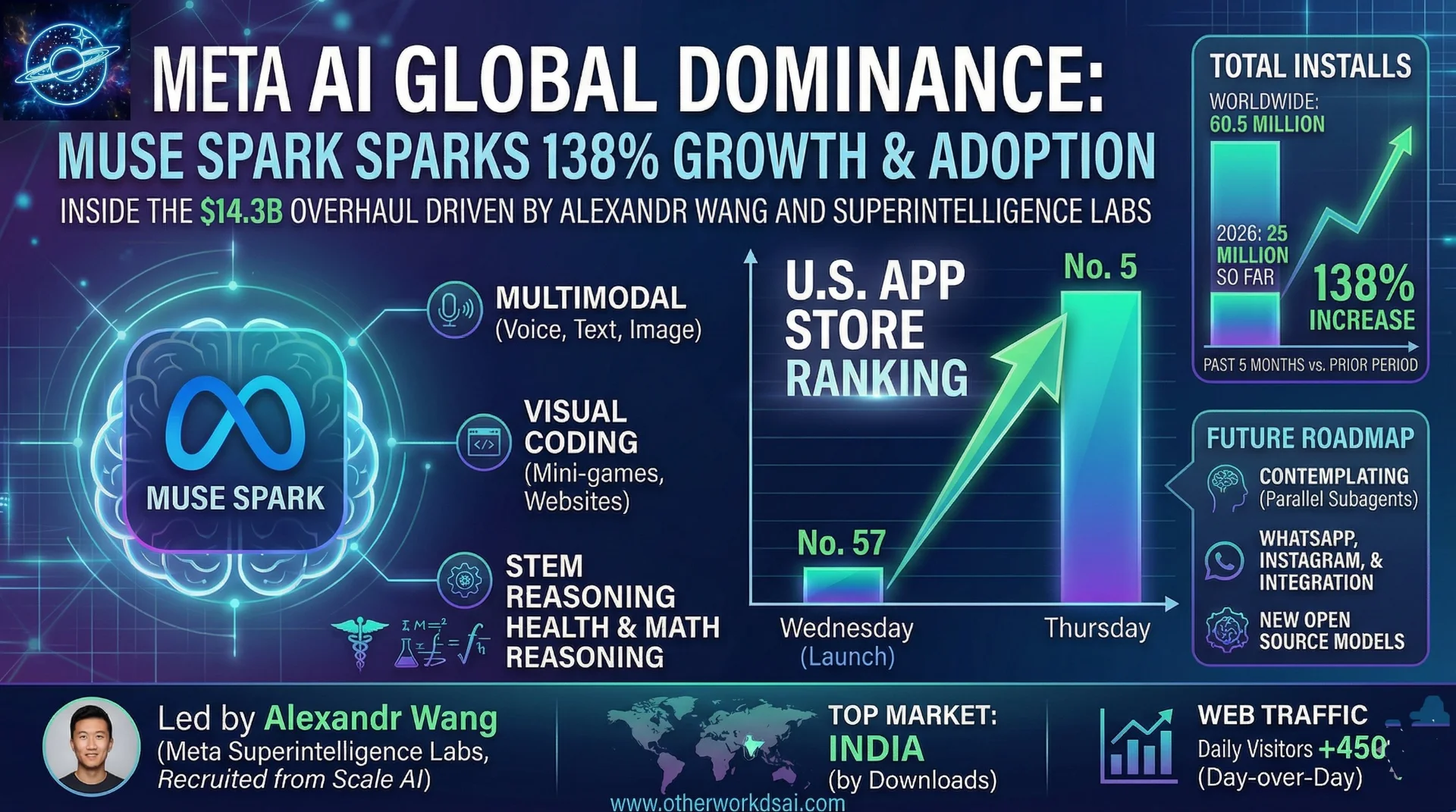
The numbers tell a jaw-dropping story: According to market intelligence provider Appfigures, the Meta AI app climbed from No. 57 on the U.S. App Store just before the Muse Spark launch on Wednesday, April 8, 2026, all the way to No. 5 by Thursday — a seismic leap that points to a massive flood of new installs driven by consumer curiosity and excitement around the new model.
-
87% surge in iOS downloads overnight: Sensor Tower estimated that Meta AI saw approximately 46,000 U.S. iOS app downloads on April 8, 2026, representing an 87% day-over-day increase. Meanwhile, Android downloads in the U.S. rose a more modest 3% day-over-day on the same date.
-
Web traffic shatters all-time records: Beyond the app stores, the excitement translated directly into explosive web traffic. Sensor Tower's data revealed that daily web visitors for Meta AI in the U.S. rose more than 450% day-over-day, and that the platform reached an all-time high in U.S. daily web visitors on April 8, 2026 —
A figure that represented an increase of more than 570% compared to the 30-day average preceding the launch. These aren't just impressive statistics — they represent a fundamental shift in consumer awareness and adoption of Meta's AI products.
Global Download Milestones: 60.5 Million Installs Worldwide:
-
Meta AI's global footprint is rapidly expanding: Appfigures data reveals that the Meta AI app has been installed a total of 60.5 million times worldwide across both the App Store and Google Play, with 25 million of those downloads occurring in 2026 alone. That is a staggering pace of growth for a product that continues to battle more established players in the AI assistant space.
-
Download growth accelerates dramatically over five months: Over the past five months, Meta AI app downloads have increased by 138% compared to the first five months of the app's availability, according to Appfigures. This trajectory suggests that consumer momentum is accelerating, not stagnating — a promising sign for Meta's long-term AI strategy.
-
Top Markets by Downloads: India leads the charge as Meta AI's number one market by total downloads, followed by the United States, Brazil, Pakistan, and Mexico. This global distribution underscores Meta's unique advantage: a pre-existing social media ecosystem with billions of active users across WhatsApp, Instagram, and Facebook.
-
Alexandr Wang celebrates the milestone publicly: Wang — who was recruited from Scale AI to overhaul Meta's AI strategy — pointed to the new high ranking in a post on X earlier that Thursday, noting with confidence that the app is "still growing." That bullish tone reflects the broader confidence inside Meta Superintelligence Labs as Muse Spark begins to find its audience.
Muse Spark Features: What Makes Meta's New AI Model Different:
Meta's most capable AI model to date: Meta describes Muse Spark as a significant upgrade over its earlier Llama 4 models. The new model accepts multimodal input — including voice, text, and images — and has been specifically designed to perform well across a range of high-value tasks. This is not just an incremental update; it represents a fundamental rethinking of what Meta's AI platform should be capable of.
Key capabilities of Muse Spark include:
-
Health intelligence at your fingertips: One of Muse Spark's most notable features is its ability to help users learn about their health and navigate complex medical questions. This positions it squarely in competition with OpenAI and Anthropic, who are also racing to make AI a trusted tool in healthcare and wellness — a market with enormous long-term potential.
-
Advanced reasoning for science and math: Muse Spark has been built to reason through complex questions in areas like science and math, making it a powerful study tool, research companion, and problem-solving assistant for students, professionals, and curious minds alike.
-
Visual coding and creative app building: Perhaps most exciting for developers and creators, Muse Spark can aid in visual coding, letting users create websites and mini-games directly from prompts. This feature alone could attract a new category of users who have never engaged with traditional coding tools but want to build simple digital experiences.
-
Multi-agent AI architecture: Meta has also confirmed that the Meta AI app is now able to launch multiple subagents simultaneously to handle user questions in parallel. The company describes this as the foundation of its upcoming "Contemplating" mode, which will allow the model to tackle even more complex, multi-step problems at greater speed: "To spend more test-time reasoning without drastically increasing latency, we can scale the number of parallel agents that collaborate to solve hard problems," Meta wrote in its official blog post.
Platform Rollout: WhatsApp, Instagram, Facebook & Meta AI Glasses:
-
Muse Spark is just getting started: While the model is currently available on both the Meta AI web platform and the Meta AI mobile app, the company has confirmed it will roll out to WhatsApp, Instagram, Facebook, Messenger, and Meta's AI glasses in the weeks ahead. This cross-platform deployment strategy is one of Meta's biggest advantages over standalone AI apps — the ability to embed AI directly into apps that billions of people already use every single day.
-
New look and feel for the Meta AI app: Alongside the model launch, both the Meta AI mobile app and website received a redesigned interface that introduces new mode-switching, allowing users to seamlessly toggle between different task-specific experiences. This UX upgrade signals Meta's intention to position the app not just as a chatbot, but as a comprehensive AI assistant platform tailored to different user needs and contexts.
The AI Chatbot War: ChatGPT vs Claude vs Gemini vs Meta AI:
Meta AI still has ground to cover against top rivals: Despite the remarkable surge in rankings, Meta AI's app still lags behind the AI chatbots from other leading model makers. As of April 8, 2026, the U.S. App Store rankings in the AI category are: No. 1 — OpenAI's ChatGPT, No. 2 — Anthropic's Claude, No. 3 — Google's Gemini, and now No. 5 — Meta AI. Closing that gap will be Meta's defining AI challenge in the months ahead.
The $14.3 billion question: Zuckerberg's investment in Scale AI — a 49% stake for $14.3 billion — combined with the high-profile recruitment of Alexandr Wang, reflects just how seriously Meta is taking this competition. The company has also aggressively recruited AI researchers from OpenAI, Anthropic, and Google to bolster its talent base.
A pivotal moment for Meta's AI future: Meta's CEO Mark Zuckerberg was reportedly unhappy with the progress of earlier Llama models and how they trailed behind ChatGPT and Claude — which is precisely why Meta Superintelligence Labs was created and Wang was brought in to spearhead a "ground-up overhaul" of Meta's AI strategy. Muse Spark is the first tangible product of that overhaul, and the download numbers suggest it is already resonating with consumers.
Privacy Considerations: What You Should Know Before Using Muse Spark:
Your Meta account is the key — but at what cost? Using Muse Spark requires logging in with an existing Meta account, such as Facebook or Instagram. While Meta does not explicitly state that personal information from these accounts will be used to personalize or train the AI, the implications are worth considering carefully. Meta has historically trained its AI models on public user data, and the company has positioned Muse Spark as a deeply personal AI superintelligence product.
Health queries raise additional privacy stakes: The push into AI-powered health assistance adds another layer of privacy sensitivity. When users ask Muse Spark about symptoms, medications, or medical conditions, they are generating health-related data within Meta's ecosystem. Users who value health data privacy should familiarize themselves with Meta's data policies before engaging with these features.
Zuckerberg's Vision: Building AI That Acts, Not Just Answers:
-
From chatbot to AI agent — Meta's long-term ambition: In a post on Threads, Zuckerberg laid out a compelling vision for where Meta AI is headed: "We are building products that don't just answer your questions but act as agents that do things for you." This agentic AI approach — where the model proactively executes tasks on behalf of users — represents the next frontier of AI development, and Meta is betting big that Muse Spark is the foundation on which that future will be built.
-
Open source remains central to Meta's AI roadmap: Zuckerberg also confirmed that Meta plans to release increasingly advanced open source AI models that push the frontier of intelligence and capabilities. This commitment to open source, combined with the commercial push behind Muse Spark, gives Meta a unique dual-track strategy: competing at the frontier while democratizing access to powerful AI tools. Looking ahead, we plan to release increasingly advanced models that push the frontier of intelligence and capabilities, including new open source models, Zuckerberg wrote.
Conclusion: Is Meta AI Finally Ready to Challenge ChatGPT and Claude?
The verdict from the App Store is clear: Meta AI's leap from No. 57 to No. 5 in a single day is more than a data point — it is a signal that the AI chatbot market remains wide open and that consumers are hungry for alternatives to ChatGPT and Claude. Muse Spark, with its multimodal capabilities, health features, visual coding tools, and multi-agent architecture, represents Meta's most credible challenge yet to the reigning AI champions.
The road ahead is long, but the direction is clear: With 60.5 million total installs, a 138% growth rate over five months, and the full weight of Meta's social media ecosystem behind it, Meta AI is no longer a footnote in the generative AI conversation. It is a legitimate contender. Whether it can close the gap on OpenAI, Anthropic, and Google — and do so while navigating real privacy challenges — will be the defining story of Meta's AI journey in 2026 and beyond.
Key Takeaway: Muse Spark is not just a new AI model. It is Meta's most ambitious declaration yet that the age of AI superintelligence is here — and that Meta intends to be a central player in shaping it.
Support our research
Independent analysis fueled by you.