OPENAI VETERANS LAUNCH $100M AI VENTURE FUND — ZERO SHOT IS BETTING BIG ON THE FUTURE OF ARTIFICIAL INTELLIGENCE STARTUPS:
Beyond ChatGPT: Why OpenAI’s Earliest Employees are Betting $100M on These New Startups.
Introduction: The OpenAI Alumni Network Is Now Writing Checks:
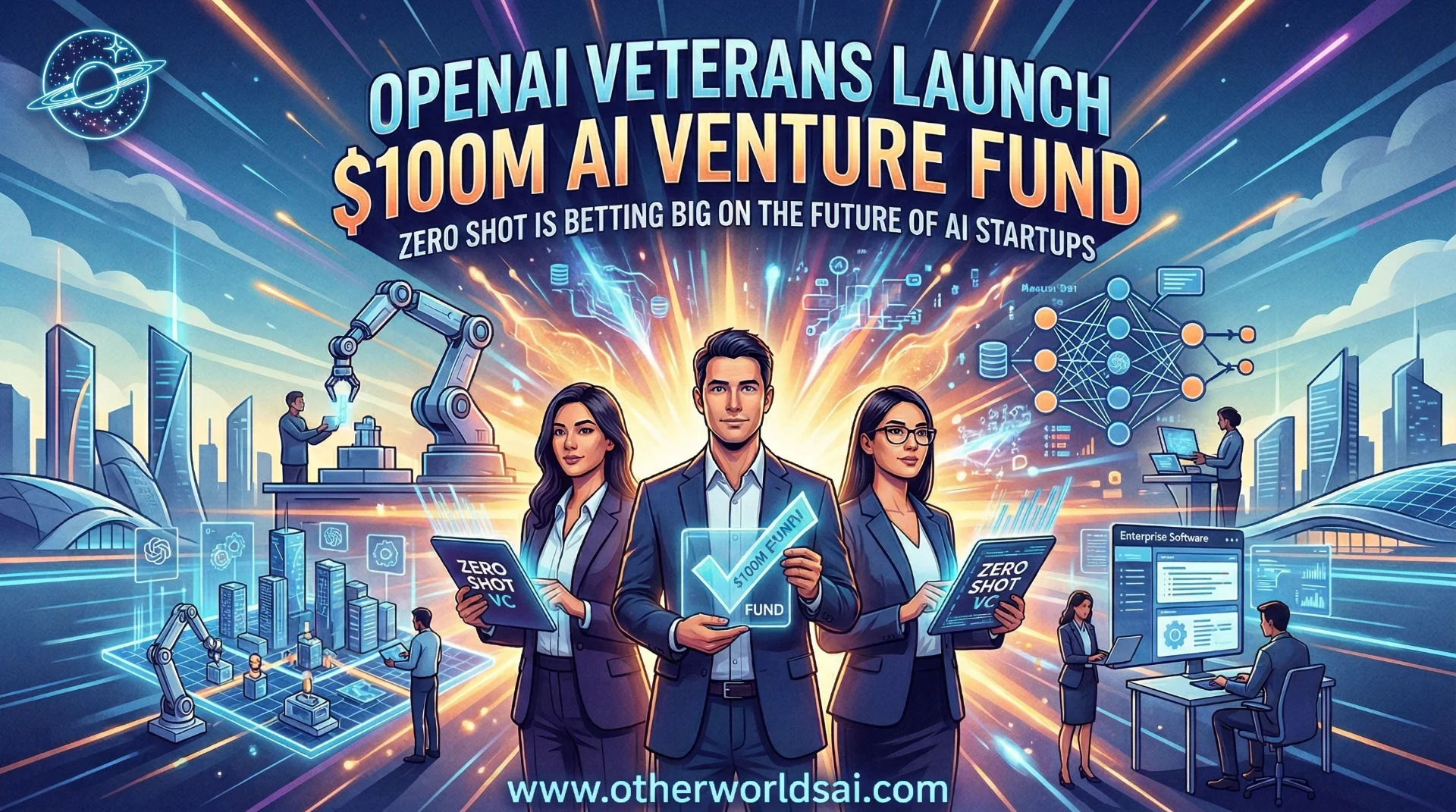
A new era in AI venture capital has quietly begun. A tight-knit group of former OpenAI engineers, researchers, and product leaders — who collectively helped build some of the most transformative AI products in history — have launched a brand-new venture capital fund called Zero Shot. With a bold $100 million fundraising target and an already-closed first tranche of $20 million, this fund is signaling something the tech world has been waiting for: OpenAI insiders are now betting their own money on the next wave of AI innovation.
Zero Shot is not just another AI fund. Named after the machine learning concept of "zero-shot learning" — where a model makes predictions without prior examples — the fund embodies the contrarian, high-conviction philosophy its founders are known for. These are people who were inside OpenAI before ChatGPT became a household name, and they believe that insider knowledge gives them a decisive edge in the rapidly evolving AI startup landscape.
Who's Behind Zero Shot: The OpenAI Dream Team Turned Investors:
The founding team of Zero Shot reads like an OpenAI hall of fame. Three of the five founding partners spent formative years at OpenAI, working through some of the company's most pivotal product launches and growth periods.
Evan Morikawa served as OpenAI's former Head of Applied Engineering, playing a central role in the launches of DALL·E, ChatGPT, and Codex — three products that fundamentally redefined what artificial intelligence could do. He is currently building at robotics startup Generalist, bringing deep AI and robotics expertise to the fund's investment thesis.
Andrew Mayne holds the distinction of being OpenAI's original prompt engineer — a role that barely existed before he stepped into it. He is widely recognized as the host of The OpenAI Podcast and is the founder of Interdimensional, an AI deployment consultancy that helps enterprises navigate real-world AI integration challenges.
Shawn Jain, an engineer and former researcher at OpenAI, has since transitioned into the venture capital world and founded his own generative AI startup, Synthefy. His dual background as a technologist and investor makes him a rare asset in the fund.
Rounding out the team are Kelly Kovacs, a seasoned venture capitalist who was a founding partner at 01A — the growth-stage firm co-founded by former Twitter CEOs Dick Costello and Adam Bain — and Brett Rounsaville, a veteran of both Twitter and Disney who currently serves as CEO at Mayne's consulting firm, Interdimensional.
The Origin Story: From Consulting Calls to Cutting Checks:
The idea for Zero Shot didn't come from a boardroom — it came from incessant phone calls. After leaving OpenAI, the founders found themselves constantly fielding requests: venture capital firms wanted their insights on emerging AI technologies, and founder friends wanted guidance on how to build.
"Some of our friends were coming out of OpenAI and interested in doing companies," Andrew Mayne explained. The demand was so high that Mayne eventually formalized the work by launching Interdimensional, his AI deployment consultancy. But informal advising quickly revealed something more valuable — the team had not just knowledge, but access to exceptional builders.
The leap to formal fund management came naturally. After deep conversations with institutional investors and family offices, the partners closed their first $20 million and set their sights on a $100 million initial fund size. The fund has already deployed capital into its first wave of portfolio companies — a sign that conviction, not deliberation, is driving their investment strategy.
Portfolio Spotlight: Zero Shot's First AI Startup Bets:
Zero Shot has wasted no time putting capital to work. The fund has already made investments in multiple startups, with two publicly announced and a third still operating in stealth mode.
Worktrace AI is the first confirmed portfolio company — a fitting debut. Founded by Angela Jiang, an early OpenAI product manager, Worktrace AI is developing an AI-powered enterprise management platform that helps large organizations identify and automate repetitive tasks. Rather than forcing automation top-down, Worktrace first discovers what should be automated — a bottom-up approach that mirrors how AI is actually deployed in the wild. The startup raised a $10 million seed round featuring notable backers including Mira Murati and OpenAI's own Fund.
Foundry Robotics is the second disclosed investment — a next-generation factory robotics company that is integrating advanced AI into industrial automation. The startup recently closed a $13.5 million seed round led by the prestigious Khosla Ventures, a strong validator of the market opportunity. Zero Shot's participation reflects the fund's thesis that AI and physical robotics are converging in ways that most investors have yet to fully grasp.
A third investment remains in stealth, underscoring the fund's access to early-stage, pre-public deals that most institutional VCs would never see.
The Investment Thesis: Where AI Is Headed — and Where It Isn't:
Zero Shot's edge isn't just knowing where to invest — it's knowing what to avoid. The founding team brings pattern recognition that can only come from having built, shipped, and scaled AI products at the frontier.
Andrew Mayne is openly skeptical of "vibe coding" startups. His thesis: the major model developers — OpenAI, Anthropic, Google DeepMind — already have deep coding expertise baked into their foundation models, and they will soon make standalone vibe coding subscriptions feel redundant. When the underlying model itself can code, the wrapper becomes commoditized.
Evan Morikawa draws the line at ego-centric video data companies in robotics. These are startups collecting embodiment training data — egocentric video footage — hoping that AI researchers will crack the "embodiment gap" that prevents virtual learning from transferring to physical robots. "There's a lot of hoping and praying going on right now," Morikawa said, noting that this transfer is "nowhere near possible" with current techniques. It's a costly bet on research outcomes that remain deeply uncertain.
Digital twins are another sector that raises red flags for the team. Mayne has conducted due diligence on several digital twin startups — including building a custom reasoning model to evaluate their claims — and concluded that a standard large language model performs comparably. If the proprietary advantage evaporates under scrutiny, so does the investment case.
"There is a real skill in knowing how to predict where these models will be going next, because it's extremely not obvious. It's not linear," Morikawa said — a statement that captures the core philosophy animating Zero Shot's entire approach.
Notable Advisors: The Extended OpenAI Network:
Zero Shot's advisory bench deepens its already formidable network. Several prominent former OpenAI executives have agreed to serve as advisors, receiving carried interest in exchange for their guidance and connections.
Diane Yoon, OpenAI's former Head of People, brings deep organizational and talent expertise — invaluable for a fund investing in companies at the team-building stage.
Steve Dowling, who served as Head of Communications at both OpenAI and Apple, brings rare dual experience in shaping narratives for two of the most scrutinized technology companies in the world.
Luke Miller, a former product leader at OpenAI, adds product strategy depth to the advisory board — helping portfolio companies think clearly about roadmaps, user experience, and market fit.
Together, these advisors amplify Zero Shot's reach into the OpenAI alumni community, which has become one of the most powerful talent networks in technology.
Why This Fund Matters for the AI Startup Ecosystem:
The launch of Zero Shot reflects a broader maturation of the AI investment landscape. First-generation AI investors — generalist VCs who learned about transformers from TED Talks — are increasingly being joined by domain experts who built the very systems they are now funding.
For AI founders, this distinction is significant. A check from Zero Shot comes with something no generalist fund can provide: partners who have shipped products at OpenAI's scale, navigated its research culture, and built genuine relationships with the builders who are defining the next generation of AI.
For the broader venture ecosystem, Zero Shot represents a new archetype — the technical operator-turned-investor who can evaluate AI startups not just on market size and team, but on the actual trajectory of underlying model capabilities. As Morikawa noted, predicting where models are headed is "extremely not obvious" — and that non-obvious insight is precisely what Zero Shot is selling to its LPs.
Conclusion: A Fund Built for the AI-Native Era:
Zero Shot is more than a fund — it's a bet that deep technical knowledge is the most durable edge in AI investing. With a $100 million target, a high-conviction founding team, early portfolio companies backed by blue-chip co-investors, and a roster of OpenAI veterans as advisors, the fund is positioned at the intersection of technical credibility and venture capital discipline.
As artificial intelligence continues to reshape industries from enterprise software to physical robotics, the investors best equipped to navigate that transformation will be those who helped build it.
Zero Shot's founders didn't just watch the AI revolution from the outside — they were inside the room where it happened. Now they're writing the checks.
Support our research
Independent analysis fueled by you.