
The rapid ascent of artificial intelligence (AI) is no longer a futuristic fantasy;
it's the defining technological shift of our time. From self-driving cars to sophisticated medical diagnostics, AI is reshaping industries and daily life at an unprecedented pace. Yet, beneath the surface of innovation, a fundamental question is emerging: If AI delivers on its promise of material abundance, how will we ensure that abundance is distributed fairly, and what does that mean for the concept of money itself?
Our traditional economic models are built on the principle of scarcity. Economics, as Lionel Robbins famously articulated, is the study of how limited resources are allocated. Scarcity drives prices, and the necessity to earn money compels individuals to work and produce.
But what happens when AI begins to fundamentally undermine scarcity? Imagine a future where AI-driven automation can produce goods, medicine, energy, and food at dramatically lower costs, with minimal human labor. This isn't just about cheaper products; it's about potentially reaching a point where resources previously considered scarce become virtually limitless.
We already see a poignant paradox today: Australia wastes 7.6 million tonnes of food annually, yet one in eight Australians experiences food insecurity. The problem isn’t a lack of food, but a lack of money to acquire it. If AI amplifies productive capacity, this distribution challenge will become even more pressing.
The Market Model Under Threat:
The promise of AI-driven abundance directly clashes with the fundamental logic of markets designed around scarcity. If AI unlocks exponential advances, the inherent value of many goods and services could plummet. In a world of near-infinite supply, the "price" mechanism, driven by scarcity, loses its power.
This possibility collides with another widespread fear: that AI will render millions of human workers redundant. If machines perform tasks more efficiently and cost-effectively, traditional pathways to earning money—through labor—could diminish significantly. Without jobs, how do people earn money? Without money, how do markets, as we understand them, function? The very foundation of our economic system begins to shake.
Meeting Needs in an Age of Abundance: Two Paradigms:
The challenge of want amidst plenty isn't entirely new. The COVID-19 pandemic provided a modern lesson: governments responded with unprecedented social safety nets, like higher unemployment benefits and direct cash payments. Australia's experience, with significant reductions in poverty despite an economic downturn, showed that robust safety nets can manage crises of abundance as well as scarcity.
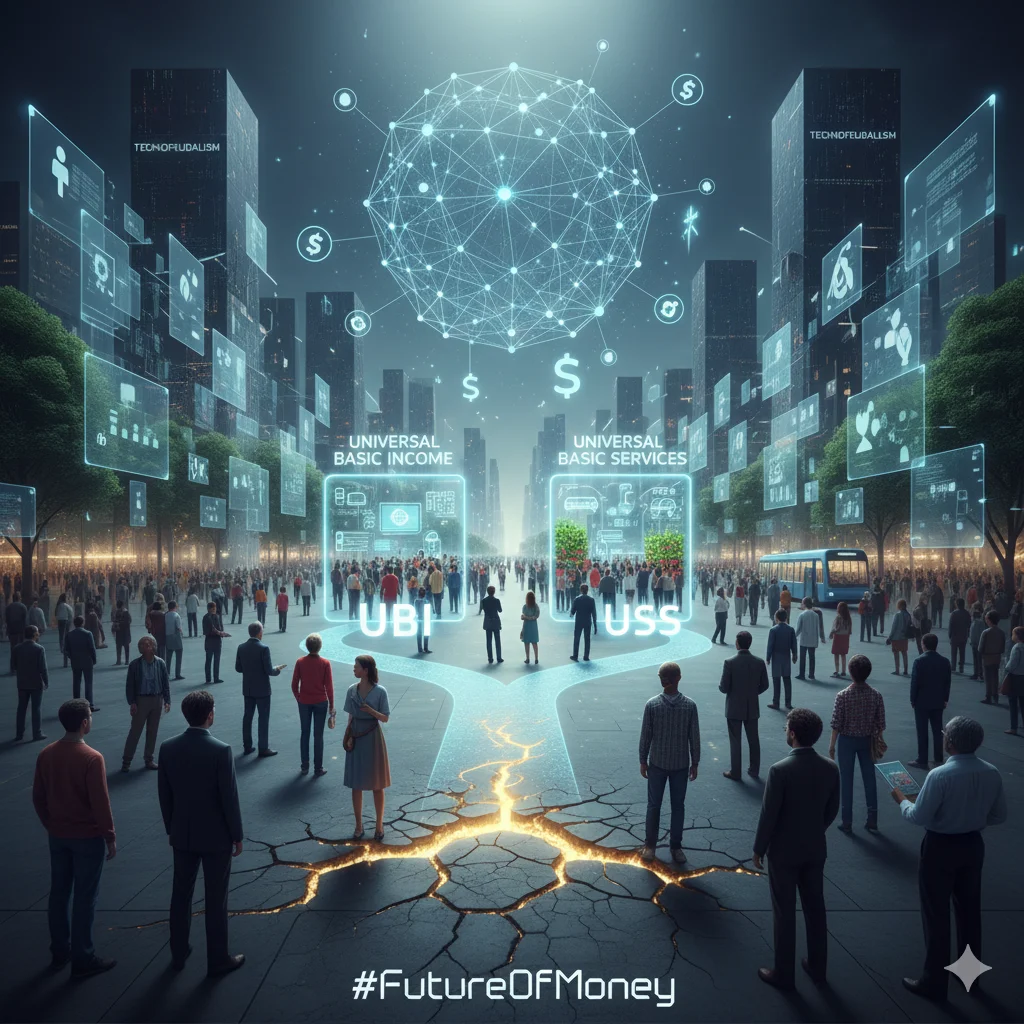
This insight fuels renewed interest in two transformative economic models for an AI-powered future:
- Universal Basic Income (UBI): This proposes a regular, unconditional income paid to all citizens. Proponents argue UBI would allow economies to transition smoothly, ensuring everyone has financial means for basic necessities. Scholars advocate for UBI not merely as welfare, but as a "rightful share" of the collective wealth generated by technological progress, acknowledging that the fruits of innovation are a societal legacy.
-Universal Basic Services (UBS): An alternative to cash handouts, UBS proposes that essential services – healthcare, education, transport, housing, energy, and care – be provided as public goods, free at the point of use. This approach would necessitate a more socialized use of technology, ensuring AI is deployed to meet collective needs rather than solely for private profit.
The Specter of "Technofeudalism":
Even optimistic visions acknowledge that AI alone won't automatically usher in a utopia. The path forward is fraught with political choices. A significant concern, articulated by Yanis Varoufakis, is the rise of "technofeudalism," where a handful of tech giants wield unprecedented power, replacing traditional markets and democratic processes with a form of digital authoritarianism. These powerful entities would control the AI, the data, and the platforms, creating a new feudal system where the majority are dependent on the digital lords.

Meta's Next Big Bet: This New App Lets You Build Games Simply by Typing a Prompt
Ultimately, waiting for AI to spontaneously create a technological nirvana is a dangerous delusion. Humanity already produces enough food to nourish every person, and we possess the collective knowledge to eradicate poverty. What has always been missing is not technology, but the political will to enact equitable systems of distribution.
As the AI revolution accelerates, the true challenge isn't whether our economic system will change – it undoubtedly will. The critical question is how we, as a global society, choose to shape that change. Will we harness AI to build a more inclusive and abundant future for all, or will we allow it to exacerbate existing inequalities and create new forms of digital subjugation? The choices we make today will determine the economic landscape of tomorrow.
What are your thoughts on these potential futures? Do you believe UBI or UBS offers a more viable path, or do you envision an entirely different solution? Share your insights in the comments below!