
Jeff Bezos' $100 Billion Bet: How Project Prometheus Plans to Rebuild American Industry With AI
The Announcement: Bezos Targets $100 Billion to Revolutionize Old Industry-
Jeff Bezos is making one of the most audacious bets in the history of American industry. According to sources cited by The Wall Street Journal, the Amazon founder and one of the world's wealthiest individuals is actively seeking to raise $100 billion for a new investment fund — a war chest of almost incomprehensible scale, aimed squarely at buying up legacy manufacturing companies and transforming them from the inside out using the power of artificial intelligence.
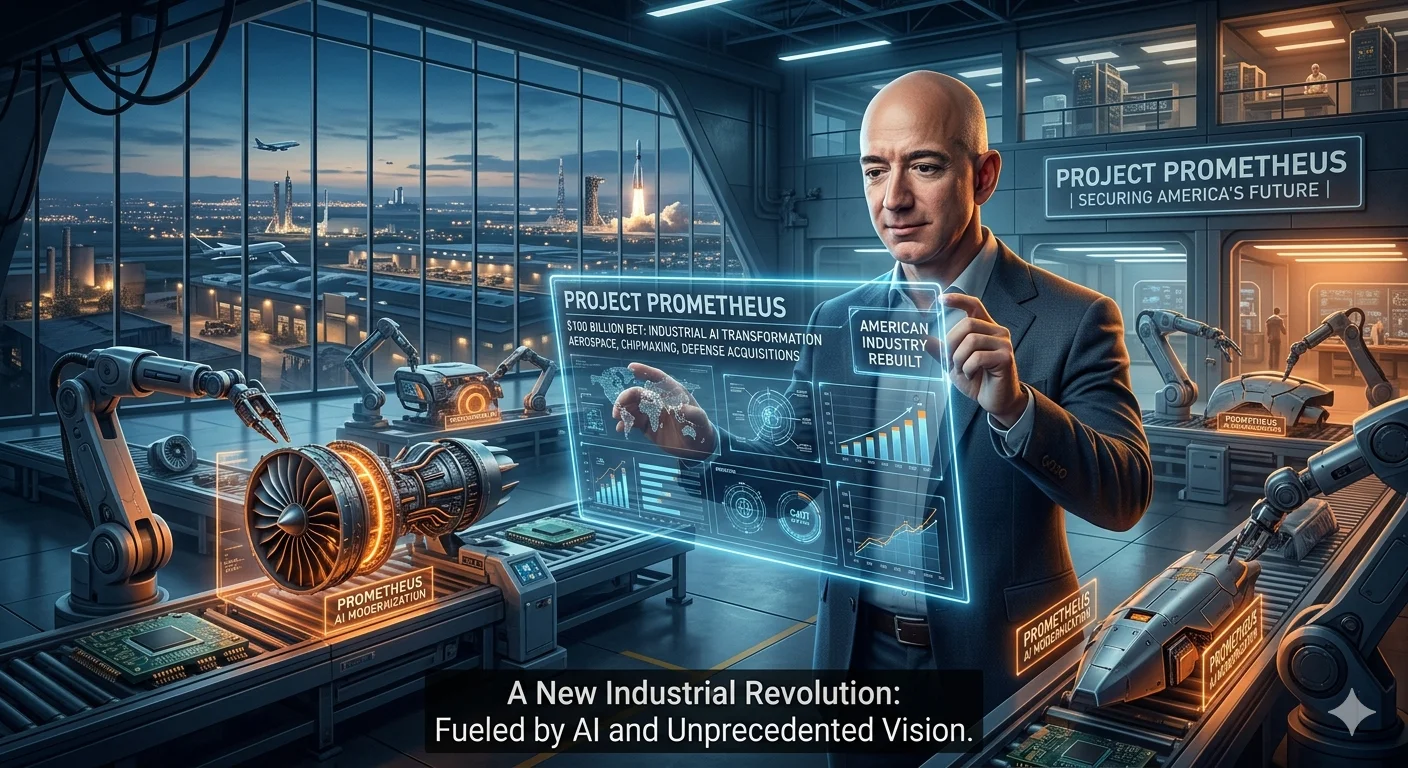
This is not a conventional venture capital play or a passive investment strategy. Bezos is reportedly planning to acquire controlling stakes in companies across major industrial sectors — aerospace, chipmaking, defense, and beyond — and then systematically modernize and automate their operations using cutting-edge AI technology. It is a vision that fuses Wall Street-scale capital with Silicon Valley ambition, and it could fundamentally reshape the landscape of American manufacturing for decades to come.
Project Prometheus: The AI Startup at the Heart of Bezos' Industrial Vision:
At the center of this sweeping strategy sits Project Prometheus, Bezos' AI startup that was first reported in November. Bezos is serving as co-founder and co-CEO of the venture alongside Vik Bajaj, a former Google executive who brings deep experience in artificial intelligence and large-scale technology deployment. Together, they are building what could become one of the most consequential AI companies in the industrial sector.
Project Prometheus launched with a formidable $6.2 billion in initial funding, signaling from day one that this is no garage startup. The company's core mission is to develop high-level, purpose-built AI models designed specifically to improve manufacturing and engineering operations across demanding industries — including aerospace, automotive, defense, and advanced chipmaking.
What makes Prometheus uniquely powerful is not just the technology it is building, but how it intends to deploy it. Rather than selling AI software licenses to manufacturers who may or may not adopt it effectively, Bezos is pursuing a radically more direct approach: buy the manufacturers outright, and implement the AI transformation from within. It is a vertically integrated strategy that eliminates the friction of customer adoption entirely.
The $100 Billion Fund: Acquiring Companies to Deploy AI at Scale:
The new manufacturing acquisition fund is the financial engine that will drive Project Prometheus' real-world impact. According to the WSJ's reporting, the fund will be used to acquire companies in key industrial sectors, which will then become direct customers and deployment environments for Prometheus' AI models. It is a closed-loop system of remarkable elegance: raise the capital, buy the companies, transform them with AI, and capture the value created.
The target sectors reflect both strategic importance and transformational potential. Aerospace companies — many of which still rely on legacy systems and manual processes developed decades ago — represent enormous opportunities for AI-driven efficiency gains. The defense sector, which faces intense pressure to modernize amid rising global competition, is another prime target. Chipmaking, perhaps the most strategically critical manufacturing sector in the world given its centrality to the AI race itself, rounds out the primary focus areas.
The scale of the fund — $100 billion — is not accidental. It reflects the reality that meaningful industrial transformation requires patient, long-term capital at a level that typical private equity or venture funds simply cannot provide. Bezos, whose personal fortune has been built on precisely this kind of patient, long-horizon thinking, is betting that the combination of sufficient capital and transformative AI technology can unlock value that the market has systematically underpriced in legacy industrial companies.
Global Fundraising: Singapore, the Middle East, and the Race for Capital:
Raising $100 billion requires going where the capital is — and Bezos has been doing exactly that. According to the WSJ, he recently traveled to both Singapore and the Middle East on a fundraising mission for the effort. These are not coincidental destinations.
Singapore has emerged as one of the world's premier hubs for sophisticated sovereign and institutional capital, while the Gulf states — Saudi Arabia, the UAE, and their sovereign wealth funds — have made no secret of their desire to deploy hundreds of billions of dollars into transformative technology investments.
The Middle East connection is particularly significant in the context of AI investment. Saudi Arabia's Public Investment Fund and Abu Dhabi's Mubadala and ADIA have each committed to becoming major players in the global AI infrastructure buildout. For Bezos, these sovereign wealth funds represent not just capital, but strategic partners who share a long-term orientation and have both the patience and the scale to support a multi-decade industrial transformation mission.
The global nature of the fundraise also signals something important about Bezos' ambitions: this is not purely an American industrial story. By drawing capital from Asia and the Middle East, Bezos is signaling that the transformation of legacy manufacturing is a global opportunity — and that Project Prometheus intends to operate on a global stage.
Why Now? The Perfect Storm for AI-Driven Industrial Transformation:
The timing of Bezos' $100 billion industrial AI play is not accidental— it reflects a confluence of forces that have made this moment uniquely ripe for exactly this kind of transformation. AI capabilities have advanced to the point where they can genuinely add measurable, significant value to complex manufacturing and engineering workflows.
The models being developed by companies like Project Prometheus are not chatbots or content generators; they are specialized systems capable of optimizing supply chains, improving quality control, accelerating materials science research, and redesigning manufacturing processes from the ground up.
At the same time, legacy industrial companies are under profound pressure. Labor shortages, supply chain fragility, rising energy costs, and intensifying global competition — particularly from China, which has invested massively in automated manufacturing — have created a burning platform for transformation that simply did not exist a decade ago. Many of these companies know they need to modernize but lack the technical expertise, the capital, or the organizational will to do it themselves. Bezos is positioning Project Prometheus as the entity that provides all three.
There is also a national security dimension that cannot be ignored. The United States' dependence on foreign manufacturing for critical components — from semiconductors to aerospace parts to defense systems — has become a first-order geopolitical concern.
A fund that simultaneously modernizes American industrial capacity and deploys AI to make it globally competitive addresses one of the most pressing structural challenges facing the U.S. economy. This alignment with national priorities may prove to be a significant advantage in both fundraising and regulatory approvals.
Bezos vs. the AI Industrial Complex: A New Kind of Competition:
Bezos' entry into AI-powered industrial transformation puts him in direct, if oblique, competition with some of the most powerful forces in both technology and traditional finance. On one side are the hyperscalers — Microsoft, Google, and Amazon itself — which are all building AI tools for manufacturing customers. On the other side are traditional private equity firms that have been buying and restructuring industrial companies for decades, but without the AI-native technology stack that Project Prometheus is developing.
What sets Bezos' approach apart from both is the depth of vertical integration. Traditional PE firms buy industrial companies and optimize them financially, but rarely transform them technologically.
Tech companies build AI tools but rarely own the manufacturing businesses that deploy them. Project Prometheus, by combining proprietary AI development with direct ownership of the businesses that use it, is attempting to capture the full value chain — a strategy that, if successful, could generate returns that dwarf either approach on its own.
The Bottom Line:
Jeff Bezos has spent his career building things that seemed impossibly ambitious until they were inevitable. Project Prometheus and the $100 billion industrial AI fund it is anchored to may well follow that same arc.
The combination of purpose-built AI models, direct ownership of legacy manufacturing companies, sovereign-scale capital, and a long-term orientation is unlike anything the industrial world has seen.
Whether Bezos succeeds in his fundraising goal, the ambition itself sends an unmistakable signal: the AI transformation of American industry is no longer a distant possibility. It is a $100 billion bet being placed right now.
Support our research
Independent analysis fueled by you.