
Why Your AI Feature Isn't Enough: The New Rules of App Retention in 2026:
Introduction: Is AI Really the Future of App Monetization?
The promise of AI in the app economy sounds irresistible. With app stores flooded with thousands of artificial intelligence tools, many developers have come to believe that integrating AI is the ultimate shortcut to higher profits, faster growth, and a loyal base of long-term subscribers.
But what if that assumption is completely wrong?
A landmark new industry report has revealed a surprising — and critical — truth: AI-powered apps are failing to hold onto their paying subscribers, and the data behind this finding is impossible to ignore. If you are a developer, investor, marketer, or app entrepreneur, these numbers should fundamentally reshape how you think about AI integration, user experience, and the long-term viability of your subscription strategy.
The Report: What Is the 2026 State of Subscription Apps?
RevenueCat is one of the most trusted subscription management platforms in the world. Used by over 75,000 app developers globally, RevenueCat released its landmark 2026 State of Subscription Apps Report — a sweeping analysis of the subscription app ecosystem across iOS, Android, and the web.
The scale of this data is staggering. The report draws from more than 1 billion in-app transactions, generating over $11 billion in annual developer revenue. This makes it one of the most comprehensive and data-rich studies of subscription app trends ever published, and its insights carry real weight for anyone operating in this space.
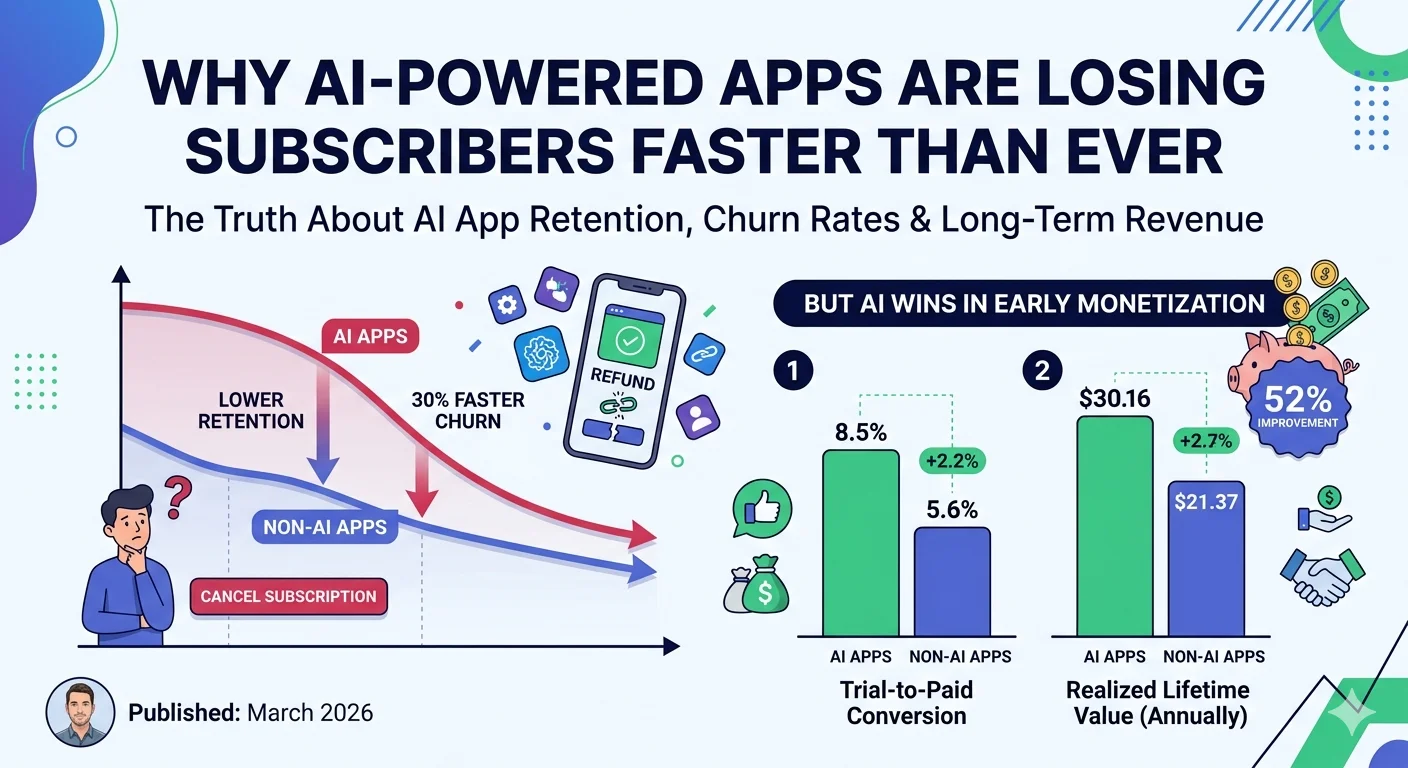
The headline finding stopped the industry in its tracks: AI-powered apps are churning subscribers 30% faster than non-AI apps.
AI Adoption: How Many Apps Are Actually Powered by AI?
Despite the relentless AI buzz dominating tech headlines, the majority of apps are still not powered by artificial intelligence.According to the report, AI-powered apps account for just 27.1% of all apps, while non-AI apps still make up the remaining 72.9%. That means roughly one in four apps is now AI-powered — a growing category, but still a clear minority of the overall ecosystem.
Adoption varies dramatically depending on the app category. Photo and Video apps lead the pack with the highest share of AI-powered products at 61.4%, while Gaming sits at the opposite end with just 6.2% AI adoption. Business apps (19.1%) and Travel apps (12.3%) also remain relatively low-AI segments — a detail that holds interesting implications for developers eyeing those spaces.
It is worth clarifying what "AI-powered" actually means in this context. The category includes widely used AI chatbots like ChatGPT and Gemini, as well as any app that actively markets itself as being driven by artificial intelligence technology.
The Retention Problem: Where AI Apps Are Falling Behind:
This is where the report delivers its most sobering finding. When it comes to keeping paying subscribers around for the long haul, AI-powered apps are significantly underperforming their non-AI counterparts — and the gap is wide enough to demand serious attention.
Annual retention tells the starkest story. After 12 months, AI apps retain just 21.1% of their subscribers, compared to 30.7% for non-AI apps. That is a difference of nearly 10 percentage points — meaning non-AI apps are holding onto nearly half again as many subscribers over the course of a year.
Monthly retention follows the same troubling pattern. AI apps show a 6.1% monthly retention rate versus 9.5% for non-AI apps — a gap of 3.4 percentage points that compounds significantly over time and eats directly into long-term revenue.
There is one bright spot, however. On a weekly basis, AI apps actually outperform, posting 2.5% retention compared to 1.7% for non-AI apps. The catch? Weekly subscriptions are the least popular pricing model in the AI app space, which means this advantage has limited real-world financial impact for most developers.
The reason behind the retention gap is not hard to find. The AI landscape moves at a breathtaking pace, and users know it. People hop between AI apps constantly, always chasing the newest model, the freshest features, and the most cutting-edge technology. This creates a "shiny object" cycle that makes building deep, long-term user loyalty extraordinarily difficult.
Refund Rates: AI Apps Have a Satisfaction Problem:
Low retention is only half the story. AI-powered apps are also generating significantly more refund requests — a telling signal that many users feel the product simply did not deliver on the promise it made during signup.
At the median, AI apps carry a 4.2% refund rate compared to 3.5% for non-AI apps — a difference of 20%. That may sound modest, but at scale, across millions of transactions, it represents a meaningful hit to realized revenue and developer profitability.
The Hidden AI War
Nobody Is Telling You About
Our latest documentary deep-dive into the geopolitical struggle for machine intelligence dominance. Explore the two paths of AI development: open source vs. closed architecture.
The upper end of the refund range is even more alarming. For AI apps, the upper bound reaches 15.6%, compared to 12.5% for non-AI apps. The report describes this as evidence of "greater volatility in realized revenue and deeper issues in user value, experience, and long-term quality" — a frank acknowledgment that some AI apps are falling well short of user expectations.
The uncomfortable takeaway here is clear. A significant share of users who pay for AI apps quickly decide the product is not worth the cost — and they want their money back. Better onboarding, honest marketing, and a sharper value proposition are not optional extras for AI app developers; they are essential business requirements.
Where AI Apps Win: Early Monetization Strength:
It is not all bad news for AI app developers — not even close. The same report that highlights retention and refund challenges also reveals that AI-powered apps have a genuine and impressive edge when it comes to early-stage monetization, and these numbers are worth celebrating.
AI apps convert trial users into paying customers at a remarkable rate. The trial-to-paid conversion rate for AI apps sits at 8.5% at the median, compared to just 5.6% for non-AI apps. That is a 52% improvement — meaning AI apps are dramatically better at convincing free users to open their wallets. The novelty, the perceived intelligence, and the curiosity factor that AI generates all work powerfully in favor of that initial conversion moment.
AI apps also monetize their downloads more efficiently. With a download-to-paying-user rate of 2.4% versus 2.0% for non-AI apps, AI products convert roughly 20% more of their total installs into revenue. For apps operating at scale, that advantage translates into meaningfully higher top-of-funnel returns.
On realized lifetime value, AI apps sustain a clear lead as well. Monthly RLTV for AI apps reaches $18.92 at the median, compared to $13.59 for non-AI apps — a 39% advantage. Annually, AI apps post $30.16 in median RLTV versus $21.37 for non-AI apps, representing a 41% lead. These figures suggest that while AI app subscribers churn faster, the ones who do stick around are delivering more financial value than their non-AI counterparts.
Key Takeaways: What This Means for Developers and Investors:
The data paints a nuanced picture — and the lessons embedded within it are actionable. Here is what every developer, marketer, and investor should walk away understanding from this report.
-
First, AI drives early buzz, not long-term loyalty. Strong trial conversions and high initial monetization are genuinely valuable, but they cannot compensate for a leaky retention bucket. Sustainable growth demands that you build real, lasting value — not just a compelling signup experience.
-
Second, user experience must go far beyond the technology itself. Many users cancel AI apps not because the AI stops functioning, but because the broader app experience — onboarding, support, interface, and ongoing engagement — fails to meet their expectations. Retention is a product problem as much as a technology problem.
-
Third, high refund rates are a warning signal that must be taken seriously. A 20% higher refund rate is a measurable and preventable problem. Closing the gap between what users expect and what they actually receive starts with honest marketing and continues through every touchpoint of the user journey.
-
Fourth, churn reduction must become a core business objective. With annual churn running 30% worse than non-AI competitors, no AI app developer can afford to treat retention as an afterthought. Habit formation, personalization, and delivering consistent value month after month must be central pillars of the product roadmap.
-
Fifth, category context matters enormously. Photo and Video apps are leading AI adoption by a wide margin. Developers building in low-AI segments like Travel or Business may find a compelling first-mover advantage — but only if their retention strategy is already solid before they scale.
Conclusion: The AI App Opportunity Is Real — But Only Half the Battle:
The verdict from RevenueCat's 2026 State of Subscription Apps Report is clear, and it carries an important message for the entire industry. AI can be a powerful, even remarkable driver of early app growth, user acquisition, and initial monetization. The numbers on trial conversion and lifetime value prove that without question.
But when it comes to keeping subscribers loyal over months and years, AI apps are currently falling well short. The retention gap, the elevated churn rate, and the higher refund figures all point to the same underlying challenge: delivering sustained, meaningful value to users in a space where the technology evolves faster than most products can keep up with.
The developers who ultimately win in this space will not simply be the ones who build the most impressive AI features. They will be the ones who combine cutting-edge technology with exceptional user experiences, honest value propositions, and relentless focus on keeping their subscribers engaged and satisfied for the long term.
The AI app race is far from over. But the finish line is retention — not just downloads.