
Musk’s $40 Billion Gamble: Inside the Personnel Overhaul at xAI:
The Admission That Shook the AI World:
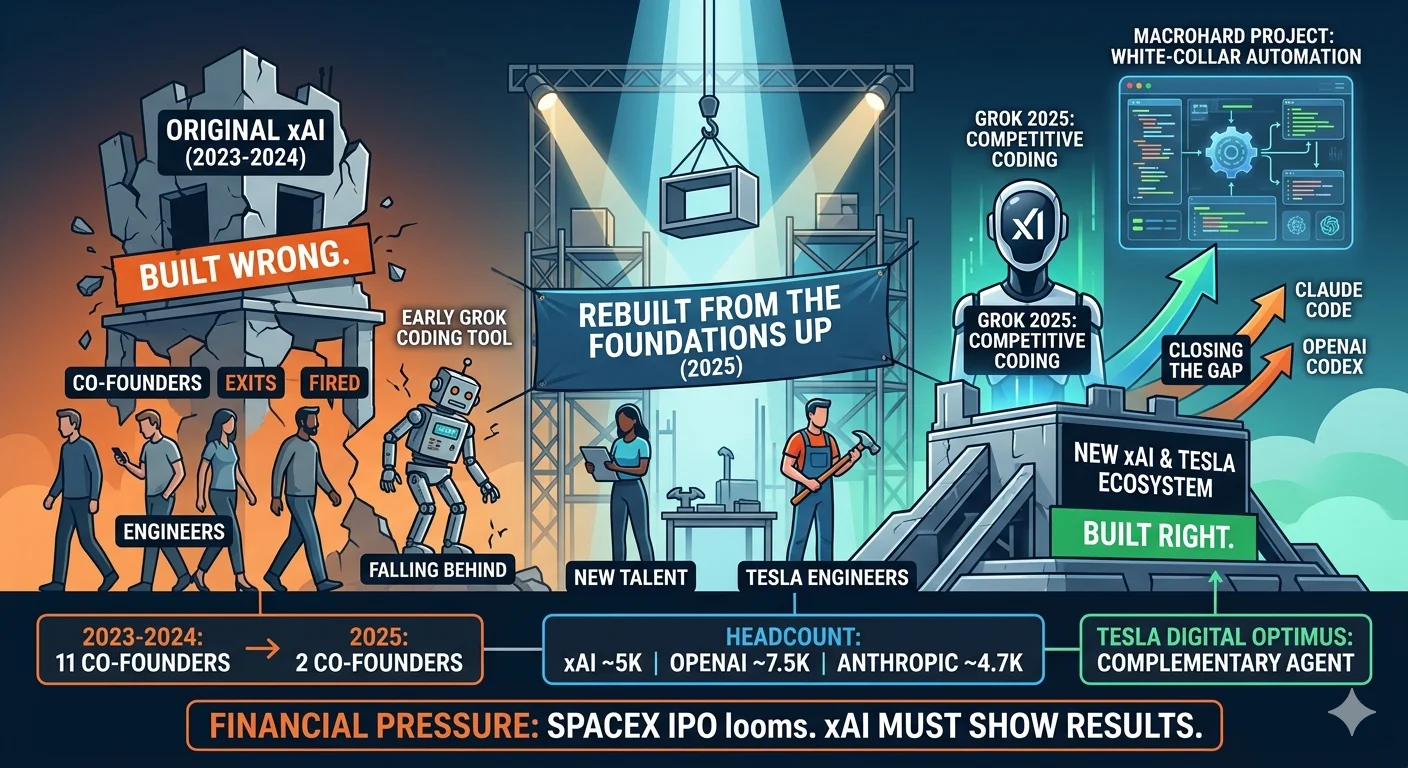
Elon Musk's artificial intelligence company xAI is undergoing one of the most dramatic corporate overhauls in the AI industry right now -- and Musk himself is not hiding it. In a candid post on X, his own social media platform, Musk made a striking confession that few founders ever make publicly: "xAI was not built right first time around, so is being rebuilt from the foundations up."
That single statement carries enormous weight. It signals not just internal turbulence, but a full strategic reset at one of the most high-profile AI labs in the world -- one that is racing to keep pace with industry titans OpenAI and Anthropic. The pressure is mounting, the competition is fierce, and the clock is ticking.
What follows is a full breakdown of exactly what is happening at xAI: why key co-founders are leaving, why the company is losing ground in the AI coding tools race, and what Musk's bold next move looks like for the future of Grok and xAI's long-term ambitions.
The Mass Exodus: Co-Founders and Engineers Are Walking Out:
When xAI first launched three years ago, it did so with 11 co-founders standing shoulder-to-shoulder with Elon Musk. Today, that founding circle has nearly completely collapsed. Only two co-founders remain: Manuel Kroiss and Ross Nordeen -- a staggering reduction that tells a story of internal friction, strategic disagreement, and relentless performance pressure.
The most recent departures hit close to the technical core of the company. Co-founders Zihang Dai and Guodong Zhang both exited xAI after Musk publicly criticized the company's AI coding tools for failing to compete with Claude Code by Anthropic and Codex by OpenAI -- the two dominant players in AI-assisted programming. Their departure was not quiet; it came directly on the heels of a company-wide reckoning over xAI's competitive position.
This was not an isolated shakeup -- it was part of a sweeping pattern. Just one month earlier, 11 senior engineers, including two additional co-founders, walked out the door following what Musk described as a "reorganization." The Financial Times reported that executives parachuted in from SpaceX and Tesla were tasked with evaluating employees and dismissing those who failed to meet the grade. The result is a workforce in flux, a leadership team being rebuilt from scratch, and a company urgently searching for its footing in one of the most competitive industries on the planet.
The Coding Crisis: Why xAI Is Falling Behind in the AI Tools Race:
The central battleground in the AI industry right now is not chatbots -- it is coding tools, and xAI is currently losing that fight. While early momentum for xAI's Grok was fueled partly by its permissive content policies, the real money in AI has always been in developer tools. Enterprise customers, software companies, and individual developers pay substantial fees for AI systems that can write, debug, and optimize code reliably and at scale.
Right now, xAI's competitors are pulling ahead in exactly this category. Claude Code from Anthropic and Codex from OpenAI are widely regarded as more capable, more reliable, and better integrated into real-world developer workflows. This is not just a perception problem for xAI -- it is a direct business problem that threatens revenue growth at a critical moment in the company's history.
Musk responded by calling a company-wide all-hands meeting dedicated entirely to closing this gap. His public prediction was characteristically bold: xAI could be competitive in the AI coding tool space by mid-2025. Whether that timeline reflects genuine internal confidence or strategic posturing for investors and talent, only time will tell -- but the urgency behind it is unmistakable.
The Talent Strategy: Hiring Fresh and Revisiting the Rejected:
xAI is not only cutting its roster -- it is simultaneously and aggressively rebuilding it. Two of the most significant new additions come from Cursor, a widely used AI-powered coding tool: Andrew Milich and Jason Ginsberg, who held joint responsibility for product engineering at one of the hottest AI developer tools on the market.
Their decision to leave Cursor for xAI is a signal worth paying attention to. Unlike Cursor, which depends on third-party frontier models like Claude and GPT-4 to power its product, xAI builds and owns its own frontier model in Grok -- along with the computing infrastructure to run it. Milich and Ginsberg's move strongly suggests that direct access to a frontier LLM and its underlying compute is becoming a decisive advantage for attracting top engineering talent in 2025.
Musk is also taking an unusually personal approach to recruitment. He revealed that he and colleague Baris Akis are personally combing through previously rejected job applications in search of candidates who deserved a second look. "My apologies," Musk wrote on X, addressing the overlooked applicants his company had ghosted. It is a rare moment of public accountability -- and a sign of just how serious the talent crunch at xAI has become.
For context, xAI's workforce still lags meaningfully behind its chief rivals:
>> xAI:        ~5,000 employees
>> OpenAI:     ~7,500 employees
>> Anthropic:  ~4,700 employees
The Hidden AI War
Nobody Is Telling You About
Our latest documentary deep-dive into the geopolitical struggle for machine intelligence dominance. Explore the two paths of AI development: open source vs. closed architecture.
The gap in headcount reflects a gap in institutional momentum -- one that xAI will need to close if it hopes to compete at the frontier of AI development.
The Macrohard Project: xAI's Biggest and Most Troubled Bet:
Beyond the immediate scramble to fix its coding tools, Elon Musk is chasing something far more ambitious -- a vision he is calling Macrohard. Yes, the name is a deliberate jab at Microsoft, and Musk is convinced it is funny. But the project itself is dead serious: an AI agent capable of doing anything a white-collar worker can do on a computer -- from scheduling and research to data analysis, writing, and complex multi-step digital workflows, all automated by AI.
The project has already hit significant turbulence. Toby Pohlen, handpicked to lead Macrohard in February 2025, departed within weeks of taking the role. Business Insider subsequently reported that Macrohard has been placed on pause -- a bruising early setback for what was supposed to be xAI's flagship agentic AI initiative.
Musk's response has been to expand the project's scope rather than scale it back. He revealed for the first time that Macrohard is now a joint effort between xAI and Tesla, with Tesla developing a complementary AI agent called Digital Optimus -- a direct reference to Tesla's humanoid Optimus robot. In Musk's vision, the xAI language model serves as the cognitive brain, directing the Tesla agent as it executes tasks on a user's behalf across their entire digital environment.
It is a compelling architecture -- but it is far from a unique one. Perplexity AI is already moving in this direction with its "Everything is Computer" offering, promising enterprise users a dedicated AI proxy to orchestrate their digital workflows. OpenAI is also investing heavily in agentic AI capabilities. xAI is entering a race it did not start, and its main competitors already have a meaningful head start.
The Investor Pressure: Why xAI's Struggles Have Real Financial Stakes:
xAI's internal struggles are no longer just a leadership story -- they carry serious financial consequences that extend well beyond the company itself. xAI is now formally part of SpaceX, and with a public offering of SpaceX shares widely anticipated, every stumble at xAI becomes a headline that nervous investors will notice.
The math is straightforward and uncomfortable for Musk. A cash-burning AI division with an uncompetitive coding product, a paused flagship agent project, and a depleted founding team is not the story you want attached to a company preparing for one of the most anticipated IPOs in recent memory. Investors will be scrutinizing xAI's ability to generate real revenue and demonstrate genuine user growth through Grok -- and right now, the numbers are not telling the story Musk needs them to tell.
The pressure to show results is as much external as it is internal -- and that dual weight is what makes the current moment at xAI so consequential for the broader AI industry.
Can xAI Actually Catch Up?
xAI stands at a genuine crossroads -- one where the path forward is both clear and extraordinarily difficult. The company still holds real advantages: a proprietary frontier model in Grok, its own computing infrastructure, Elon Musk's singular ability to attract attention and resources, and a stated commitment to rebuilding from the foundations up.
But the headwinds are significant and real. A founding team reduced to two. A workforce under intense external scrutiny. Rivals like OpenAI and Anthropic with years of institutional momentum in the very coding tools category xAI most urgently needs to win. A flagship AI agent project on pause. And a financial clock tied to a SpaceX IPO that is not waiting for xAI to find its footing.
Musk has defied impossible odds before -- repeatedly and publicly. Tesla was written off. SpaceX was called a fantasy. Both became defining companies of the modern era. But the AI industry operates on a different timeline than rockets and electric vehicles. The window to close the gap with OpenAI and Anthropic is narrow, and it is closing.
Whether xAI's second attempt at building itself "right" will succeed is now the defining question hanging over one of the most closely watched companies in tech --
and the answer will shape not just xAI's future, but the competitive landscape of artificial intelligence for years to come.