
Artificial intelligence has made remarkable progress over the past few years.
Today’s AI chatbots can answer complex questions, summarize long documents, generate software code, and solve advanced mathematical problems. Yet despite these advances, most AI systems still operate in a narrow mode: they assist one user at a time.
What they cannot do—at least not well—is handle the complex, messy, and deeply human challenge of coordination. Managing groups with conflicting priorities, tracking decisions over weeks or months, mediating disagreements, and keeping teams aligned remains largely beyond the reach of current AI models.
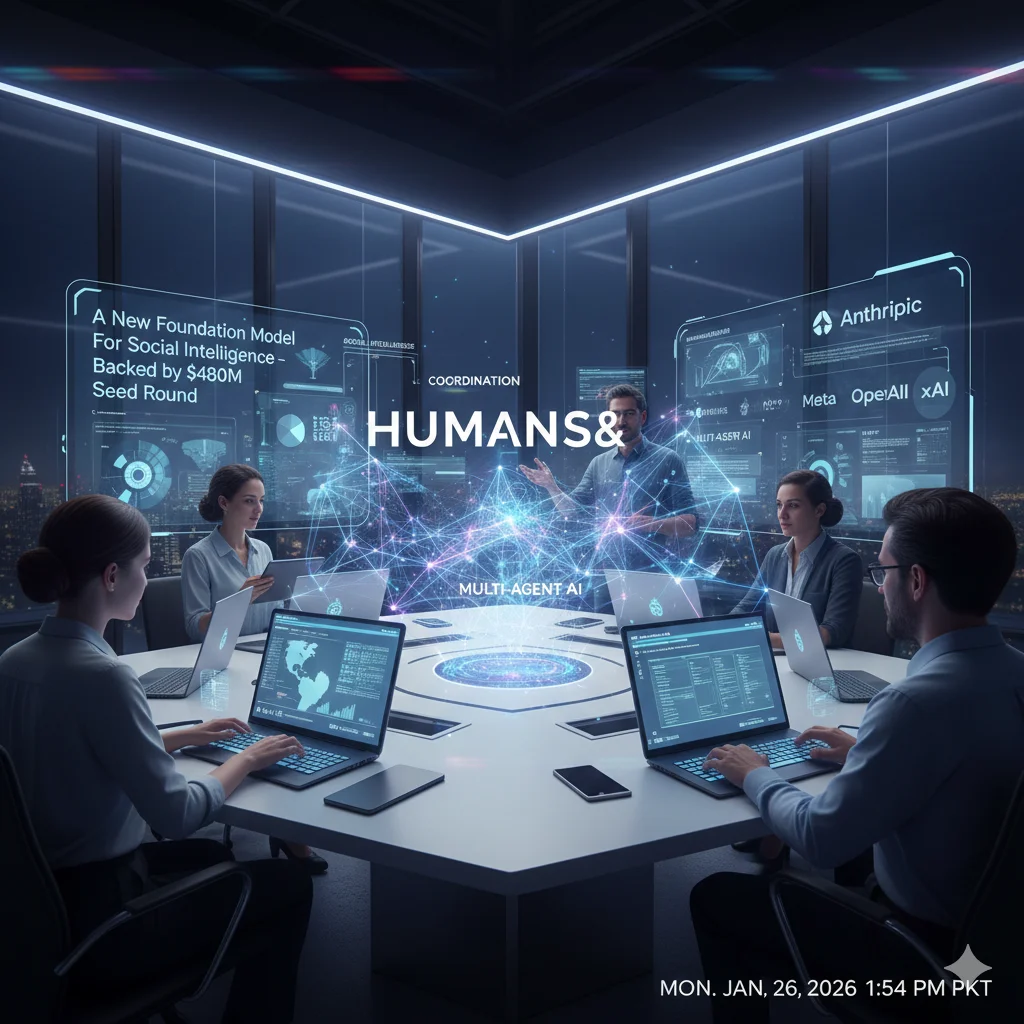
A new startup called Humans& believes that closing this gap is the next major frontier for artificial intelligence. Backed by a staggering $480 million seed round, the three-month-old company is building what it calls a “central nervous system” for the human-plus-AI economy—a new kind of foundation model designed for social intelligence and collaboration, not just question answering.
A New AI Startup With Unusual Ambitions:
Humans& was founded by a high-profile team of researchers and engineers from Anthropic, Meta, OpenAI, xAI, and Google DeepMind. That pedigree alone helped the startup raise one of the largest seed rounds in Silicon Valley history.
Early headlines have focused on Humans&’s positioning around “AI that empowers humans rather than replacing them.” While that framing resonates in a world increasingly anxious about automation and job displacement, the company’s true ambition goes much deeper. Rather than building another chatbot or productivity assistant, Humans& wants to reinvent how AI models understand and support human collaboration.
Moving Beyond the First Wave of AI Scaling:
According to Andi Peng, Humans& co-founder and former Anthropic researcher, the AI industry is nearing the end of its first major paradigm.
“It feels like we’re ending the first paradigm of scaling, where question-answering models were trained to be very smart at particular verticals,” Peng explained. “Now we’re entering a second wave, where the average user is trying to figure out what to actually do with all these models.”
In other words, AI systems are technically capable—but workflows, coordination, and real-world integration are lagging behind.
Companies are moving from chatbots to autonomous agents, yet most organizations struggle to deploy these tools in a way that truly improves how teams work together. The result is frustration, confusion, and a growing sense that AI is powerful but poorly aligned with human collaboration.
The Coordination Problem AI Hasn’t Solved:
Coordination is fundamentally different from automation.
While automation focuses on replacing tasks, coordination focuses on:
- Managing long-running decisions.
- Understanding group dynamics.
- Balancing competing goals.
- Maintaining shared context over time.
- Helping people reach consensus.
These are not one-shot problems. They unfold across meetings, messages, documents, and conversations—often involving dozens or thousands of people.
Humans& argues that current foundation models were simply not trained for this kind of work.
Owning the Collaboration Layer:
Notably, Humans& does not intend to build a model that plugs neatly into existing tools like Slack, Google Docs, or Notion. Instead, the company wants to own the collaboration layer entirely.
While the startup has not yet launched a product, its founders have suggested that Humans& could become:
- A replacement for team communication platforms.
- A new kind of collaborative workspace.
- A shared environment where humans and AI work together continuously.
The target audience could include both enterprises and consumers, from large organizations to families.
Designing the Model and the Product Together:
One reason the product remains undefined is intentional.
According to Peng, Humans& is co-evolving the model and the interface at the same time.
“As the model improves, we want to evolve the interface and behaviors into a product that actually makes sense for people,” she said.
This approach contrasts with most AI startups, which build a product first and then retrofit AI into it later.
Training AI to Communicate Like a Colleague:
Eric Zelikman, co-founder and CEO of Humans& and a former xAI researcher, emphasized that the model is being trained to ask better questions, not just give better answers.
Today’s chatbots often ask follow-up questions—but without understanding why those questions matter.
According to Zelikman, that’s because existing models are optimized for:
- Immediate user satisfaction.
- Answer correctness.
Humans& wants to optimize for something else entirely: productive collaboration.
Meta's Next Big Bet: This New App Lets You Build Games Simply by Typing a Prompt
“We want the model to feel like interacting with a colleague or a friend—someone who’s trying to understand you and help the group move forward,” Zelikman said.
Long-Horizon and Multi-Agent Reinforcement Learning:
To achieve this, Humans& is rethinking how AI models are trained.
According to co-founder Yuchen He, a former OpenAI researcher, the startup is using:
- Long-horizon reinforcement learning, which teaches models to plan, revise, and follow through over time.
- Multi-agent reinforcement learning, where multiple humans and AIs interact in shared environments.
These techniques are gaining momentum in academic research as scientists push AI systems beyond single-turn responses toward persistent, goal-oriented coordination.
Support our research
Independent analysis fueled by you.
Memory also plays a critical role.
“The model needs to remember things about itself and about you,” He explained. “The better its memory, the better its understanding."
Why This Moment Matters:
The timing of Humans&’s launch is critical.
Organizations are:
- Deploying AI agents without clear workflows.
- Experimenting with automation but struggling with adoption.
- Facing employee anxiety about AI replacing human roles.
At the same time, influential voices are reframing AI’s future around coordination rather than automation.
Reid Hoffman, LinkedIn co-founder, recently argued that companies are implementing AI incorrectly by treating it as isolated pilots rather than a coordination layer embedded into daily work.
“AI lives at the workflow level,” Hoffman wrote. “The people closest to the work know where the friction is.”
A Crowded and Competitive Landscape:
Despite its ambition, Humans& faces serious risks.
Training and scaling a new foundation model requires:
- Enormous capital.
- Access to advanced compute.
- Competition with Big Tech.
The company is not only competing with collaboration platforms like Slack, Notion, and Google Workspace, but also with AI giants themselves.
- Anthropic is building Claude Cowork.
- Google Gemini is embedded throughout Workspace.
- OpenAI is pushing multi-agent orchestration tools.
While these companies are improving collaboration features, none appear to be rebuilding their models specifically around social intelligence—which could give Humans& a unique edge.
Acquisition Target or Generational Company?
With its talent pool and funding, Humans& could easily become an acquisition target. Major AI labs are aggressively recruiting and acquiring teams to strengthen their capabilities.
However, Humans& says it is not interested in being acquired.
“We believe this can be a generational company,” Zelikman said. “This could fundamentally change how humans interact with AI models.”
Whether Humans& succeeds or not, its core thesis reflects a broader shift in AI thinking: intelligence alone is not enough. The next wave of AI will be judged not by how smart it is, but by how well it helps humans work together.
Conclusion: Coordination as the Future of AI:
Humans& is betting that the most valuable AI systems of the future won’t just answer questions or automate tasks—they’ll understand people, groups, and shared goals.
By building a foundation model centered on coordination, collaboration, and social intelligence, the startup is challenging the dominant paradigm of AI development.
If they’re right, the next breakthrough in artificial intelligence won’t look like a smarter chatbot—it will look like a system that finally understands how humans work together.