
Google Vids Gets a Major Upgrade: AI Avatars, Veo 3.1, YouTube Export & More:
Google’s New AI Video Editor Can Now Export Directly to YouTube:
Google is doubling down on its AI-powered video creation platform, Google Vids, with a sweeping set of new features that push the boundaries of what an AI video editor can do. From directing lifelike avatars through natural language prompts to exporting finished videos directly to YouTube, Thursday's update cements Google Vids as a serious contender in the enterprise content creation space.
For businesses, marketers, educators, and creators, this update is a significant leap forward. Here's a full breakdown of everything new in Google Vids — and why it matters.
Direct AI Avatars With Text Prompts:
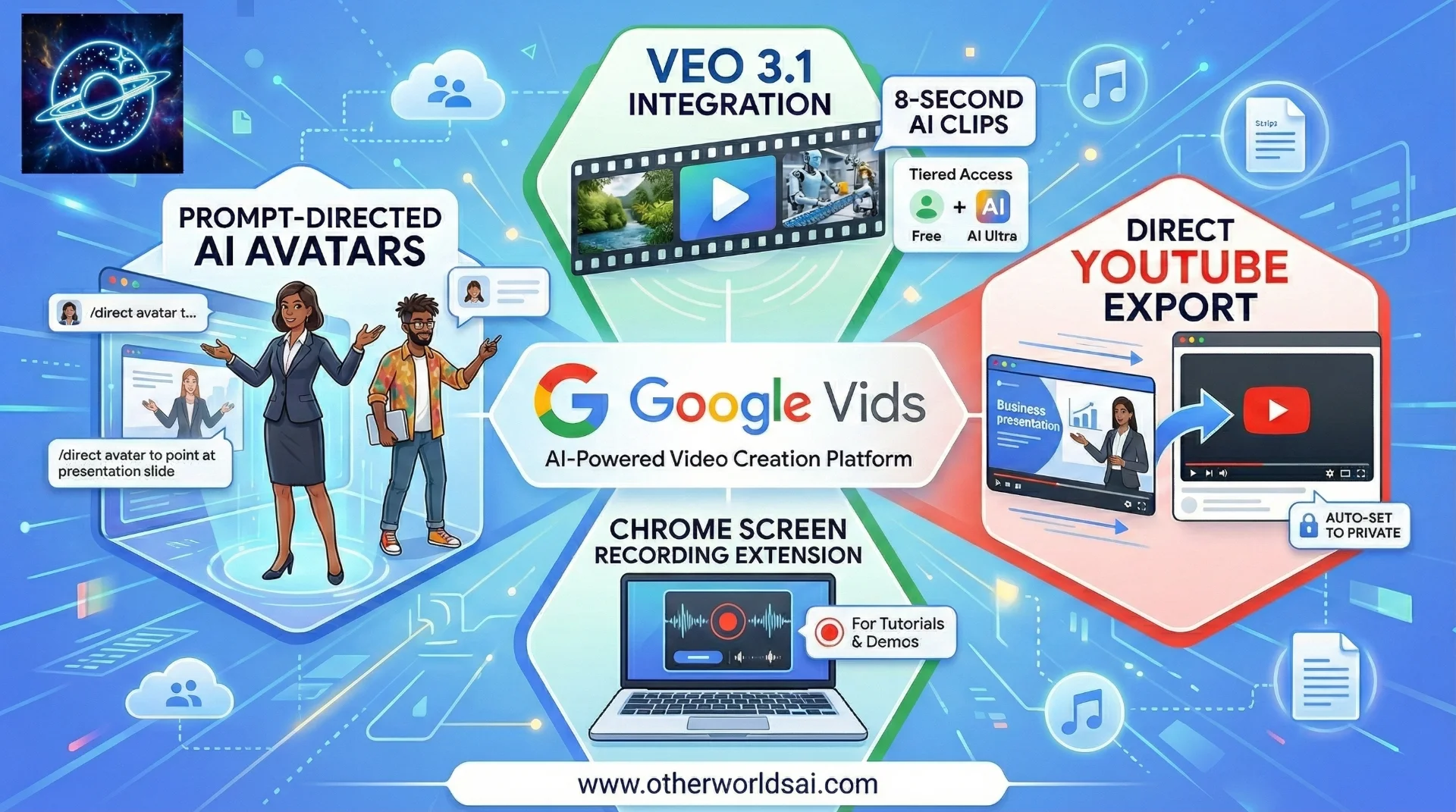
The most headline-grabbing feature in this update is the ability to direct AI avatars through natural language prompts. Users can now instruct avatars to "act" within a scene — interacting with products, props, or pieces of equipment — simply by typing what they want the avatar to do. It's essentially giving everyday users the power of a film director, without requiring any technical expertise.
Crucially, Google has engineered the system to maintain character consistency across these dynamic, prompt-driven outputs. So even as your avatar moves, gestures, and interacts with different elements, it remains the same recognizable character throughout the video — a major technical challenge that Google says it has solved.
Customize Avatars: Appearance, Apparel & Backgrounds:
Beyond directing avatars, users can now fully customize their virtual characters through text prompts. Based on the theme of the video, creators can tweak the avatar's appearance, change their apparel, and generate entirely new backgrounds — all through simple, conversational language. This means brands can tailor avatars to match their visual identity, and creators can build immersive, on-theme video environments without needing a design team.
This builds on Google's earlier work with AI avatars in Vids. Last year, the company introduced AI avatars and expanded access to consumers. In February 2025, Google added 2D and 3D cartoon-style avatars and rolled out voice-over language support for seven new languages: French, German, Italian, Korean, Portuguese, Spanish, and Japanese.
Veo 3.1 Integration — Eight-Second AI Video Clips:
Google is now bringing its latest video-generation model, Veo 3.1, directly into the Vids editing environment. With this integration, users can generate eight-second AI-generated video clips without ever leaving the app. This is a powerful addition for content creators who need quick, high-quality footage to fill gaps in their productions or illustrate a concept.
Here's the tiered access breakdown for Veo 3.1 generations:
-
•All users: 10 free Veo video generations per month.
-
• Google AI Ultra & Workspace AI Ultra accounts: Up to 1,000 Veo video generations per month.
Export Videos Directly to YouTube:
One of the most practical quality-of-life improvements in this update is seamless YouTube export. Users can now publish finished videos directly from Google Vids to their YouTube channel — eliminating the time-consuming cycle of downloading, re-uploading, and re-formatting content.
Privacy is built in by default. All videos exported to YouTube are set to private automatically, giving creators the chance to review and approve the final cut before it goes public. It's a thoughtful feature that prevents accidental publishing — especially useful for teams and enterprise workflows where multiple stakeholders need to sign off before a video goes live.
New Chrome Extension for Screen Recording:
Rounding out the update is a new screen-recording Chrome extension that integrates directly with the Google Vids suite. Users can capture their screen with synchronized audio or video, making it ideal for tutorials, product demos, training materials, and walkthroughs. This positions Google Vids as a one-stop shop for enterprise video production — from script to screen capture to final publish.
The Road So Far: Google Vids' Evolution:
Google first unveiled Vids in 2024 as an AI-powered video editor built for enterprise content creation. Since then, the platform has seen a steady cadence of feature additions that show a clear strategic vision: make professional-grade video creation accessible to everyone in the workplace.
Last month, Google integrated its Lyria 3 and Lyria 3 Pro music creation models into Vids, allowing users to generate custom sound effects and background music for their clips. Combined with today's updates, Google Vids now covers the full video production pipeline — from AI-generated footage and avatar-led presentations to music, voiceovers, screen recordings, and direct publishing.
Google Vids vs. The Competition:
Google Vids is entering an increasingly competitive arena. It now goes head-to-head with established AI video platforms including Synthesia, HeyGen, D-ID, and Lemon Slice — all of which have carved out strong positions in the AI avatar and synthetic media space.
What sets Google apart is its deep integration with the broader Google and Workspace ecosystem. The ability to publish directly to YouTube, leverage Veo 3.1 for footage generation, and pair the tool with Google's AI Ultra subscriptions gives Vids a unique distribution and infrastructure advantage that competitors will struggle to match.
Final Thoughts:
Google Vids is rapidly maturing into a comprehensive AI video creation platform — one that blends generative AI, avatar technology, music creation, and seamless publishing into a single, integrated experience. Thursday's update with prompt-directed avatars, Veo 3.1, YouTube export, and Chrome screen recording is proof that Google is committed to making Vids the go-to video tool for modern enterprise teams.
Whether you're a solo creator, a marketing team, or a large organization, Google Vids is evolving fast — and it's worth paying close attention.
Support our research
Independent analysis fueled by you.