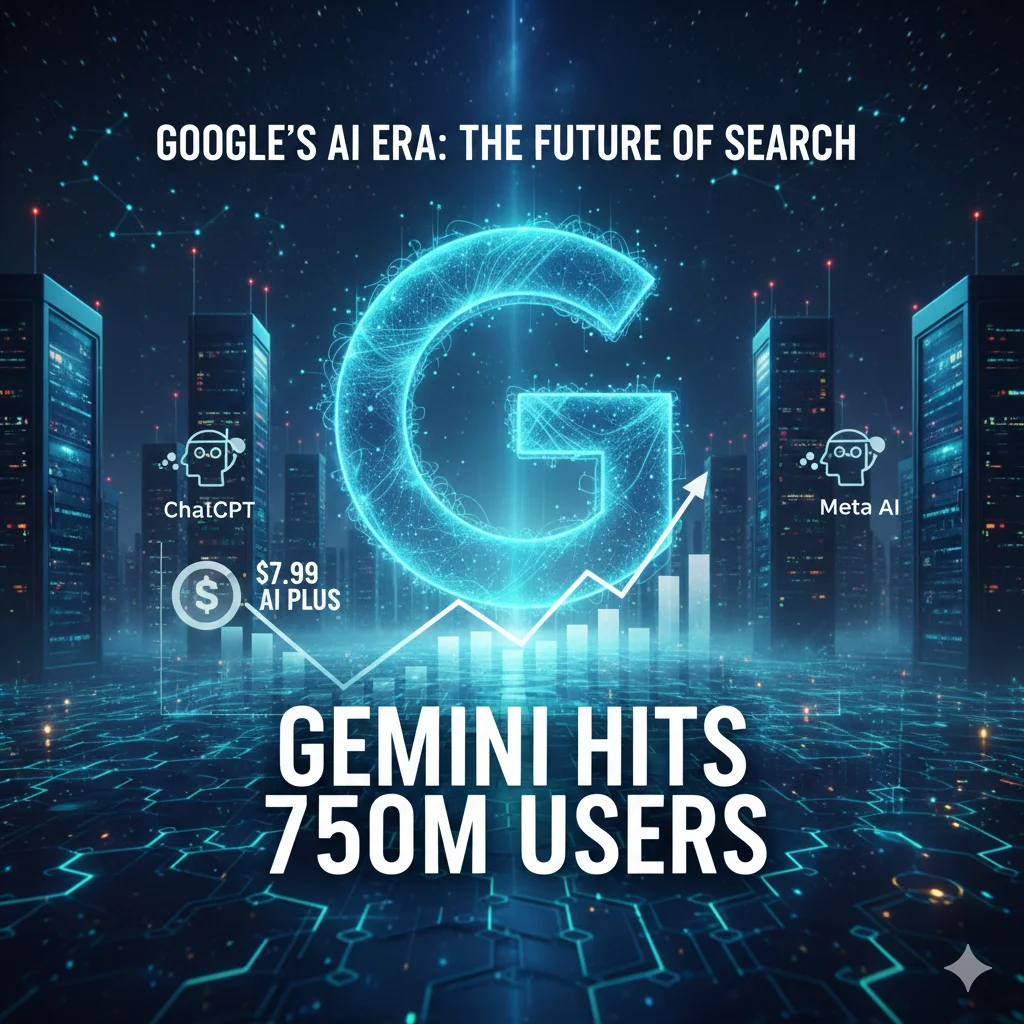

The "AI Summer" isn't cooling down anytime soon.
In a blockbuster Q4 2025 earnings report, Google officially announced that its Gemini app has surpassed 750 million monthly active users (MAUs). This isn't just a win for Google’s marketing team; it’s a clear signal that the way we interact with the internet, process information, and even think about productivity has fundamentally shifted.
In just three months, Gemini jumped from 650 million to 750 million users, proving that the appetite for advanced AI is growing faster than almost any other tech segment in history. This phenomenal surge places Google at the forefront of the generative AI revolution, a position it intends to solidify with continued innovation and strategic market plays.
The Clash of the Titans: Gemini vs. ChatGPT and the Evolving AI Landscape:
While 750 million is a staggering number, the competition remains fierce, illustrating the dynamic and rapidly evolving nature of the AI market. For context, Meta AI is currently holding steady at nearly 500 million users.
Meta's strategy has largely revolved around embedding AI directly into its massive social ecosystem, with seamless integrations across WhatsApp, Instagram, and Facebook. This ubiquitous presence allows Meta AI to capture a significant segment of users who primarily interact with AI through their social feeds and messaging apps.
However, the real heavyweight bout, the one that tech enthusiasts and investors are watching with bated breath, is between Google's Gemini and OpenAI's ChatGPT. ChatGPT is estimated to have hit roughly 810 million MAUs in late 2025. While Gemini is still technically the underdog in terms of raw user count, the gap is closing rapidly.
With an astonishing growth rate of 100 million users in a single quarter, Google is not just gaining ground; it's sprinting towards the top spot. This rapid acceleration suggests that Google's integrated approach, leveraging its existing user base and technological prowess, is paying off handsomely. The AI wars are truly underway, and every quarter brings new twists and turns.
What’s Fueling the Surge? Enter Gemini 3 and Google's AI Infrastructure Powerhouse:
The secret sauce behind this massive spike? The recent, highly anticipated launch of Gemini 3. Google’s latest large language model represents a paradigm shift in how AI handles complexity, understanding nuance, and generating sophisticated, contextually rich responses.
According to CEO Sundar Pichai, Gemini 3 offers an "unprecedented level of depth and nuance," making it far more than a simple search tool or chatbot. It positions Gemini as a sophisticated collaborator, capable of tackling complex tasks, synthesizing information across multiple modalities, and engaging in more natural, human-like conversations. This leap in capability is a critical differentiator in a crowded AI market.
During the earnings call, Pichai didn't just highlight user growth; he delved into the underlying infrastructure powering this revolution:
"The launch of Gemini 3 was a major milestone,and we have great momentum. Our first-party models, like Gemini, now process over 10 billion tokens per minute via direct API use by our customers, and the Gemini App has grown to over 750 million monthly active users. Search saw more usage than ever before, with AI continuing to drive an expansionary moment."
This isn't just about chatting; it's about robust, scalable infrastructure. Google also unveiled Ironwood, its latest generation TPU (Tensor Processing Unit) AI accelerator chip. By building its own custom hardware to compete directly with industry giants like Nvidia, Google is ensuring that Gemini stays fast, smart, and—most importantly—scalable to meet the demands of a rapidly expanding user base and increasingly complex AI tasks.
This vertically integrated approach, from chips to models to applications, gives Google a significant competitive edge, allowing for optimized performance and cost efficiency.
Making AI Affordable: The $7.99 Revolution and Democratizing Access:
Growth isn't just driven by "smart" tech; it's profoundly driven by accessibility and affordability. Google recently introduced Google AI Plus, a budget-friendly subscription tier priced at just $7.99 per month.
While this new plan didn't impact the Q4 numbers (it launched too recently to influence the reported figures), it’s a strategic masterstroke aimed squarely at budget-conscious students, small businesses, and creators who might find the standard $20/month AI subscriptions (like ChatGPT Plus) a bit too steep.
Philipp Schindler, Google’s chief business officer, emphasized this dual-pronged approach during the investor call: "We are focused on a free tier and subscriptions and seeing great growth." By offering a robust free tier alongside an affordable premium option, Google is positioning itself to capture the massive middle market, democratizing access to advanced AI capabilities.
This strategy could significantly broaden Gemini’s appeal and accelerate its user acquisition in the coming quarters, potentially allowing it to leapfrog competitors who rely primarily on higher-priced subscription models.
Why Google’s New Free Gemini Feature Is a Massive Wake-Up Call for Businesses
By the Numbers: Alphabet’s $400 Billion Milestone and the AI-Driven Economy:
The success of Gemini is undoubtedly the crown jewel in a historic financial year for Alphabet. For the first time in its history, the company has surpassed $400 billion in annual revenue. This monumental achievement underscores the profound impact of Google’s strategic pivot towards AI. The company explicitly attributes a significant portion of this growth to the expansion of its AI division, which has seen unprecedented demand and adoption.
It’s clear that Google Search isn't dying; it’s evolving. Pichai emphasized that Search is seeing "more usage than ever before," fueled by AI-driven results that provide more comprehensive, generative answers to complex queries. Instead of a "blue link" graveyard, users are getting a dynamic, interactive experience that synthesizes information, answers follow-up questions, and personalizes results in ways never before possible.
AI is not just enhancing search; it's redefining it, making it more intuitive and powerful. This integration of generative AI into its core product is vital for Google's continued dominance in the information landscape.
Why This Matters for You: Embracing the AI Future:
Whether you're a casual internet user, a student grappling with research papers, a creative professional, or a developer building the next generation of applications, the message is clear: AI is the new operating system.
With Gemini’s deep integration into the Google ecosystem—from Workspace productivity tools to the Android mobile platform—it is rapidly becoming the default interface for millions, if not billions, of people globally. This pervasive integration means that AI capabilities will be seamlessly embedded into our daily digital lives, making tasks easier, faster, and more intuitive.
As we move deeper into 2026 and beyond, the question isn't whether you'll use AI, but which AI will win your loyalty and become your indispensable digital assistant. With Gemini 3’s advanced reasoning capabilities,Google’s aggressive pricing strategy for AI Plus, and its robust, self-sufficient AI infrastructure, Google is making a very compelling case for itself. The future of AI is here, and it’s accelerating at an incredible pace.
What do you think? Has Gemini 3 replaced your traditional Google searches yet, or are you still loyal to ChatGPT? What features are most important to you in an AI assistant? Let's discuss in the comments below!
Support our research
Independent analysis fueled by you.