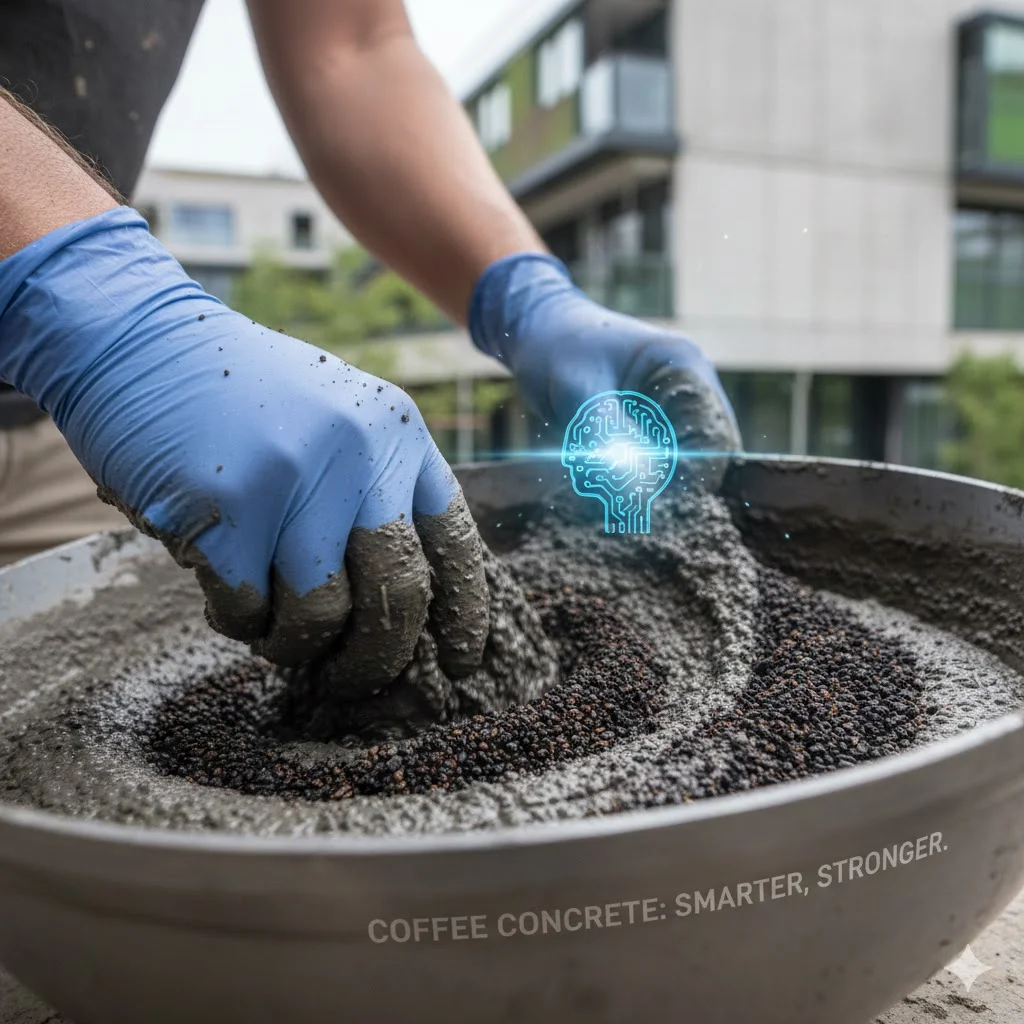

We love our coffee.
That morning brew, the afternoon pick-me-up – it's a daily ritual for billions. But have you ever stopped to think about the massive amount of waste generated from all those delicious cups? We're talking 10 billion kilograms (22 billion pounds) of used coffee grounds annually, most of which ends up in landfills, slowly releasing harmful greenhouse gases.
But what if I told you that your coffee waste could actually help build stronger, greener cities? Scientists in Australia have made a groundbreaking discovery that's turning heads in the construction world, and it leverages some clever scientific processing.
The Coffee-Concrete Connection:
Researchers at RMIT University have found that by treating used coffee grounds, they can make concrete up to 30 percent stronger. This isn't just about reducing waste; it's about tackling two massive environmental challenges at once: overflowing landfills and the unsustainable extraction of natural sand, a key component in concrete.
"The ongoing extraction of natural sand to meet the rapidly growing demands of the construction industry has a big impact on the environment," explains RMIT engineer Jie Li. "With a circular-economy approach, we could keep organic waste out of landfill and better preserve natural resources like sand."
The AI (and Scientific) Twist: Biochar's Secret:
You can't just dump raw coffee grounds into concrete – they actually weaken it. This is where the innovation, driven by careful scientific investigation and optimization (a process that AI could further accelerate in the future), comes in.
The researchers developed a method where used grounds are heated to precisely 350 °C (660 °F) in the absence of oxygen. This process, called pyrolysis, transforms the waste into a carbon-rich material called biochar.
This isn't just any charcoal; it's a porous, lightweight, and surprisingly strong material. When mixed into concrete, this coffee-derived biochar forms tight bonds within the cement matrix, boosting strength and stability by a remarkable 30 percent! The team even tested different temperatures, finding that 350 °C was the "sweet spot" for optimal strength, a kind of optimization problem that AI algorithms are perfectly suited to solve by rapidly analyzing countless variables.
Looking to a Greener Future:
While still in early stages, this research offers a tantalizing glimpse into a future where waste isn't just discarded but transformed into valuable resources. Imagine AI-powered systems analyzing waste streams from cafes and processing plants, predicting optimal pyrolysis conditions, and even designing new biochar compounds for specific construction needs. AI could help scale this process efficiently, ensuring the right temperature, duration, and mixing ratios for maximum impact.
The scientists are now testing the long-term durability of their coffee-infused concrete and experimenting with other organic wastes like wood and food scraps, all with the goal of creating a more sustainable building industry.
As RMIT engineer Shannon Kilmartin-Lynch puts it, "Inspiration for my research, from an Indigenous perspective, involves Caring for Country – ensuring there’s a sustainable life cycle for all materials and avoiding things going into landfill."
So, the next time you enjoy your coffee, remember that those humble grounds might soon be part of the foundation of our future, thanks to ingenious science and the potential of AI to help us unlock such sustainable solutions.
It's a powerful reminder that innovation often comes from the most unexpected places – even our coffee cups!
Support our research
Independent analysis fueled by you.