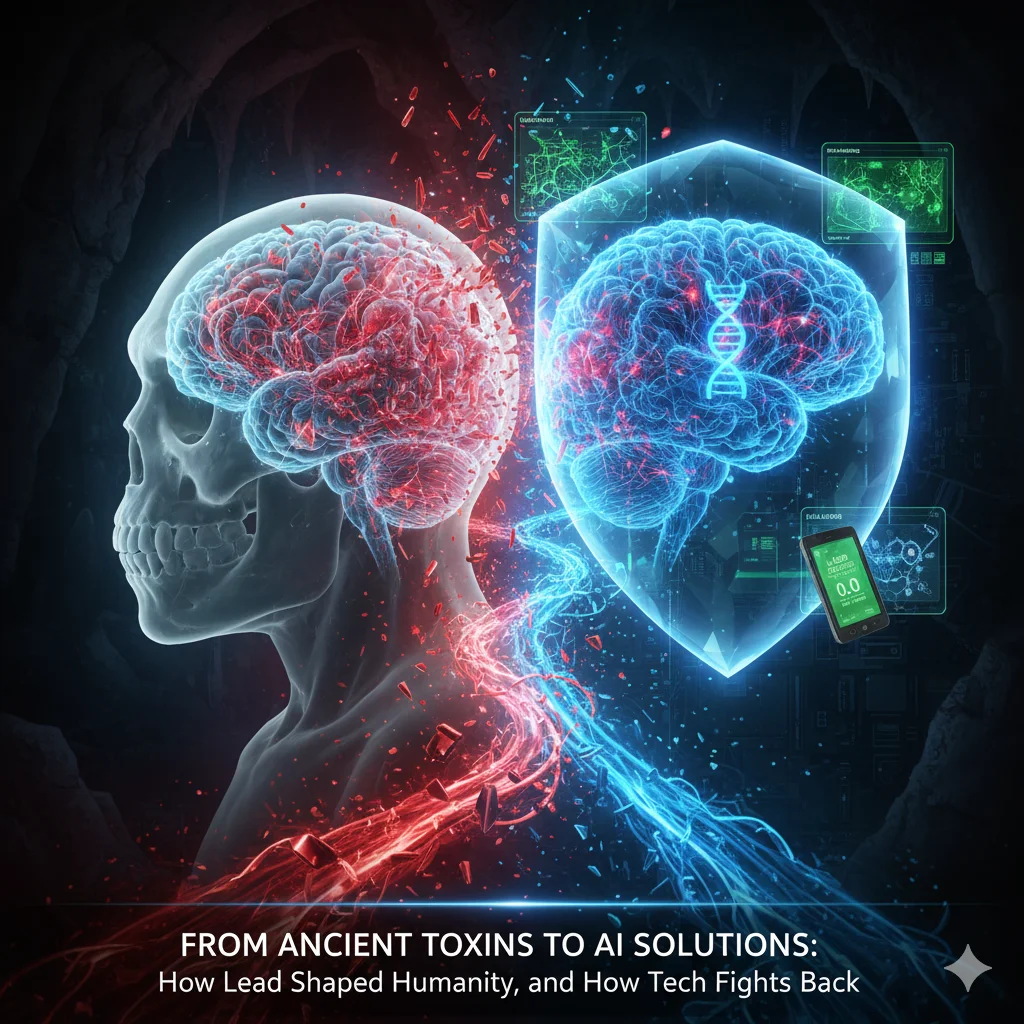

For millions of years, our ancestors faced an invisible threat that quietly molded their brains, behaviors,
and even their capacity for language: lead exposure. This isn't a modern industrial tale, but a profound evolutionary saga revealed by cutting-edge science. Now, as we grapple with lead's lingering public health crisis, Artificial Intelligence is emerging as a critical tool in understanding, detecting, and ultimately mitigating this ancient foe.
The Unseen Hand of Lead in Human Evolution:
Groundbreaking research published in Science Advances has overturned our understanding of lead poisoning. Forget just industrial smoke—our very early hominid ancestors, including Homo sapiens and Neanderthals, encountered lead from natural sources like volcanic activity, soil, and water for over two million years.
The most astonishing discovery lies in the NOVA1 gene. Scientists studied lab-grown brain organoids (mini-brains) with two versions of this crucial neurodevelopmental gene: one found in modern humans, and an older variant found in Neanderthals. When exposed to lead:
-
Neanderthal-like organoids showed severe disruption in brain regions vital for speech and language.
-
Modern human organoids displayed significantly less damage.
This suggests that our Homo sapiens lineage may have evolved a genetic resistance to lead toxicity—a silent adaptation that potentially gave us a cognitive edge, perhaps even fostering our advanced communication skills, while our Neanderthal cousins struggled under the same environmental pressure. Lead, it seems, wasn't just a toxin; it was an unexpected, harsh catalyst for our evolution.
AI: Illuminating the Past, Protecting the Future:
This revolutionary study itself is a testament to the power of interdisciplinary science, where advanced technologies, including forms of AI and computational analysis, played a crucial role. But beyond research, AI is now being deployed to combat our toxic legacy:
- Predictive Modeling & Risk Mapping: AI algorithms can analyze vast datasets—geological surveys, historical industrial data, demographic information, and even old building permits—to identify areas with high lead contamination risk. This allows public health officials to proactively target interventions, preventing exposure before it occurs.
-
Faster, Cheaper Detection: Imagine handheld AI-powered sensors that can instantly detect lead in water, paint, or soil. Instead of sending samples to labs and waiting days for results, AI can provide real-time analysis, enabling immediate action in homes, schools, and communities.
-
Personalized Health Interventions: As AI in medicine advances, understanding an individual's genetic predisposition to lead toxicity (like their NOVA1 variant) could lead to personalized prevention strategies or more targeted treatments for lead exposure. AI could analyze complex patient data to recommend tailored nutritional interventions or chelation therapies.
-
Early Warning Systems for Infrastructure: AI-driven monitoring systems are being developed to detect lead leaching from aging pipes in real-time, sending alerts to utility companies. This prevents widespread contamination, a far cry from waiting for people to get sick.
-
Accelerating Remediation: AI can optimize the planning and execution of lead remediation projects, identifying the most effective and cost-efficient methods for decontamination in various environments, from old urban centers to contaminated agricultural lands.
A Toxic Legacy, A Technological Promise:
The story of lead and humanity is a stark reminder that our environment has always been an active participant in our evolutionary journey. From ancient volcanic vents to modern industrial factories, lead has been a constant, insidious presence.

Meta's Next Big Bet: This New App Lets You Build Games Simply by Typing a Prompt
However, the future isn't just about adaptation; it's about prevention and proactive solutions. As AI continues to evolve—learning, analyzing, and predicting—it offers humanity a powerful new shield against this ancient poison.
Just as our ancestors biologically adapted to survive lead, we are now using our most advanced intelligence to finally free ourselves from its grip, ensuring a healthier future for generations to come.
Support our research
Independent analysis fueled by you.