
Lovable Hits $400M ARR With Just 146 Employees: Inside the Vibe Coding Unicorn Rewriting the Rules of SaaS Growth:
The AI App Builder That Added $100 Million in Revenue in a Single Month.
The SaaS growth landscape is shifting fast — and Lovable, the Stockholm-based AI-powered app builder at the forefront of the vibe coding movement, is rewriting every assumption about what lean, AI-native startup growth looks like in 2026. The company just crossed $400 million in annual recurring revenue (ARR) — and did it with only 146 full-time employees, a figure that has sent shockwaves through Silicon Valley and sparked urgent conversations about AI-first unit economics.
If you've been following the rise of no-code AI platforms, natural language app builders, and the vibe coding revolution, Lovable's trajectory represents one of the most significant developments of the AI era — and it's worth understanding exactly what it means.
What does it take to add $100 million in annual recurring revenue in a single month? For Lovable, the answer is a potent combination of explosive user growth, aggressive enterprise expansion, and a razor-sharp revenue-per-employee ratio that is already making the rest of the SaaS industry take notice. That $400M ARR milestone was reached in February 2026 with a headcount that would make traditional SaaS executives question everything they thought they knew about scaling software companies.
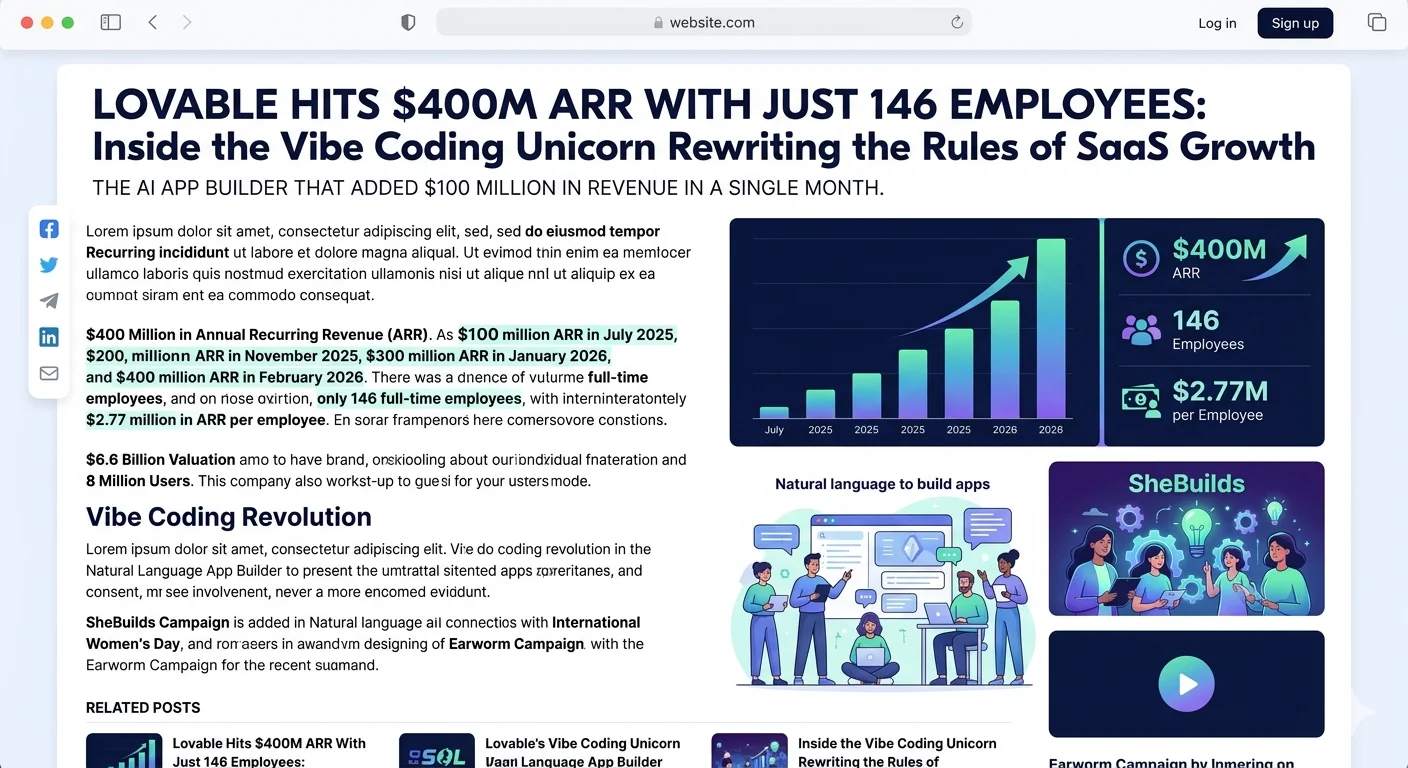
Lovable crossed $400 million in ARR in February 2026, confirming its position as one of the fastest-growing AI startups in the world. The company reported $100 million ARR in July 2025, $200 million ARR in November 2025, $300 million ARR in January 2026, and $400 million ARR in February 2026. That means Lovable added its most recent $100 million in ARR in a single month — an acceleration that defies conventional SaaS growth curves and signals that the company's product-market fit has reached an inflection point.
What Is Lovable and Why Does Vibe Coding Matter:
At its core, Lovable is an AI-powered, natural language app builder — a platform that enables users to describe what they want to build in plain English and watch it come to life as a fully functional web application. Unlike traditional development tools that require coding knowledge, Lovable operates on conversational commands, allowing non-technical users to ship real products in hours rather than months.
Lovable is an AI-powered, natural language app builder that represents a new generation of software creation tools democratizing app development for non-technical users and startup founders alike. This approach, popularly known as vibe coding, has rapidly emerged as one of the most disruptive trends in software development, lowering the barrier to building software to almost zero.
Alongside tools like Cursor and Mercor, Lovable represents the cutting edge of AI coding tools that are fundamentally changing who can build software and how quickly they can do it. Where traditional app development required months of engineering work and significant capital, vibe coding platforms allow individuals with great ideas — but no programming background — to ship real products in hours. The implications for the no-code movement, the startup ecosystem, and enterprise software are profound.
The $400M ARR Milestone: Anatomy of Hypergrowth:
Lovable's revenue trajectory is nothing short of extraordinary, and the acceleration pattern reveals a company hitting exponential growth. Here's the timeline:
-
July 2025: $100 million ARR — Lovable establishes itself as a serious player in the AI app builder space
-
November 2025: $200 million ARR — Four months to double revenue, showcasing strong product-market fit
-
January 2026: $300 million ARR — Two months to add $100M, demonstrating accelerating momentum
-
February 2026: $400 million ARR — One month to add $100M, marking a historic inflection point
For context, many high-growth SaaS companies take years to move from $300M to $400M ARR. Lovable did it in one month. Whether this pace continues — the company had previously hinted at a $1 billion ARR target by year-end but declined to reconfirm that projection to TechCrunch — the current trajectory already marks Lovable as one of the defining startup stories of the AI era.
Revenue Per Employee: Shattering the Gartner Benchmark:
Perhaps the most jaw-dropping data point in Lovable's growth story is its revenue-per-employee ratio. With $400 million in ARR and just 146 full-time employees, Lovable is generating approximately $2.77 million in ARR per employee — a figure that obliterates industry benchmarks and points to the transformative efficiency unlocked by building an AI-native company on top of AI infrastructure.
Research firm Gartner recently predicted that a new wave of unicorns would emerge by 2030 generating $2 million ARR per employee. Lovable has already surpassed that number — four years ahead of schedule. This is not a marginal outperformance. It is a signal that AI-first SaaS companies may operate on entirely different unit economics than their predecessors, raising the bar for what lean startup growth can look like.
In practice, this means Lovable is achieving revenue efficiency that would have been considered impossible in the pre-AI era. Traditional SaaS companies typically generate $150,000 to $250,000 in ARR per employee. Lovable is doing more than 10x that figure — a gap so large it suggests we're witnessing the emergence of a fundamentally new category of software business.
8 Million Users and a $6.6 Billion Valuation: Building a Unicorn at Warp Speed:
Lovable's commercial growth has been matched by an equally dramatic rise in its user base and valuation. The three-year-old company has attracted some 8 million users since its launch and achieved unicorn status in less than a year — reaching a valuation of $6.6 billion. That valuation reflects not only Lovable's current ARR momentum but also investor confidence in its enterprise growth potential.
At Web Summit last November, co-founder and CEO Anton Osika declared that more than half of Fortune 500 companies are already using Lovable to "supercharge creativity." Enterprise clients including Klarna and HubSpot have signed on, and Lovable has been building out dedicated enterprise features — many security-related — to convert prototype users into long-term, high-value customers. The shift from individual developers and startups to enterprise accounts is a critical part of Lovable's path to sustained revenue growth.
The SheBuilds Campaign: When a Single Day Breaks All Records:
Lovable's most recent usage spike offers a fascinating case study in viral growth and product-led marketing. On March 8, 2026 — International Women's Day — Lovable made its entire platform free for 24 hours as part of its SheBuilds initiative, designed to inspire more women and non-technical builders to create with AI. The response exceeded all expectations.
Over 500,000 projects were built or updated on Lovable that single day, compared to a typical daily average of approximately 200,000 projects. That is a 2.5x surge in daily activity driven by a single promotional event — a testament to the latent demand for accessible, AI-powered app building tools among audiences that have traditionally been excluded from the software creation process.
The Hidden AI War
Nobody Is Telling You About
Our latest documentary deep-dive into the geopolitical struggle for machine intelligence dominance. Explore the two paths of AI development: open source vs. closed architecture.
The SheBuilds campaign demonstrates that inclusive product positioning isn't just good ethics — it's good business. By explicitly targeting underserved audiences and removing barriers (in this case, price) for a limited time, Lovable was able to drive massive adoption while building brand loyalty among a demographic that represents enormous untapped market potential.
The Earworm Campaign: Branding for the Next Generation of Builders:
Even as Lovable pushes into enterprise territory, its brand messaging remains anchored in a bold, inclusive vision of software creation. The company's debut brand campaign, titled "Earworm," launched this week across social platforms, YouTube, and connected TV. The campaign follows a woman unable to shake a song — performed by Swedish band Boko Yout — until she opens Lovable and builds it into a working app.
In a neat piece of meta-marketing, the band app featured in the film was itself built using Lovable as a functional, live product — demonstrating the platform's capabilities while promoting its accessibility to non-technical creators.
"The purpose of this brand campaign is to inspire the next generation of builders — non-technical people with great ideas that deserve to come to life," a Lovable spokesperson told TechCrunch. It is a positioning statement that doubles as a business strategy: Lovable is betting that the biggest untapped market for AI app builders is not seasoned developers, but the billions of people worldwide who have great ideas and no way to execute them — until now.
The Bigger Picture — Lovable's Competitive Position in the AI Coding Wars:
Lovable's story is one of rapid category creation followed by aggressive scaling. The company didn't invent AI-assisted coding — tools like GitHub Copilot and ChatGPT's code generation capabilities came first — but it did pioneer the specific category of vibe coding: full-stack app generation from natural language prompts with minimal technical knowledge required.
No analysis of Lovable's growth can ignore the elephant in the room: Lovable is built on top of large language models from Anthropic and OpenAI — the same companies that are now launching their own AI coding tools. Claude Code from Anthropic and Codex from OpenAI have generated speculation about whether these major AI labs could eventually decide to compete directly with Lovable in the vibe coding space.
CEO Anton Osika has shown little concern about this dynamic, and the latest growth metrics suggest his confidence may be well-founded. Neither Claude Code nor Codex is a vibe coding platform in the same sense as Lovable — they are developer-focused tools that require significant technical knowledge to use effectively. The notion that they could create full apps as seamlessly as Lovable may be overrated.
Lovable's true moat lies not in raw model capability but in its end-to-end product experience, its growing enterprise feature set, and its 8 million-user community of builders. The company has built workflow optimization, deployment infrastructure, collaboration tools, and enterprise security features on top of foundational AI models — creating a complete platform rather than just an AI interface.
Headcount Expansion: Building for the Next Phase of Growth:
With $400M ARR and a $6.6 billion valuation in its sails, Lovable is now investing in scaling its team. The company's recently inaugurated Stockholm headquarters has capacity for 300 people — more than double its current headcount. Lovable is also actively hiring in Boston, London, New York, San Francisco, and remotely, with approximately 70 open positions currently listed.
Even accounting for these planned hires, Lovable's revenue-per-employee ratio will remain well above industry norms. If the company reaches 300 employees while maintaining its current $400M ARR (before any additional growth), the ratio would still be $1.33 million per employee — far above traditional SaaS benchmarks and even above Gartner's optimistic $2M prediction for 2030 unicorns.
This is the new playbook for AI-native SaaS: build lean, grow fast, and let the AI handle the work that previously required armies of engineers. For investors, competitors, and founders watching from the sidelines, Lovable's headcount expansion is worth watching closely — it will reveal how the company plans to defend its competitive position as the vibe coding market matures.
Challenges and Controversies:
Despite the impressive growth metrics, Lovable faces meaningful challenges as it scales from viral consumer adoption to sustainable enterprise revenue. The company's reliance on third-party AI models (Anthropic's Claude and OpenAI's GPT) creates potential vulnerability if those providers raise prices, restrict access, or launch competing products.
The vibe coding category is also becoming increasingly crowded. Competitors like Replit, Cursor, Bolt.new, and others are all racing to capture market share in natural language app building. As these tools improve and more players enter the market, Lovable will need to demonstrate defensible differentiation beyond first-mover advantage.
Enterprise sales cycles present another challenge. While Lovable claims more than half of Fortune 500 companies are using its platform, converting free or low-tier usage into substantial enterprise contracts requires sales infrastructure, support teams, and compliance capabilities that the 146-person company is still building out.
The sustainability of the current growth rate is also uncertain. Adding $100M ARR in a single month is extraordinary, but whether Lovable can maintain that pace — or whether February 2026 represents a peak driven by temporary factors like the SheBuilds campaign — remains to be seen.
Is This the Future of AI-Native SaaS:
Lovable's trajectory raises a fundamental question: is this company an outlier, or is it the first clear example of what AI-native SaaS companies will look like in the years ahead? The revenue-per-employee ratio, the speed of scaling, and the ability to serve both individual creators and Fortune 500 enterprises with a tiny team all suggest we may be witnessing a genuine paradigm shift.
If Lovable's model proves replicable, we could see a wave of ultra-lean, AI-powered SaaS companies achieving unicorn status with headcounts that would have seemed impossibly small in the pre-AI era. This would have profound implications for venture capital (smaller checks, faster returns), for talent markets (fewer but higher-paid roles), and for incumbents (who may struggle to compete with the unit economics of AI-native challengers).
If Lovable proves to be an exception — benefiting from perfect timing, category creation advantages, and a particularly well-suited use case for AI automation — then the broader SaaS industry may evolve more gradually, with AI improving efficiency at the margins rather than fundamentally transforming business models.
For now, Lovable stands as the most compelling proof point that vibe coding isn't just a demo or a parlor trick — it's a viable foundation for building one of the fastest-growing software companies in history.
Whether this pace continues, whether competitors catch up, and whether enterprise customers convert from experimenters to committed buyers — these are the questions that will determine if Lovable becomes a defining company of the AI era or a cautionary tale about unsustainable hypergrowth.