
Anthropic Faces Pentagon Ultimatum: AI Safety Principles vs. Defense Production Act in Unprecedented Standoff:
From Hero to "Adversary"? Why the Pentagon Might Label a Top U.S. AI Company a National Security Risk.
The U.S. government is threatening to invoke emergency wartime powers against one of America's leading artificial intelligence companies — and the confrontation could fundamentally reshape the relationship between Silicon Valley and the Pentagon for decades to come.
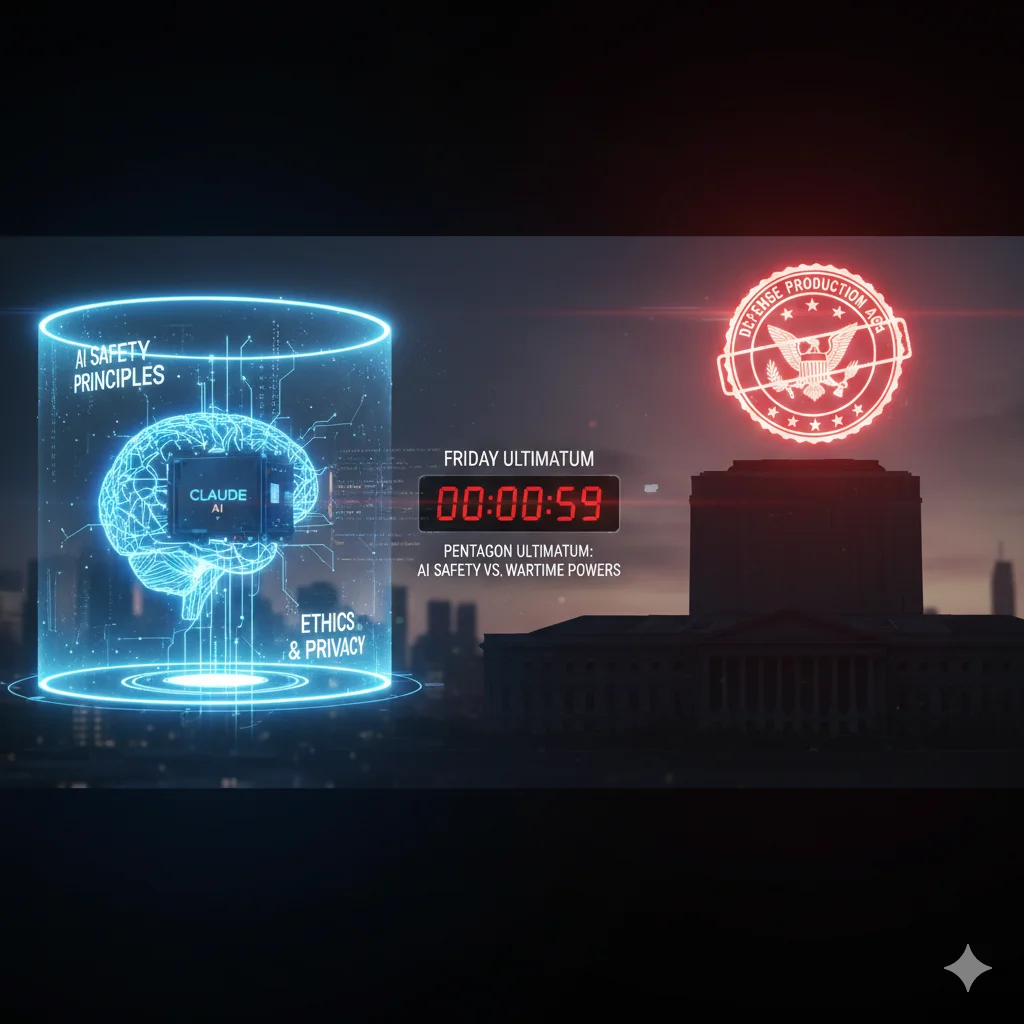
Anthropic, the AI safety-focused company behind the Claude large language model, has until Friday evening to either grant the U.S. military unrestricted access to its AI systems or face severe consequences. According to reports from Axios, Defense Secretary Pete Hegseth delivered an ultimatum to Anthropic CEO Dario Amodei in a tense meeting Tuesday morning: either remove all usage restrictions on Claude for military applications, or the Pentagon will designate Anthropic as a "supply chain risk" — a label typically reserved for foreign adversaries like Chinese technology companies — or invoke the Defense Production Act to force compliance.
The dispute centers on Anthropic's refusal to compromise on two core safety principles: the company will not allow its AI technology to be used for mass surveillance of American citizens or for fully autonomous weapons systems. The Pentagon, facing a single-vendor dependency problem and lacking backup options for classified AI systems, is now threatening to use emergency legal powers designed for wartime manufacturing crises to override a private company's ethical guidelines.
This is not a typical government contractor dispute. This is a fundamental collision between AI safety principles, national security imperatives, executive authority, and the rule of law — with profound implications for every AI company, defense contractor, and technology investor watching from the sidelines.
What Is the Defense Production Act? Understanding the Pentagon's Nuclear Option:
The Defense Production Act (DPA) is a Korean War-era law that grants the President of the United States extraordinary authority to compel private companies to prioritize or expand production for national defense purposes. Originally passed in 1950 during the Korean War, the DPA has been invoked periodically during national emergencies to ensure the U.S. military and critical infrastructure have access to essential goods and services.
Most Americans became familiar with the DPA during the COVID-19 pandemic, when President Trump and later President Biden invoked the law to force companies like General Motors, 3M, and others to produce ventilators, personal protective equipment, and vaccines. In those cases, the DPA was used to redirect manufacturing capacity toward life-saving medical equipment during a public health crisis.
Using the DPA in a dispute over AI safety guardrails and usage policies, however, would mark a dramatic and unprecedented expansion of the law's modern application. Never before has the Defense Production Act been invoked to force a technology company to remove ethical restrictions on how its software can be used. Legal experts and policy analysts are describing the Pentagon's threat as a potential watershed moment in government-tech relations.
"Using the DPA in a dispute over AI guardrails would mark a significant expansion of the law's modern use," according to Dean Ball, senior fellow at the Foundation for American Innovation and former senior policy advisor on AI in the Trump White House. "It would also reflect an expansion of a broader pattern of executive branch instability that has intensified in recent years."
Anthropic's Red Lines: Mass Surveillance and Autonomous Weapons:
Anthropic has been exceptionally clear and consistent about the boundaries it will not cross. The company, founded in 2021 by former OpenAI researchers including Dario Amodei (CEO) and Daniela Amodei (President), built its entire corporate identity around the concept of AI safety and responsible development of large language models.
The two specific use cases Anthropic refuses to enable are:
-
Mass surveillance of Americans: Anthropic will not allow its Claude AI models to be used for widespread, dragnet-style monitoring of U.S. citizens' communications, activities, or data — a capability that raises profound Fourth Amendment concerns and civil liberties implications.
-
Fully autonomous weapons systems: Anthropic will not allow its AI to make lethal decisions without meaningful human oversight — refusing to enable "killer robots" or weapons systems that can select and engage targets without direct human authorization.
These positions are not arbitrary corporate virtue signaling. They reflect deep concerns within the AI safety research community about the potential for advanced AI systems to be deployed in ways that could cause catastrophic harm, erode democratic norms, or spiral beyond human control. Anthropic's founding team left OpenAI specifically because they believed the company wasn't taking safety concerns seriously enough.
According to Reuters, Anthropic does not plan to ease its usage restrictions, even under threat of government action. This represents a remarkable act of corporate courage — or, depending on your perspective, a dangerous refusal to prioritize national security over Silicon Valley ideology.
The Pentagon's Position: National Security Trumps Corporate Usage Policies:
From the Defense Department's perspective, Anthropic's safety restrictions represent an unacceptable constraint on military operations and national security decision-making. Pentagon officials have argued that the military's use of technology should be governed by U.S. law, Congressional oversight, and constitutional limits — not by the usage policies of private contractors.
The military's argument is straightforward: we are subject to extensive legal constraints, oversight mechanisms, and accountability structures. The Uniform Code of Military Justice, laws of armed conflict, Congressional authorization for use of military force, inspector general oversight, and judicial review all constrain what the military can and cannot do. Adding an additional layer of restrictions imposed by a private company's corporate policies, the Pentagon argues, creates an unworkable command structure and undermines civilian control of the military.
Defense Secretary Pete Hegseth's ultimatum to CEO Dario Amodei reflects the Pentagon's view that this is ultimately a question of authority: does a private company get to dictate the terms under which the U.S. military operates, or does the democratically accountable government make those decisions?
The ideological dimension of the dispute has also become impossible to ignore. AI czar David Sacks and others in the current administration have publicly criticized Anthropic's safety policies as "woke" — language suggesting the conflict is as much about cultural and political alignment as it is about operational requirements. This framing has alarmed many in the technology and policy communities who see it as evidence of politicization of what should be technical and ethical decisions.
The Single-Vendor Problem: Why the Pentagon Has No Backup Plan:
One of the most striking aspects of this confrontation is that Anthropic is apparently the only frontier AI lab with classified Department of Defense access. This means the Pentagon is currently dependent on a single AI provider for critical national security applications — a vulnerability that dramatically increases the government's leverage in the current dispute but also reveals a dangerous lack of redundancy in military AI infrastructure.
"If Anthropic canceled the contract tomorrow, it would be a serious problem for the DOD," Ball told TechCrunch. He noted that this single-vendor dependency appears to violate a National Security Memorandum from the late Biden administration that explicitly directs federal agencies to avoid reliance on a single classified-ready frontier AI system.
"The DOD has no backups. This is a single-vendor situation here," Ball continued. "They can't fix that overnight." That lack of redundancy may help explain the Pentagon's aggressive posture — the Defense Department is essentially threatening to destroy its own sole supplier rather than accept restrictions it views as operationally unacceptable.
Reports indicate the Pentagon has recently reached a deal to use xAI's Grok model (developed by Elon Musk's AI company) in classified systems, but it's unclear whether Grok has the same level of capability, security clearance, or operational readiness as Anthropic's Claude. If Grok is not a true substitute, the Pentagon's threat to designate Anthropic as a supply chain risk or invoke the DPA becomes even more puzzling — it would amount to cutting off the only supplier the military actually has.
The Supply Chain Risk Designation: A Label Reserved for Foreign Adversaries:
The Pentagon's threat to designate Anthropic as a "supply chain risk" is particularly dramatic because this designation has historically been reserved for foreign companies — particularly Chinese technology firms — that U.S. national security agencies believe pose espionage, sabotage, or geopolitical risks to American interests.
Companies like Huawei, ZTE, and various Chinese semiconductor manufacturers have been designated as supply chain risks, effectively banning them from U.S. government contracts and, in many cases, from doing business with American companies at all. The designation is devastating for affected companies, often amounting to an economic death sentence in the U.S. market.
Applying this designation to Anthropic — an American company founded by U.S. citizens, headquartered in San Francisco, and widely regarded as one of the most responsible actors in the AI industry — would be unprecedented and deeply controversial. It would signal that the U.S. government views companies that refuse to comply with Pentagon demands as equivalent threats to Chinese state-influenced technology firms.
"It would basically be the government saying, 'If you disagree with us politically, we're going to try to put you out of business,'" Ball said. "Any reasonable, responsible investor or corporate manager is going to look at this and think the U.S. is no longer a stable place to do business."
The Broader Implications: What This Means for AI Companies and Tech Investors:
The Anthropic-Pentagon standoff is sending shockwaves through Silicon Valley, the venture capital community, and the global AI industry. If the U.S. government successfully forces Anthropic to abandon its safety principles through emergency legal powers, the implications extend far beyond this single company.
Every AI startup, every defense tech company, and every technology investor will need to reconsider fundamental assumptions about the stability and predictability of the U.S. regulatory and legal environment. Companies that have built their brands around responsible AI development will face difficult questions about whether those principles are sustainable if the government can override them at will.
International competitors, particularly in Europe and China, will seize on the dispute as evidence that American AI companies cannot be trusted to maintain their ethical commitments under government pressure. European regulators already skeptical of U.S. tech giants will have powerful ammunition for arguing that EU companies and citizens need sovereign AI alternatives not subject to American government control.
"This is attacking the very core of what makes America such an important hub of global commerce," Ball argued. "We've always had a stable and predictable legal system." The prospect of the U.S. government using emergency powers to override corporate policies based on ideological disagreements threatens that stability in ways that could have lasting economic consequences.
The AI Safety Community's Perspective: A Dangerous Precedent:
For researchers and advocates focused on AI safety, the Pentagon's ultimatum to Anthropic represents a worst-case scenario. The AI safety movement has long argued that as artificial intelligence systems become more powerful, maintaining human control and preventing catastrophic misuse becomes increasingly critical.
Anthropic's restrictions on mass surveillance and autonomous weapons are precisely the kind of guardrails that AI safety experts believe are essential to preventing dystopian outcomes. If the U.S. government can simply override these restrictions by invoking emergency powers, it effectively means that no AI safety principles are enforceable when they conflict with government desires.
The concern extends beyond just military applications. If the precedent is set that the government can force AI companies to remove safety restrictions, what prevents future administrations from using similar tactics to compel AI companies to enable domestic surveillance, political targeting, or other ethically problematic uses?
The Friday Deadline: What Happens Next?:
As of this writing, Anthropic has until Friday evening to respond to the Pentagon's ultimatum. The company appears to be holding firm on its principles, but the pressure is immense. Potential outcomes include:
-
Anthropic capitulates: The company removes or significantly weakens its usage restrictions for military applications, preserving its government contracts but potentially undermining its core identity and alienating the AI safety community.
-
Anthropic refuses and faces designation as supply chain risk: The Pentagon follows through on its threat, effectively ending Anthropic's ability to work with the U.S. government and potentially triggering broader restrictions on the company's operations.
-
The government invokes the Defense Production Act: The Pentagon uses emergency wartime powers to force Anthropic to create a custom version of Claude without the disputed restrictions, setting a dangerous precedent for government override of corporate policies.
-
A compromise is reached: Both sides find middle ground, perhaps through enhanced oversight mechanisms, narrower definitions of restricted use cases, or technical solutions that address both safety concerns and operational requirements.
-
The dispute escalates to courts: Anthropic challenges the legality of the Pentagon's actions, potentially setting up a landmark legal battle over the scope of government authority, corporate free speech, and the limits of the Defense Production Act.
The Bottom Line: A Defining Moment for AI Governance:
The confrontation between Anthropic and the Pentagon is far more than a contract dispute. It's a defining moment in the evolution of AI governance, touching on fundamental questions about corporate responsibility, government authority, national security imperatives, and the future of AI safety principles in an increasingly geopolitical technology landscape.
Anthropic's willingness to stand firm on its principles, even under threat of government action, represents a remarkable test case for whether AI safety commitments can survive collision with state power. The company's decision — and the government's response — will shape the behavior of every AI company for years to come.
For those who believe AI safety is essential to humanity's future, Anthropic's resistance to government pressure is a courageous defense of critical principles. For those who prioritize national security and government authority, the company's refusal to comply represents a dangerous example of Silicon Valley overreach.
What's clear is that the old assumptions about the relationship between technology companies and government — built on voluntary cooperation, market incentives, and regulatory negotiation — are breaking down.
The Friday deadline is just the beginning of a much longer, much more consequential struggle over who controls the future of artificial intelligence.
Support our research
Independent analysis fueled by you.